


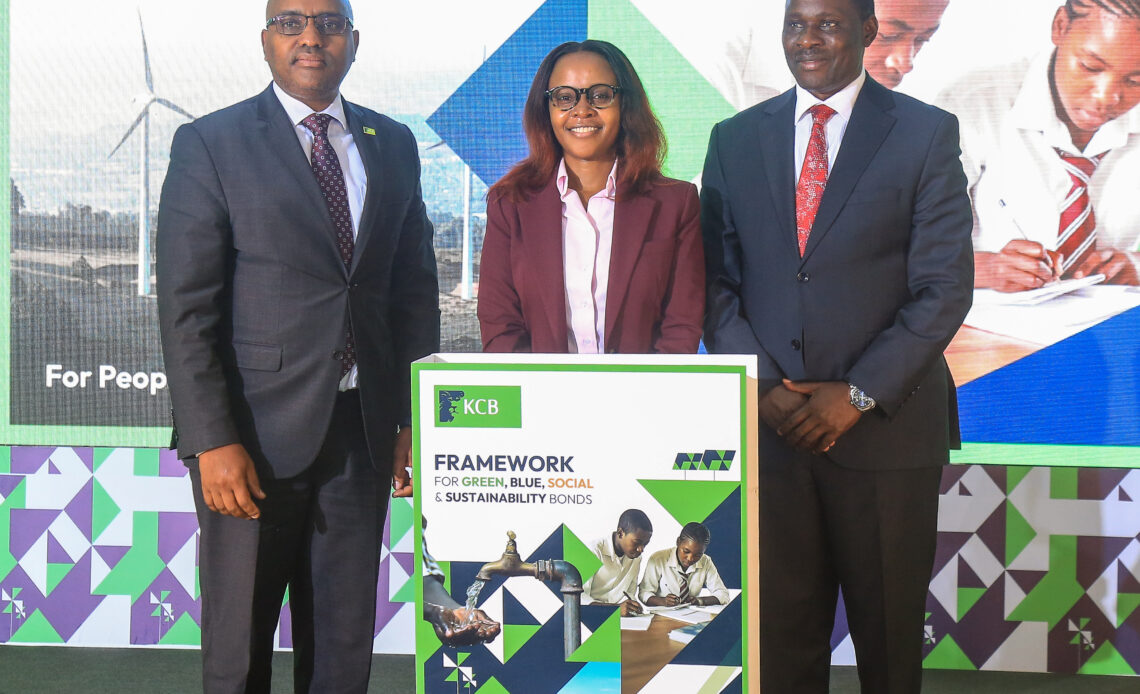
KCB Group has unveiled its Sustainability Bond Framework, paving the way for a planned KSh300 billion Medium Term Note (MTN) Programme that will mobilise long-term capital for environmental and social investments across East Africa.
The five-year programme, which is subject to the necessary regulatory approvals, will have a first tranche of up to KSh100 billion. Funds raised through the sustainability bond will be ring-fenced for eligible Green, Blue and Social projects.
The framework identifies several areas that could benefit from the financing, including renewable energy, green buildings, clean transportation, sustainable water management and agriculture.
Other targeted areas include the blue economy, affordable housing, micro, small and medium enterprises (MSMEs), women and youth-led businesses, as well as initiatives aimed at supporting employment and livelihood creation.
The framework received a Sustainability Quality Score of SQS 2 – Very Good from Moody’s, providing an independent assessment of its sustainability credentials.
KCB Group CEO Paul Russo said the framework builds on the financial institution’s long-standing efforts to develop innovative financing solutions with economic and social impact.
“The launch of the Sustainability Bond Framework is a natural progression of the work the Group has been doing over the last two decades to structure innovative financing solutions and support investments that have a meaningful economic and social impact,” Russo said.
He added that the framework seeks to bring together capital, purpose and accountability while positioning finance as a tool for sustainable value creation.
The framework incorporates two approaches: Use of Proceeds (UoP) and Sustainability-Linked Bonds. According to KCB, the dual structure provides flexibility for future issuances while strengthening the integration of sustainability into the Group’s financial strategy.
Principal Secretary, State Department for Public Investments and Asset Management, Cyrell Wagunda Odede, welcomed the initiative, saying sustainable bonds would play an important role in expanding Kenya’s sources of development financing.
Odede said innovative financial instruments could help attract capital and unlock opportunities in infrastructure, enterprise development, climate action and other national development priorities.
Principal Secretary, State Department for Blue Economy and Fisheries, Betsy Njagi, also commended KCB for publishing the framework, describing it as a contribution to efforts to diversify financing sources for Kenya’s development agenda.
She said partnerships between government and financial institutions would be important in directing capital towards environmental resilience, inclusive growth and sustainable development.
The bond framework builds on KCB Group’s sustainability journey, which formally began in 2008 when the Group adopted sustainability as a way of doing business. Its approach has been anchored on four pillars: financial, economic, social and environmental sustainability.
KCB said its experience in sustainable finance positions the Group to deploy capital towards projects supporting the region’s transition to a low-carbon and climate-resilient economy.
Since 2022, the Group has disbursed more than KSh187 billion in green loans, demonstrating its growing focus on financing environmentally sustainable projects.
Also read: In 2025 alone, KCB disbursed KSh48.8 billion in green financing across its regional markets. The financing supported projects in renewable energy, sustainable agriculture, green buildings, clean transportation, water management and climate-smart investments.
The proposed KSh300 billion MTN Programme therefore represents an expansion of KCB’s sustainable finance strategy, with the framework providing a structure for directing future capital towards projects with measurable environmental and social benefits.
The planned bond issuance remains subject to relevant regulatory approvals before the first tranche can be offered to investors.