

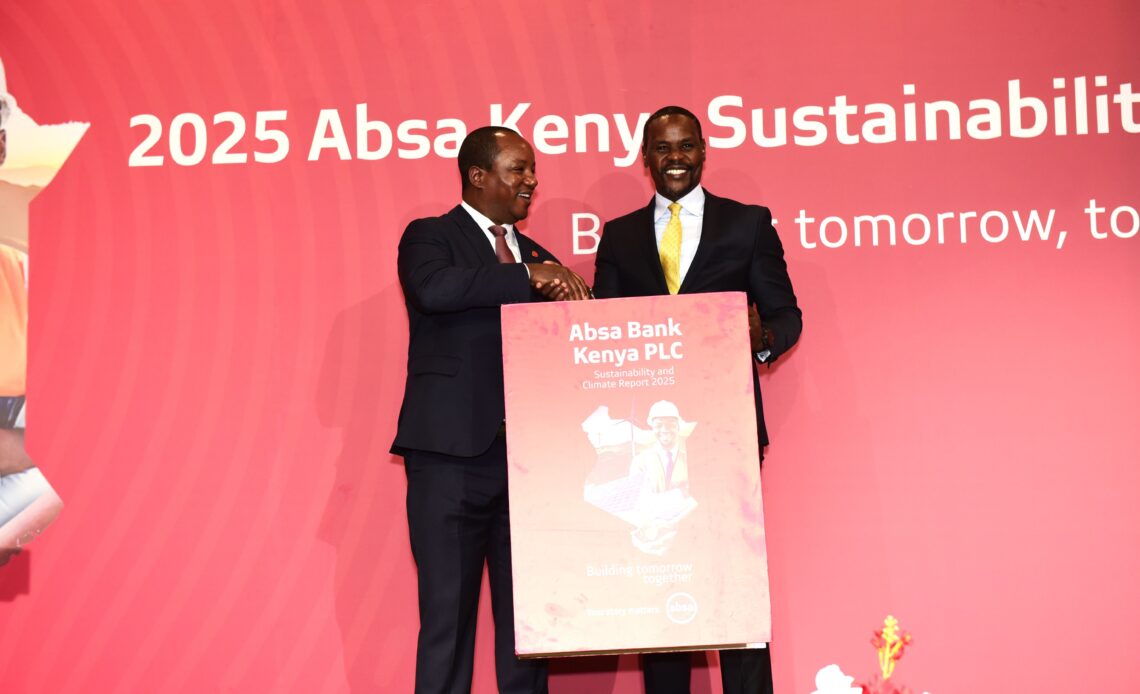
Absa Bank Kenya has channelled more than KES 204 billion into sustainable finance between 2022 and 2025, as the lender scales up financing for financial inclusion, climate action, enterprise growth and social development.
The bank disbursed KES 55.3 billion in sustainable finance in 2025, up from KES 47 billion in 2024, according to its 2025 Sustainability and Climate Report.
Sustainable finance accounted for 30 per cent of Absa Bank Kenya’s gross loan disbursements during the year, exceeding the bank’s initial target of 10 per cent by 2025.
Of the total amount disbursed in 2025, KES 48.8 billion went towards financial inclusion, supporting small and medium-sized enterprises, women-led businesses, young entrepreneurs and underserved communities.
A further KES 6.5 billion was allocated to climate finance, supporting projects in renewable energy, green buildings, energy efficiency and climate-smart agriculture.
Speaking during the unveiling of the report at Strathmore University, Absa Bank Kenya Interim Managing Director and Chief Executive Officer Yusuf Omari said the bank had deliberately directed capital towards areas capable of generating economic, social and environmental impact.
“Our 2025 Sustainability and Climate Report highlights what we have achieved under our 2021–2025 sustainability strategy, which was anchored on 13 commitments aimed at delivering meaningful economic, social and environmental impact,” Omari said.
He added that the bank would continue working with customers and stakeholders to promote a more inclusive, resilient and sustainable Kenyan economy.
Absa steps up environmental action
Beyond financing green projects and climate-related initiatives, Absa increased its own environmental interventions during 2025.
The bank planted 283,969 trees during the year, nearly four times the 72,000 trees planted in 2024. This brought the cumulative number of trees planted through its initiatives to more than 1.5 million.
Absa also achieved a 96.4 per cent waste recycling rate and reduced its operational energy footprint by 41 per cent, reflecting its efforts to lower its environmental impact and progress towards its net-zero ambitions.
The lender also continued investing in youth employability, entrepreneurship and community development.
Through its ReadytoWork programme, nearly 38,000 young people gained employability and entrepreneurial skills in 2025, taking the programme’s total beneficiaries to more than 300,000.
During the year, the Absa Kenya Foundation also reached more than 50,000 people through initiatives under its strategic pillars of education and skills development, entrepreneurship and natural resource management.
Government calls for more climate financing
Principal Secretary, State Department for Environment and Climate Change, Dr Festus Ng’eno, who graced the report unveiling, commended Absa for its sustainability initiatives and contribution to private-sector climate action.
He noted that climate change is already affecting livelihoods, infrastructure, ecosystems and economic productivity, making increased investment in climate solutions an economic as well as environmental priority.
The PS called on financial institutions, investors and development partners to expand support for climate solutions, green enterprises and sustainable infrastructure.
Climate risks embedded in lending decisions
During the year, Absa strengthened its climate governance and risk management by integrating climate considerations into its business strategy, lending decisions and enterprise risk management processes.
The approach is intended to help the bank and its customers navigate an operating environment increasingly influenced by climate change, technological developments and changing stakeholder expectations.
Absa also enhanced its sustainability reporting by aligning disclosures with the International Sustainability Standards Board (ISSB) framework, including IFRS S1 and IFRS S2.
The move is expected to strengthen transparency and accountability around sustainability and climate-related risks.
New sustainability strategy targets 30% sustainable lending
Following the completion of its 2021–2025 Sustainability Strategy, Absa Bank Kenya has launched a new strategy built around four measurable pillars.
The first pillar targets continued growth in sustainable finance, with the bank seeking to ensure that at least 30 per cent of gross loan disbursements support financial inclusion, green finance and nature-based finance initiatives.