


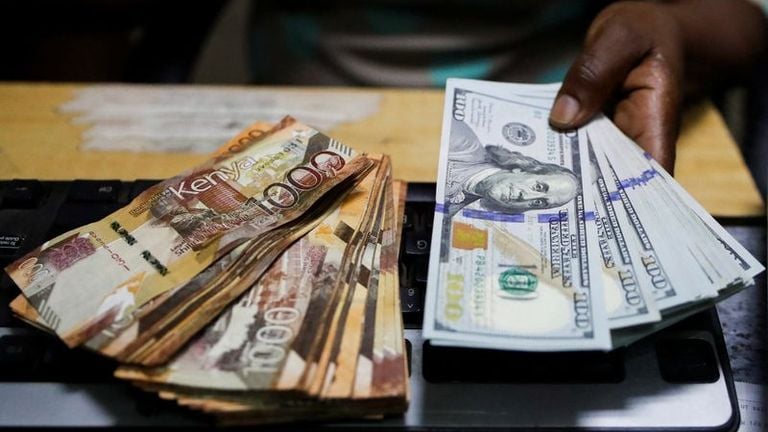
The Kenya Shilling remained largely stable against major international and regional currencies during the week ending June 25, 2026, according to the Central Bank of Kenya (CBK) weekly bulletin.
The local currency traded at KSh 129.63 against the US dollar on June 25, compared to KSh 129.55 recorded on June 18, reflecting minimal movement despite global economic uncertainties.
Foreign Reserves Remain Above Statutory Threshold
Kenya’s foreign exchange reserves stood at USD 13.17 billion as of June 25, equivalent to 5.6 months of import cover.
The reserves remain above the CBK’s statutory requirement of maintaining at least four months of import cover, providing a buffer against external shocks and supporting stability in the foreign exchange market.
Money Market Remains Liquid
The domestic money market continued to experience sufficient liquidity during the week, supported by active open market operations.
Commercial banks held excess reserves averaging KSh 16.7 billion above the 3.25 percent Cash Reserve Ratio (CRR) requirement.
The Kenya Shilling Overnight Interbank Average Rate (KESONIA) remained unchanged at 8.75 percent on June 25, the same level recorded a week earlier.
Interbank activity increased during the period, with the average number of transactions rising to 28 from 15 in the previous week. The average value traded also climbed to KSh 16.1 billion from KSh 5.6 billion.
Treasury Securities Attract Strong Investor Demand
The Treasury bill auction held on June 25 received bids worth KSh 28.1 billion against an advertised amount of KSh 24 billion, translating to an oversubscription rate of 116.9 percent.
Interest rates for the 91-day, 182-day and 364-day Treasury bills recorded marginal increases during the auction.
Meanwhile, the June 23 tap sale of 20-year and 25-year Treasury bonds attracted bids totaling KSh 31 billion against an advertised amount of KSh 20 billion, achieving a performance rate of 155.1 percent.
NSE Market Performance Improves
Trading activity at the Nairobi Securities Exchange (NSE) strengthened during the week, with key market indicators recording gains.
The Nairobi Securities Exchange All Share Index (NASI), NSE 25 Share Index and NSE 20 Share Index increased by 2.24 percent, 2.42 percent and 2.81 percent respectively.
Market capitalization rose by 3.46 percent, while total shares traded and equity turnover increased by 18.33 percent and 39.80 percent respectively.
Bond Market Turnover Rises
Activity in Kenya’s domestic secondary bond market improved, with bond turnover increasing by 36.38 percent during the week.
In international markets, yields on Kenya’s Eurobonds rose by an average of 4.02 basis points. Similar increases were recorded for Eurobond yields in Côte d’Ivoire and Angola.
Global Markets Respond to Easing Geopolitical Risks
Globally, concerns over inflation eased during the week following a decline in oil prices after the United States and Iran reached a ceasefire agreement, which included the reopening of the Strait of Hormuz.
The US core Personal Consumption Expenditure (PCE) inflation measure rose slightly to 3.4 percent in May 2026 from 3.3 percent in April, in line with market expectations.
The US Dollar Index strengthened by 0.6 percent during the week.
Oil and Gold Prices Decline
Commodity prices fell as geopolitical tensions eased and investor sentiment improved.
Murban crude oil prices declined to USD 69 per barrel from USD 74.41 per barrel a week earlier, while spot gold prices dropped to USD 4,026 per ounce from USD 4,208.59 per ounce.
The decline in gold prices reflected reduced demand for safe-haven assets as global markets responded positively to improved geopolitical conditions.