


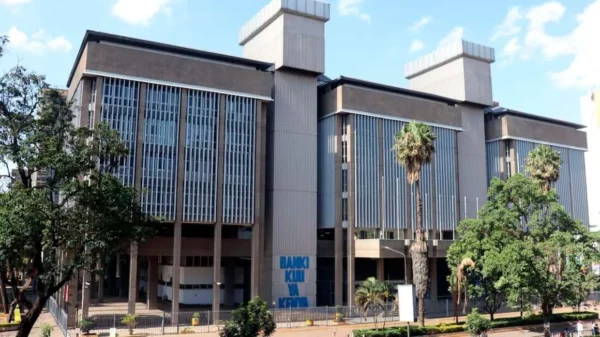
The Central Bank of Kenya (CBK) has retained the Central Bank Rate (CBR) at 8.75 percent as it seeks to keep inflation expectations anchored amid rising global economic uncertainties.
The Monetary Policy Committee (MPC), during its meeting on June 9, 2026, noted that disruptions to global supply chains caused by the conflict in the Middle East had pushed energy prices higher, contributing to an increase in Kenya’s inflation rate.
Kenya’s overall inflation rose to 6.7 percent in May 2026 from 5.6 percent in April 2026, although the MPC expects inflation to remain within the target range in the near term.
“The current monetary policy stance, with the Central Bank Rate unchanged at 8.75 percent, remains appropriate to ensure that inflation expectations remain anchored within the target range,” CBK said in its weekly bulletin.
Lending Rates Continue to Decline as Credit Growth Improves
The MPC observed that average lending rates in the domestic market have continued to decline, while private sector credit growth has shown signs of improvement.
The Committee said maintaining the current policy rate would support economic stability while ensuring the exchange rate remains stable amid global market pressures.
Kenya Shilling Remains Stable Against Major Currencies
The Kenya Shilling maintained stability against major international and regional currencies during the week ending June 11, 2026.
The local currency traded at KSh129.48 against the US dollar on June 11, compared with KSh129.37 recorded on June 4.
CBK attributed the stability to improved market conditions and continued monitoring of foreign exchange developments.
Foreign Exchange Reserves Stand at $13.24 Billion
Kenya’s foreign exchange reserves remained adequate at USD13.24 billion as of June 11, 2026, equivalent to 5.6 months of import cover.
The reserves exceed the Central Bank’s statutory requirement of maintaining at least four months of import cover, providing a buffer against external shocks and supporting exchange rate stability.
Money Market Remains Liquid
The domestic money market remained liquid during the week, supported by active open market operations by the CBK.
Commercial banks held excess reserves averaging KSh17.9 billion above the 3.25 percent Cash Reserve Ratio (CRR) requirement.
The Kenya Shilling Overnight Interbank Average Rate (KESONIA) remained unchanged at 8.75 percent on June 11.
Interbank market activity increased, with the average number of transactions rising to 25 from 17 in the previous week, while the average value traded grew slightly to KSh11 billion from KSh10.7 billion.
Treasury Bill Demand Surpasses Government Target
The Treasury bill auction held on June 11 attracted strong investor demand, receiving bids worth KSh39.3 billion against an advertised amount of KSh24 billion.
This represented an auction performance rate of 163.9 percent.
Interest rates on the 91-day, 182-day, and 364-day Treasury bills increased marginally during the auction.
However, a Treasury bond tap sale held on June 8 recorded weaker demand, with reopened 15-year and 25-year bonds receiving bids worth KSh8.7 billion against an advertised amount of KSh15 billion, representing a performance rate of 58.4 percent.
NSE Market Activity Declines
Trading activity at the Nairobi Securities Exchange (NSE) weakened during the week ending June 12, 2026.
The Nairobi Securities All Share Index (NASI), NSE 25 Share Index, and NSE 20 Share Index declined by 0.17 percent, 0.41 percent, and 0.06 percent respectively.
Market capitalization fell by 0.17 percent, while total shares traded and equity turnover dropped by 23.38 percent and 26.71 percent respectively.
Bond Market Turnover Rises
Activity in Kenya’s domestic secondary bond market increased significantly, with bond turnover rising by 90.53 percent during the week.
In the international market, yields on Kenya’s Eurobonds increased by an average of 6.13 basis points, reflecting changing investor sentiment in global markets.
Global Inflation and Commodity Markets Under Pressure
Globally, inflation concerns remained elevated, with US inflation rising to 4.2 percent in May 2026 from 3.8 percent in April, marking the highest level since April 2023.
The US labour market remained relatively resilient, with unemployment standing at 4.3 percent, although initial jobless claims increased slightly to 229,000.
In the Euro Area, the European Central Bank raised its policy rate to 2.25 percent and revised its 2026 growth forecast to about 0.8 percent, citing weaker demand and the impact of higher energy costs.
The US Dollar Index weakened by 0.2 percent during the week as demand for safe-haven assets eased following signs of reduced geopolitical tensions in the Middle East.
Oil and Gold Prices Decline
Commodity prices declined during the week ending June 11, 2026, following optimism around US-Iran negotiations.
Murban crude oil prices dropped to USD84.60 per barrel from USD87.38 per barrel a week earlier.
Gold prices also declined to USD4,213.84 per ounce from USD4,473.89 per ounce as investors reduced demand for safe-haven assets amid easing geopolitical concerns.