


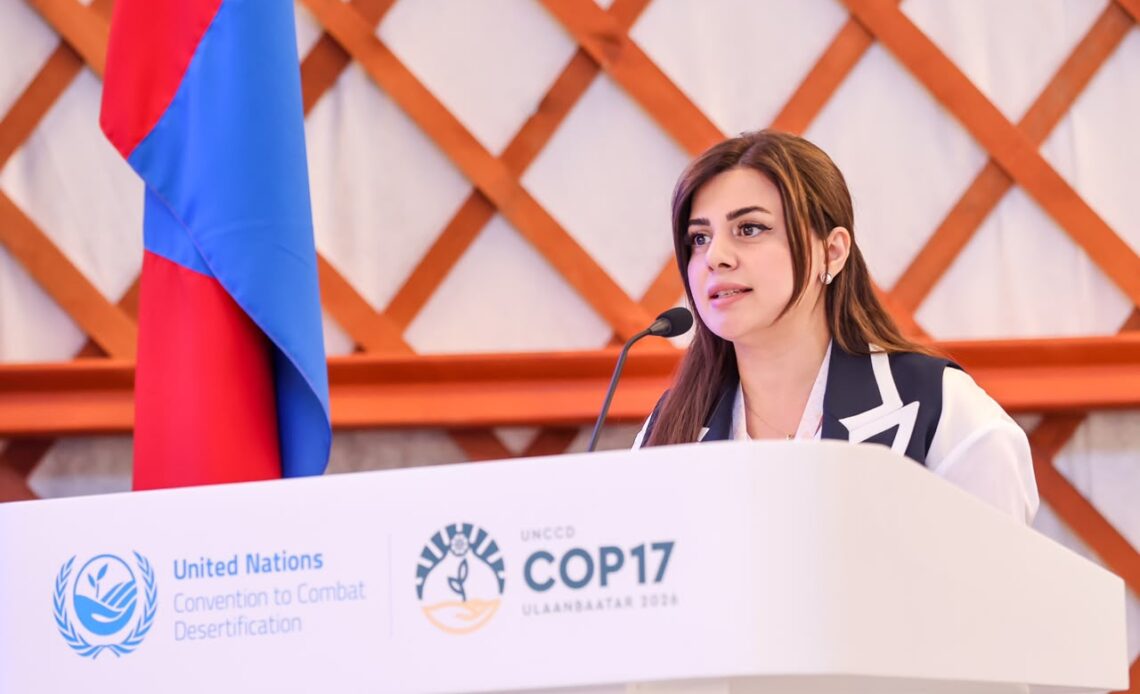
Azerbaijan has called for land restoration to be elevated from a narrow environmental concern to a broader priority for climate action, economic resilience, food security and social development.
Speaking at the 17th Conference of the Parties to the United Nations Convention to Combat Desertification (UNCCD COP17) in Ulaanbaatar, Mongolia, Member of the Azerbaijan Parliament Parvana Valiyeva said the conference theme, “Restoring Land, Restoring Hope,” goes beyond environmental protection to address livelihoods, dignity and resilience.
She said climate change is increasing the frequency of droughts, degrading soils and threatening food security, particularly in developing countries.
“Land restoration is not just an environmental investment; restoring land is restoring climate, economy, health, life and culture,” Valiyeva said, stressing that restoration should be treated as a climate, economic and social priority.
According to Valiyeva, food security begins with healthy soil, adequate water and resilient ecosystems. She warned that land degradation has consequences extending from individual farmers to households and entire national economies.
“For a farmer, degraded land can mean a failed harvest. For a family, it can mean higher food prices and difficult choices. And for a country, it can mean greater dependence, vulnerability and instability,” she said.
Valiyeva urged parliamentarians to move land degradation beyond the environmental agenda and integrate it into policies on economic resilience, social protection, food and water security and sustainable development.
She also called for a shift from reacting to drought and land degradation after they occur towards prevention, preparedness and restoration.
Key measures, she said, include early-warning systems, vulnerability assessments, national drought planning, financing and international cooperation. More than 70 countries have national drought plans, she noted.
The Azerbaijani legislator said COP17 is particularly important because it is the first of three major environmental COP processes taking place in close succession in 2026. The three processes address climate change, land degradation and desertification, and biodiversity loss under the Rio Convention framework.
She said the sequence provides an opportunity to strengthen synergies between climate action, land restoration and biodiversity conservation instead of addressing the challenges separately.
Healthy soils, forests, grasslands, wetlands and other land ecosystems can act as natural carbon sinks. Valiyeva cited UNCCD estimates that restoring degraded land could remove around 3 billion tonnes of carbon from the atmosphere annually.
The conference is also focusing on rangelands and pastoralists, with 2026 designated the UN International Year of Rangelands and Pastoralists. Rangelands cover more than half of the world’s land surface and support around two billion people.
Valiyeva said stronger investment, policies and recognition of pastoralists as land stewards are necessary to protect these ecosystems and the livelihoods dependent on them.
However, she identified financing as a major obstacle. UNCCD estimates that about $355 billion is required annually to address land degradation and drought, against approximately $77 billion currently invested, leaving a financing gap of about $278 billion each year.
Valiyeva highlighted Azerbaijan’s experience in developing an integrated approach to land and ecosystem management. The country has legal frameworks covering land, forests, environmental protection, biodiversity and protected areas.
Azerbaijan has been a UNCCD party since 1998 and is implementing the Convention’s Strategic Framework, including sustainable land management and Land Degradation Neutrality initiatives. It has also developed a National Drought Plan and pledged under the Bonn Challenge to restore 270,000 hectares by 2030.
The country is further pursuing a green economic transition under its NDC 3.0, targeting a 40 per cent reduction in greenhouse-gas emissions by 2035, while expanding renewable energy, improving energy efficiency, reducing methane emissions and promoting electric mobility.
Valiyeva said restoration in Azerbaijan’s liberated territories presents both challenges and opportunities due to mine and unexploded ordnance contamination, land degradation, damaged infrastructure and ecosystem impacts.
She said Azerbaijan is therefore pursuing integrated landscape restoration encompassing soil, water, forests, biodiversity, climate resilience and sustainable livelihoods rather than focusing solely on tree planting.
Valiyeva expressed hope that Azerbaijan could host a future UNCCD COP, saying the country remains committed to advancing land restoration, climate resilience and sustainable development.