


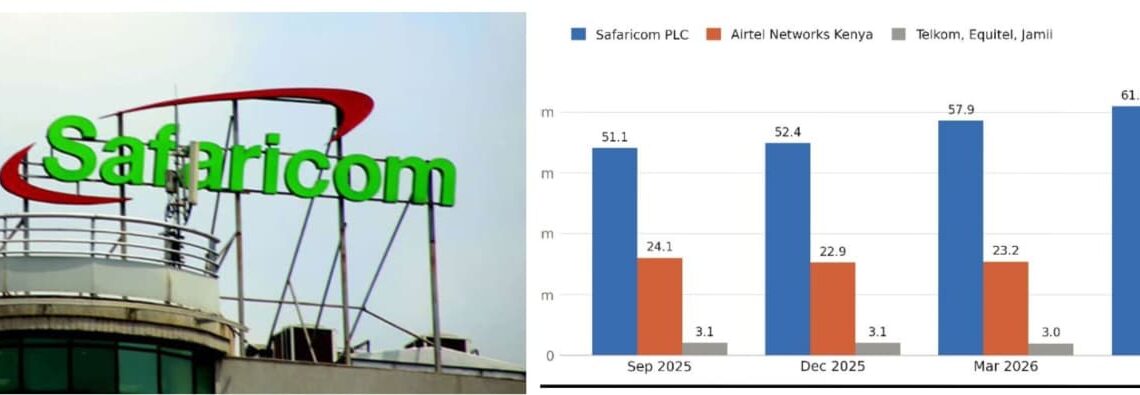
Safaricom added more than 10.3 million active mobile subscriptions in the 2025/26 financial year, widening its lead over Airtel Kenya as competition for subscribers intensified across the telecommunications sector.
According to data from the Communications Authority of Kenya (CA), Safaricom’s active subscriptions increased from 51.12 million in September 2025 to 61.45 million by June 2026, representing 20.2 per cent growth.
In contrast, Airtel Kenya lost 456,549 active subscriptions during the same period, leaving it with 23.6 million lines. Telkom Kenya suffered a sharper decline, with its customer base falling by more than a third to 545,765.
The contrasting performance pushed Safaricom’s market share from 65.3 per cent to 69.8 per cent, while Airtel’s declined from 30.7 per cent to 26.8 per cent.
Why Safaricom gained millions of lines
The growth came as mobile operators stepped up customer win-back campaigns, according to the CA. However, Safaricom captured a significantly larger portion of the additional subscriptions generated in the market.
The entire industry gained 9.68 million active subscriptions during the period, meaning Safaricom’s 10.32 million increase was greater than the sector’s net growth.
A key factor behind Safaricom’s position is its broad ecosystem of mobile services. The company combines voice, mobile data, broadband and mobile money, with M-Pesa providing an important part of its customer ecosystem.
By June 2026, Safaricom controlled 88.8 per cent of mobile money subscriptions, compared with Airtel Money’s 11.1 per cent. Although Safaricom’s share declined slightly from 89.7 per cent in September, M-Pesa remained the dominant mobile money platform.
This gives customers multiple reasons to remain on Safaricom’s network, particularly where mobile payments are integrated into everyday business and consumer transactions.
Safaricom also continued to lead in network usage. During the financial year, its customers generated 80.33 billion voice minutes, compared with 46.19 billion for Airtel. Safaricom also carried 52.79 billion SMS messages, against Airtel’s 4.33 billion.
Why Airtel’s base shrank
Airtel’s decline occurred despite the wider market expanding, with its share falling by nearly four percentage points in nine months.
The CA attributes overall industry growth partly to customer win-back campaigns, but the figures show that the campaigns did not produce uniform results across operators.
Airtel’s weaker position in mobile money, traffic and overall subscriber numbers means it operates with a smaller ecosystem than Safaricom. The gap is particularly pronounced in mobile money, where Safaricom’s M-Pesa remains far ahead of Airtel Money.
However, Airtel continues to hold a substantial second-place position, with 23.6 million active subscriptions by June.
Why Safaricom remains the market leader
Safaricom’s dominance extends beyond the number of mobile lines. By June, it held 64.4 per cent of mobile broadband subscriptions and 88.8 per cent of mobile money subscriptions.
The operator also accounted for 72.5 per cent of industry voice revenue, 74.4 per cent of data revenue and 73.4 per cent of SMS revenue, according to CA data.
Its advantage is, therefore, built on a combination of subscriber scale, mobile money dominance, network usage, and multiple digital services.
However, the figures do not mean Safaricom acquired 10.3 million new individual customers. The CA defines an active subscription as a line that generated revenue within the previous three months.
Kenya had 88 million active subscriptions against 79.68 million connected handsets in June, showing that many users hold multiple SIM cards.
Safaricom’s lead is also being challenged in fixed internet, where its market share stood at 36.1 per cent as competition from other providers intensified.