


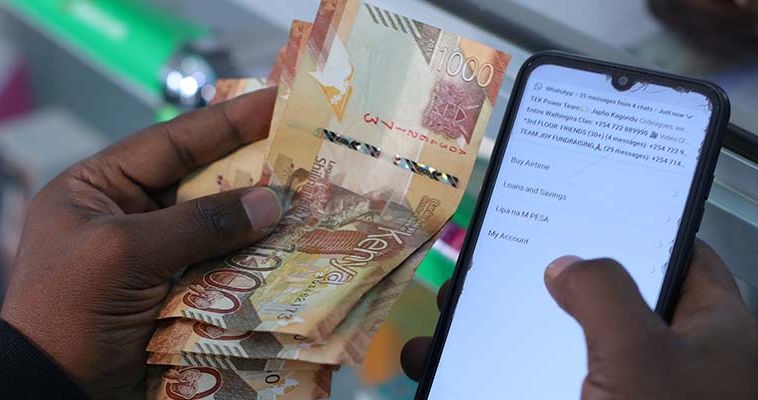
A mobile phone is becoming more than a communication tool for Kenya’s smallest traders. In busy markets, roadside stalls, and rural trading centres, it is increasingly serving as a cash register, business ledger, and a safer place to keep daily earnings.
The shift is being driven by the rapid growth of mobile money, with subscriptions reaching 54 million, representing a 13.2 per cent annual increase and pushing penetration beyond 101 per cent. Safaricom accounts for 88.8 per cent of the subscriptions, placing its mobile money ecosystem at the centre of everyday commerce.
A Wallet That Separates Business From Home
For a mama mboga selling vegetables, a kiosk owner, or a boda-boda rider, one of the biggest challenges has traditionally been knowing how much money the business actually makes. Pochi La Biashara is changing that equation by giving small traders a dedicated business wallet linked to their existing M-PESA line.
Activation requires no new SIM card, formal business registration or complicated paperwork. Traders can receive customer payments separately from personal funds, creating a clearer picture of daily sales. That simple separation can influence how a trader makes decisions. Instead of treating all money in the phone as available household cash, business earnings can
remain earmarked for stock, transport, rent or other operating expenses.
From Cash in Hand to Records on a Phone
Pochi La Biashara also gives informal businesses something they previously struggled to maintain: a transaction trail.
A trader can access mini-statements, transfer funds between business and personal wallets, withdraw through an agent, pay other businesses through Lipa na Pochi and sell airtime for commissions.
The record of transactions can provide a clearer picture of business activity, potentially helping traders demonstrate their financial behaviour when accessing relevant financial services. Safaricom says Pochi’s active merchants have surpassed 2.2 million, compared with roughly one million active Lipa na M-PESA business tills.
Different Tools, Same Digital Road
While Pochi is designed with informal traders in mind, Lipa na M-PESA continues to support more structured businesses and retailers through Buy Goods tills and Paybill services. Together, the platforms are expanding the number of businesses able to accept digital payments without depending entirely on physical cash.
A customer can pay without searching for exact change, while the trader avoids keeping large amounts of money exposed at a stall or shop. The change may appear small during an individual transaction, but repeated throughout a trading day, it alters how money moves through a business.
A Bank Branch in the Palm
Safaricom’s My OneApp adds another layer by bringing services such as M-PESA, Pochi and other financial tools into one interface. For traders with limited access to conventional banking infrastructure, the phone becomes a gateway to services that would otherwise require travelling to a bank or financial institution.
Women operating businesses in peri-urban markets, rural vendors, and young people running side hustles can receive payments, monitor transactions, and move money using tools already familiar to them.
The Remaining Digital Divide
The transformation is not without gaps. Some traders remain unfamiliar with features such as mini-statements and airtime trading, while digital literacy remains uneven, particularly in some rural communities.
Yet the direction is unmistakable.
Kenya’s mobile money revolution is increasingly being measured not only by the number of transactions processed, but by what happens after a customer pays. A digital payment can become a record, a planning tool, and a clearer boundary between
household spending and business capital.
That may be the quieter revolution happening inside Kenya’s informal economy: the mobile phone is helping small traders not simply receive money, but understand where their business stands.