


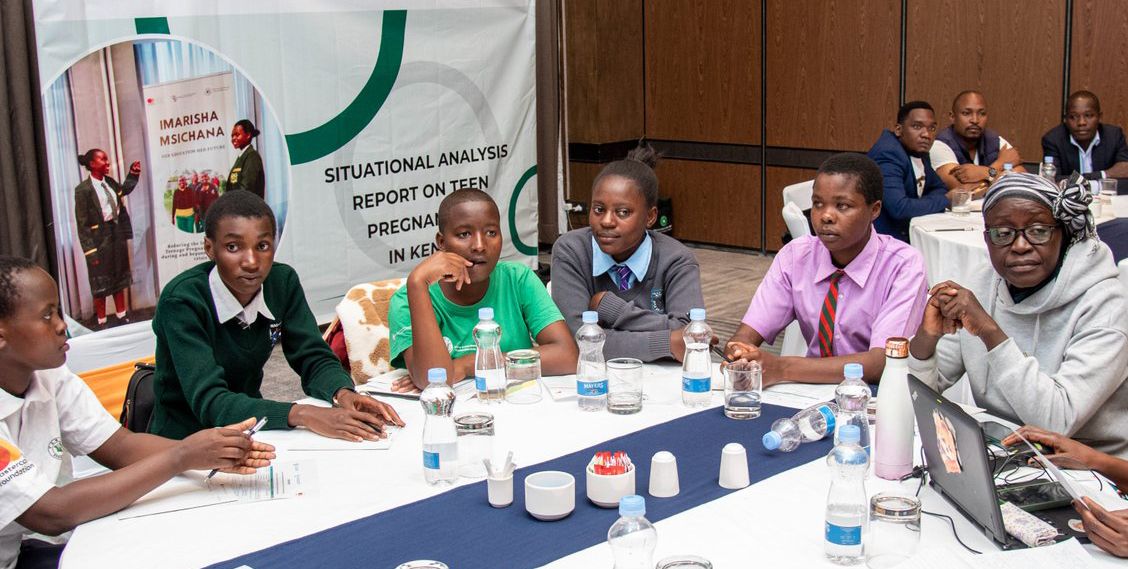
The Forum for African Women Educationalists (FAWE) has unveiled an in-depth situational analysis report addressing teenage pregnancy in Kenya.
The report, titled “Situational Analysis on Teen Pregnancies in Kenya,” was launched at an event in Nairobi, shedding light on teenage pregnancy statistics, contributing factors, and socio-economic effects on young girls and their communities.
The launch also celebrated media professionals with the Best Gender-Responsive Reporters awards, acknowledging their impactful journalism on gender issues.
The analysis, conducted across 20 counties, is part of FAWE’s Imarisha Msichana Program, implemented with the Mastercard Foundation. The findings reveal that 27.4 percent of girls aged 15 to 18 are affected by teenage pregnancies, with counties like Narok, Kajiado, and Turkana experiencing the highest rates at 43.3 percent , 35.6 percent, and 34.2 percent, respectively. Counties with the lowest rates include Nyeri (6 percent, Nyandarua 8 percent, and Muranga (9.2 percent.
Alongside teenage pregnancy, the report highlights high incidences of child marriage, with Garissa recording the highest prevalence at 43 percent, followed by Turkana at 38 percent. The report estimates that 18.6 percent of girls between 15 to 18 are in child marriages, a decrease from the 23 percent reported in 2014 by the Kenya Demographic and Health Survey.
In response to these findings, the report offers recommendations aimed at combating teenage pregnancy and child marriage in Kenya. Proposed interventions include enhancing parental education, providing family-life counseling, implementing mental health programs in schools, enforcing laws and policies, and offering financial support to girls and boys in need.
FAWE advocates for the establishment of awareness campaigns on teenage pregnancy laws and the creation of empowerment forums within schools. A notable example is FAWE’s Tuseme Clubs, which are part of the Imarisha Msichana Program and encourage girls to speak out against challenges they face.
Speaking at the event, Ms. Teresa Omondi-Adeitan, Deputy Executive Director at FAWE Africa, emphasized the importance of the report, stating, “The Situational Analysis Report on Teen Pregnancies in Kenya is a testament to our commitment to understanding and addressing the issue of teenage pregnancy. The insights gained will be invaluable in shaping our future interventions. Addressing teenage pregnancy is not just about reducing numbers; it’s about transforming lives and communities.”
Echoing these sentiments, Hannah Tsadik, Acting Country Director of the Mastercard Foundation in Kenya, expressed optimism that the report will drive action towards more inclusive economic opportunities. “As we implement our Young Africa Works strategy, which aims to enable seven million young Kenyans to access dignified and fulfilling work by 2030, this report confirms that early marriage and motherhood are also economic challenges. Delivering solutions to this challenge unlocks opportunities for everyone,” she said.
The event included a panel discussion, where stakeholders discussed potential multi-sectoral interventions to effectively address teenage pregnancy across the country. This dialogue underscored the necessity of collaborative efforts in realizing the report’s recommendations and creating lasting, positive change.
In addition to launching the report, FAWE presented awards to journalists who excelled in gender-sensitive reporting. Categories for the awards included Best Feature Story, Best Investigative Piece, and Best Gender Reporting.
FAWE Kenya CEO Jeanette Nyanjom commended the journalists, saying, “Quality, gender-responsive journalism is crucial in creating awareness and driving societal change. The journalists we are honouring today have set a high standard in their reporting. The role of media in promoting gender equality cannot be overstated.”
FAWE’s Imarisha Msichana Program has trained 250 journalists in gender-sensitive reporting, equipping them to contribute significantly to the fight against teenage pregnancy through informed, accurate coverage. The report’s insights, along with the media’s influence, are expected to drive meaningful interventions and reduce teenage pregnancy rates in Kenya.