

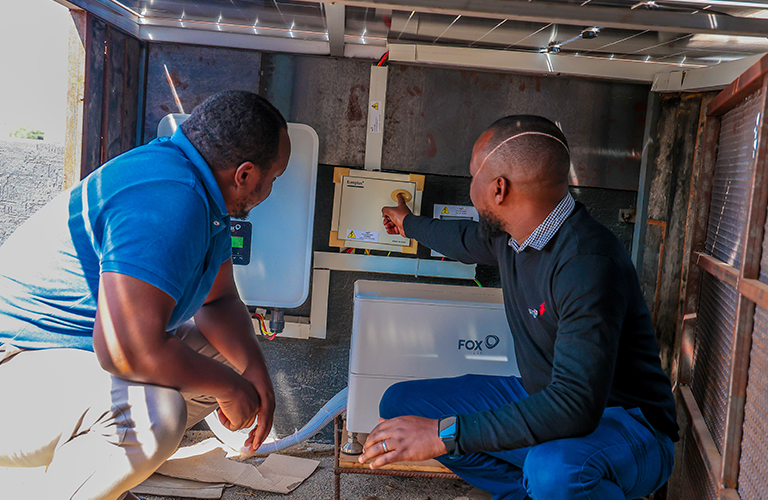
As more Kenyan households and businesses turn to solar energy to cut electricity costs and improve power reliability, experts are warning consumers against making key mistakes when choosing and installing solar systems.
For David Njugi, the decision to go solar began with the high cost of connecting his new home to the national electricity grid.
“The national grid had not yet reached my site, and connecting it would have been quite expensive. Solar was a good alternative,” Njugi said.
His home now runs entirely on solar power, an experience that reflects a wider shift towards renewable energy across Kenya.
Businesses are also increasingly adopting solar to reduce electricity bills and manage disruptions caused by power outages. About 2,000 of Safaricom’s 7,000 base transmission stations are now fully powered by solar energy, while commercial developments such as Two Rivers Mall have invested in large-scale rooftop solar installations.
The growth comes as electricity access in Kenya continues to expand. According to the International Energy Agency (IEA), electricity access increased from 37 per cent in 2013 to 79 per cent in 2023, putting the country on course for universal electricity access by 2030.
Kenya has also emerged as East Africa’s largest off-grid solar market, accounting for nearly 74 per cent of solar home system sales in the region. About one in five Kenyan households uses standalone solar systems or mini-grids, according to the IEA.
However, experts caution that purchasing solar equipment is only the first step. Choosing a system that matches a household’s actual electricity needs is critical to avoiding unnecessary costs.
System sizing a key step
Gilbert Mugo, who established Keru Solar in 2024 after working on Kenya’s Last Mile Connectivity Programme, says many customers make the mistake of determining their solar investment based on their budget rather than their energy consumption.
“Many people focus on how much they want to spend instead of how much power they actually need. They come with a fixed budget and ask for a solar system worth a certain amount,” Mugo said.
He recommends that homeowners first undergo an energy assessment before purchasing equipment.
The process, known as system sizing, determines the amount of electricity a household requires and matches it with the appropriate combination of solar panels, batteries and inverters.
An undersized system may fail to meet a household’s electricity demand, while an oversized installation could leave consumers paying for capacity they rarely use.
For Njugi, having engineers assess his home before installation helped the family settle on a system that matched their needs.
“The engineers visited the site, carried out their assessment and designed the system. We agreed on what was reasonable before settling on a 10-kilowatt system,” he said.
Solar also requires a change in habits
Njugi’s wife, Hellen Wangui, initially had doubts about whether solar power could handle the demands of a modern Kenyan household.
“I had always heard about solar, but I didn’t believe it was practical,” she said.
Her biggest concern was whether the system could support everyday household activities, particularly cooking and other energy-intensive tasks.
After adopting solar, however, the family found that efficient energy management was essential to getting the most from their system.
They schedule activities such as cooking, ironing and using other high-power appliances between 10 a.m. and 4 p.m., when solar generation is at its peak.
After sunset, the household reduces its electricity consumption to preserve stored energy.
The experience highlights another important consideration for consumers: installing a solar system does not automatically guarantee maximum efficiency. How electricity is consumed can significantly affect system performance, particularly in homes that rely heavily on battery storage.
Cheaper equipment may prove costly
While falling equipment prices have made solar more accessible, Mugo cautions consumers against choosing equipment solely because it is cheaper.
He advises homeowners to work with qualified technicians, ensure the system is properly sized and invest in quality equipment designed for long-term use.
A properly installed solar system can serve a household for between 20 and 25 years, making the decision an important long-term investment.
For Kenyan households considering the transition to solar, experts say the key lessons are clear: assess your electricity needs first, size the system correctly, use qualified installers and prioritise quality equipment over the lowest upfront price.
For Wangui, the results have changed her view of solar completely.
“Solar works. I didn’t believe it. Now I’m living it,” she said.