


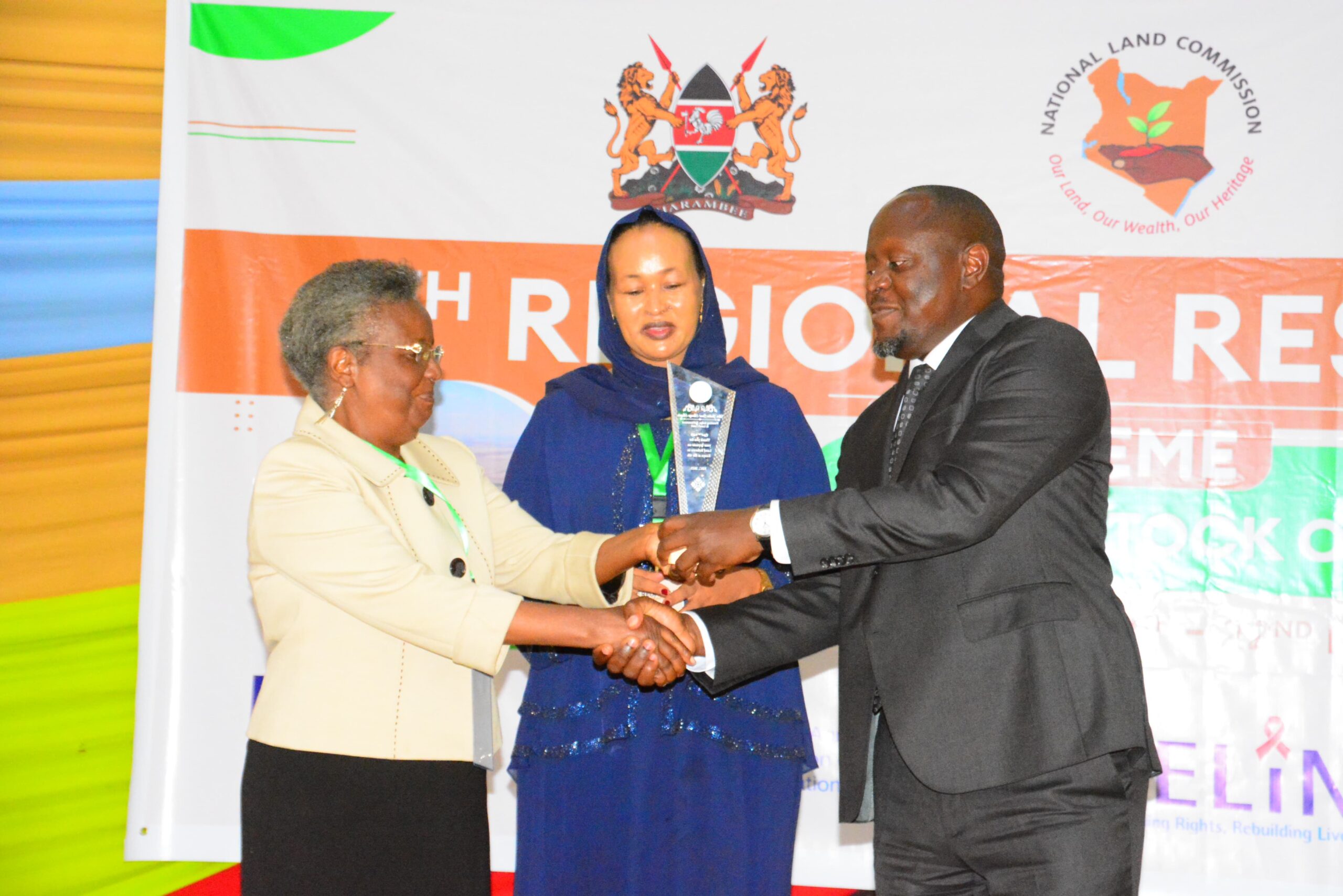
The 4th Regional Research Conference on Land Reform in Kenya kicked off on Tuesday at the Kenya School of Government (KSG), Nairobi, bringing together government agencies, judiciary officials, civil society, researchers, and international partners to evaluate Kenya’s land reform journey under the theme: “Taking Stock of the Land Reform Progress in Kenya.”
Organized by the National Land Commission (NLC), the three-day conference has ignited robust discussions on long-standing land injustices, weak enforcement of land laws, and the critical need for secure land tenure.
While recognizing notable reforms since the enactment of the 2010 Constitution, stakeholders expressed concerns over fraudulent land transactions, systemic exclusion, and the failure of authorities to ensure just compensation for landowners during compulsory acquisitions.
Opening the conference, NLC CEO Kabale Tache Arero emphasized the importance of the forum in evaluating land governance gains and gaps. She acknowledged key partners including FAO, the Ministry of Lands, and the National Bank of Kenya for supporting the initiative, and urged researchers, civil society actors, and policymakers to collaborate in driving equitable reforms.
Delivering the keynote address, Hon. Justice Oscar Angote, Principal Judge of the Environment and Land Court (ELC), underscored the judiciary’s pivotal role in shaping progressive land jurisprudence. “Land is not merely a commodity; it is the soul of our heritage and the anchor of our identity,” he said, reflecting on how the courts have evolved from rigid legal formalism to a justice-centered approach aligned with the Constitution.
Justice Angote cited landmark rulings that have redefined land law interpretation. These include the Dina Management Ltd v County Government of Mombasa (2023) and Torino Enterprises Ltd v AG (2023) cases, which held that illegally acquired land cannot be protected under the guise of innocent purchase. The courts have also upheld accountability, with registrars being personally fined for misfeasance in title issuance, as seen in Hamran Ahmed Salim v Cooperative Bank (2024).
The judiciary has also clarified leasehold renewal processes, compelling public agencies to respect legitimate expectations of lessees. In matters of compulsory acquisition, the ELC condemned delayed compensations, affirming the constitutional right to prompt and fair redress for affected landowners.
Further, challenges surrounding the mandate of the NLC were discussed, particularly regarding historical land injustices and the tension between the NLC and the Ministry of Lands. Justice Angote called for greater coordination and mutual accountability between institutions.
Commissioner Easther Murugi Mathenge reiterated NLC’s commitment to research and policy dialogue as mandated under Article 67(2)(d) of the Constitution. She highlighted cross-cutting challenges such as gender inequity, unsustainable land use, and urbanization, calling for enhanced use of land information systems and grassroots participation.
The conference continues to serve as a crucial platform for stakeholders to deliberate on reforms that can deliver equitable, transparent, and sustainable land governance for all Kenyans. With support from the EU, FAO, UON, NRF, and TUK, the forum focuses on legal frameworks, dispute resolution, governance, and natural resource management—key pillars in advancing land justice.
