

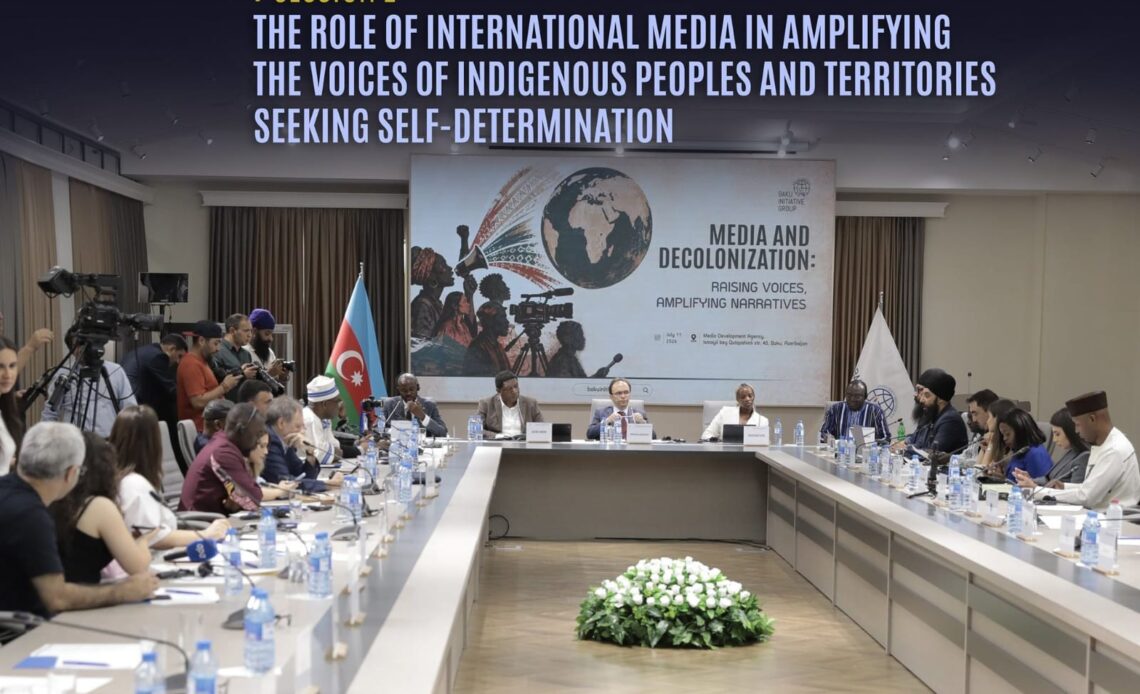
The struggle for decolonization is moving beyond political and diplomatic arenas into the information space, where media narratives increasingly influence global perceptions of peoples, territories and independence movements, while shaping debates over identity, sovereignty and self-determination worldwide.
This was the central message at the international conference “Media and Decolonization: Rising Voices, Amplifying Narratives,” organised by the Baku Initiative Group in Baku, Azerbaijan, on July 11, 2026.
The forum brought together representatives of communities affected by colonial policies, journalists, academics, human rights defenders and civil society actors to examine how media can either reinforce historical power structures or provide marginalised communities with a platform to tell their own stories.
Participants argued that colonialism historically extended beyond military occupation and economic exploitation. Education, language, cultural institutions and media were also used to influence public opinion, weaken indigenous identities and legitimise systems imposed by colonial powers.
Although formal colonial rule has largely ended, speakers said similar dynamics continue to influence the modern information environment.
The media sometimes gives limited attention to the demands of peoples seeking self-determination, political representation and protection of cultural identity. In other instances, such movements are framed primarily in terms of geopolitical interests, raising concerns about double standards in global reporting.
Yet the rise of digital media has also changed the balance of power. Social media and independent digital platforms allow indigenous peoples and minority communities to document abuses, preserve cultural memory, communicate in their own languages and reach international audiences without depending entirely on traditional media gatekeepers.
However, speakers cautioned that technology has not eliminated inequality. Algorithmic visibility, content moderation, disinformation, language barriers and unequal access to digital resources can still determine which voices are heard and which remain invisible.
For Africa, the discussion has particular historical significance. European powers including Britain, France, Germany, Portugal, Spain, Belgium and Italy colonized large parts of the continent during the late 19th and early 20th centuries. The colonial legacy included borders that divided ethnic and cultural communities, extraction of natural resources, forced labour and the displacement or suppression of indigenous political, economic and cultural systems.
The consequences, according to participants, continue to shape contemporary debates over sovereignty and economic independence.
In some parts of Africa, concerns about foreign influence, control of strategic resources, external debt and economic dependency have fuelled renewed discussions about neocolonialism.
Countries such as the Democratic Republic of Congo, Mali, Niger, Cameroon and Equatorial Guinea have become part of wider debates over resource ownership, foreign influence and national sovereignty.
Kenya and Uganda, meanwhile, have faced criticism over the legacy of structural adjustment programmes, external debt and policy conditionalities associated with international financial institutions.
Speaking with Nipashe Biz Media during the Baku conference, Baku Initiative Group Executive Director Abbas Abbasov said the organisation’s strength lies in sustained advocacy around colonialism and self-determination.
He said the group began its work in 2023 with five overseas territories and has since expanded its engagement to more than 20 independent countries and overseas territories that, according to the organisation, continue to experience forms of colonial domination.
“Today we have more than 20 independent countries and overseas territories which are still suffering from colonial domination of French, Dutch, Belgian and other colonial powers,” said Abbasov
The Baku Initiative Group aims to bring the existing inequalities created by the colonial policies in the information space onto the international agenda and to contribute to the formation of a more just and balanced media environment.
The debate has also reached the United Nations decolonization process.
In a separate communication, Jozé Jean-Pierre, President of MIR Guadeloupe, drew the attention of the UN Special Committee on Decolonisation to a July 20, 2026 letter by French overseas parliamentarians concerning statements by Azerbaijani President Ilham Aliyev on the “incomplete decolonisation” of France’s overseas territories.
Jean-Pierre highlighted the status of New Caledonia and French Polynesia, which remain on the UN list of Non-Self-Governing Territories. He also questioned the historical incorporation of Guadeloupe, Martinique, Réunion and French Guiana into France as departments in 1946, arguing that the process occurred without referendums in the territories concerned.
For advocates of decolonisation, the controversy illustrates why control over information remains inseparable from the struggle for self-determination.
The Baku conference ultimately called for stronger cooperation among journalists and media organisations, more balanced international representation and greater space for indigenous languages, histories and perspectives.