


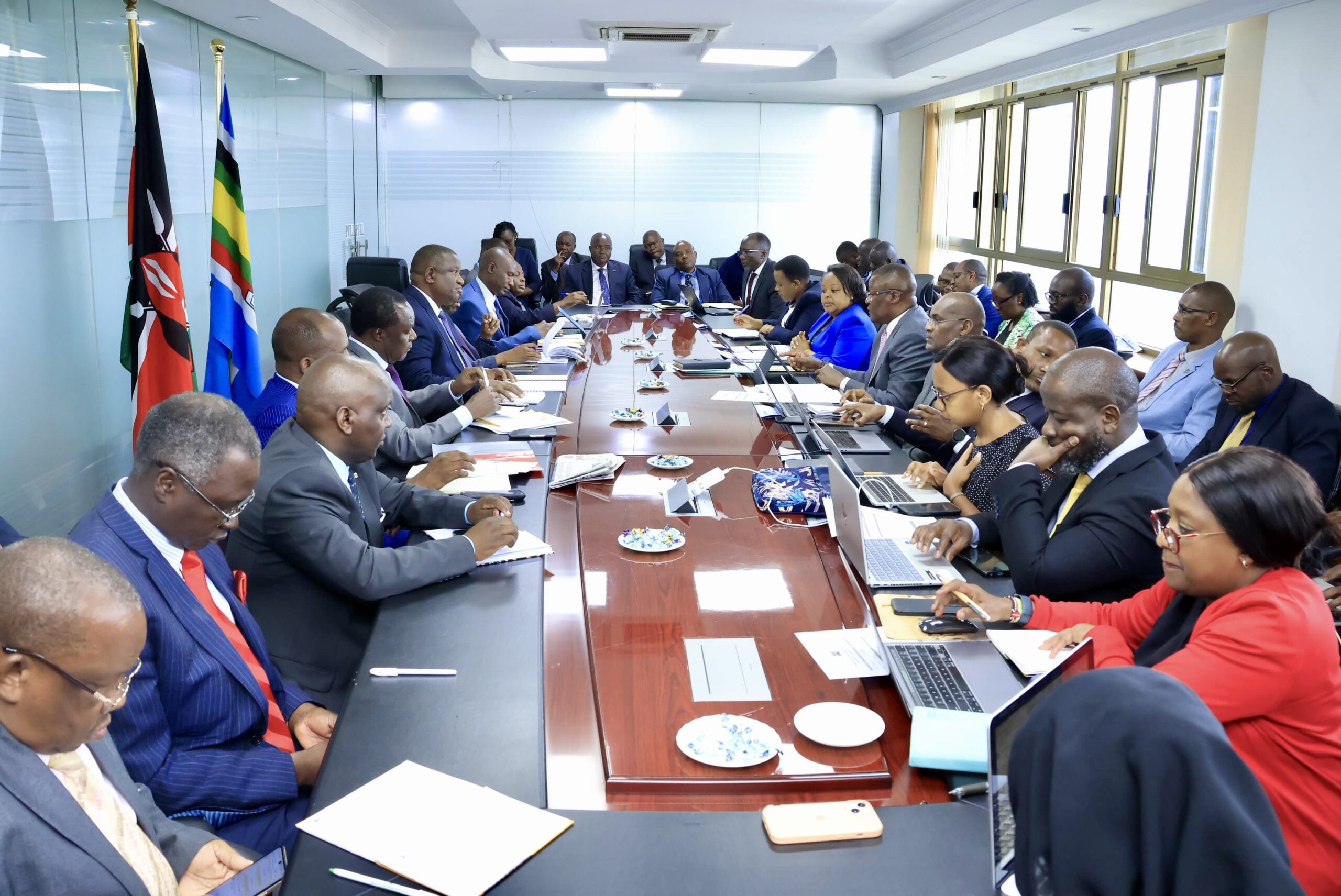
In a significant step towards enhancing economic performance, the Ministry of Investments, Trade, and Industry has successfully negotiated a Performance Contract aimed at increasing accountability and achieving measurable outputs. The contract was presented by Deputy Chief of Staff Eliud Owalo, alongside Secretary to the Cabinet Mercy Wanjau and Principal Secretary Aurellia Rono.
The newly established contract outlines clear performance indicators and time-bound targets, ensuring the ministry is held accountable for its commitments. The meeting was attended by Cabinet Secretary Salim Mvurya, as well as PSs Abubakar Hassan Abubakar and Juma Mukhwana, who led the ministry’s team.
Investment, Trade and Industry Cabinet Secretary Salim Mvurya outlined key initiatives in the contract include the operationalization of five Special Economic Zones (SEZs) in Uasin Gishu, Nakuru, Murang’a, Busia, and Kirinyaga, alongside the establishment of 19 County Aggregation and Industrial Parks (CAIPs). These projects are set to be completed by the end of June 2025 and are expected to significantly boost investments and agro-processing in the country.
Deputy Chief of Staff Eliud Owalo emphasized the government’s commitment to achieving a 10 percent annual growth in exports, focusing on leveraging small businesses involved in the processing of agricultural produce. This goal will be supported by the SEZs and CAIPs, which aim to empower Small and Medium-sized Enterprises (SMEs) to enhance their production capabilities for the export market.
To further support local industry, the government will coordinate the procurement of textile and leather products for the Disciplined Forces from local manufacturers, reinforcing the “Buy Kenya, Build Kenya” initiative. This approach aims to bolster local production while ensuring a stable supply of essential goods.
In addition, the Development of a Cotton, Textile, and Apparels Policy will be implemented to de-risk value chains through concessional loans and co-investments, facilitating the transition of SMEs into exporters.
The Ministry has also committed to a turnaround strategy for the Kenya National Trading Corporation to stabilize prices for essential food items and consumer goods, with new targets set for realization by June 2025.
Furthermore, discussions with the UK have focused on addressing energy costs and taxation policies, aiming to attract more UK-based firms to Kenya. Currently, there are approximately 350 UK firms operating in the country, reflecting a robust bilateral economic relationship.
As the government pursues these ambitious goals, it remains focused on fostering an environment conducive to investment and growth, ensuring that Kenya’s economic landscape continues to evolve positively in the coming years.
