


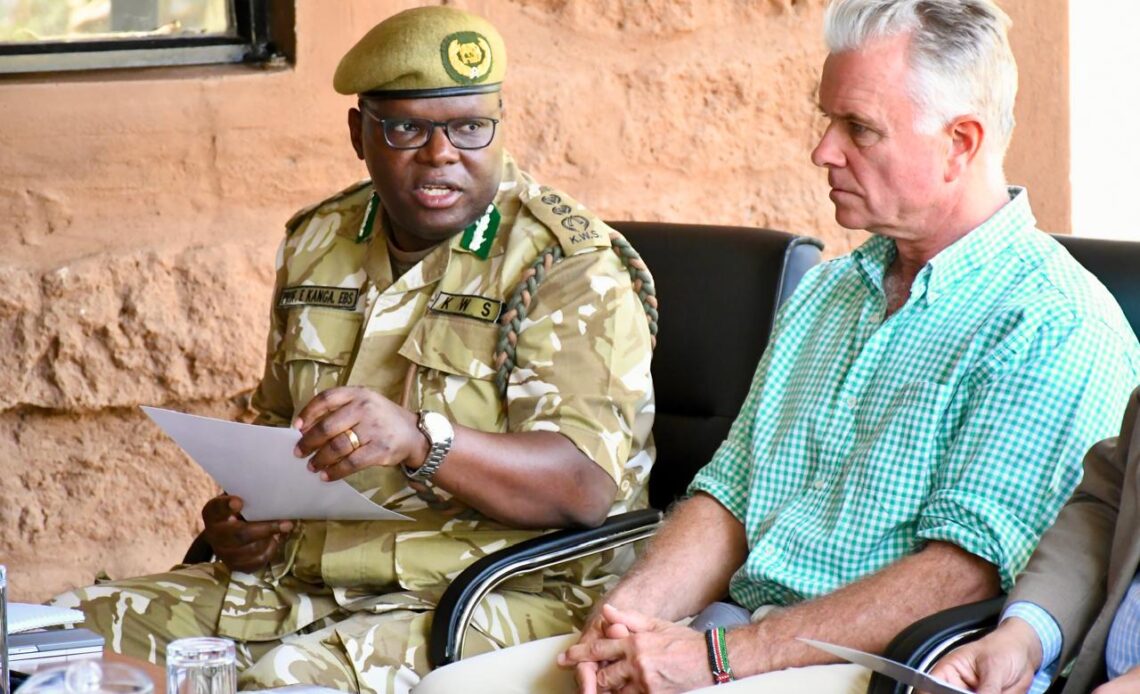
The Kenya Wildlife Service (KWS) Board of Trustees, led by Chairman Lt. Gen. (Rtd) Walter Raria Koipaton, did a familiarisation visit to the Lewa Joint Operations and Communications Centre (JOCC) in Northern Kenya.
The visit signalled the Service’s continued commitment to utilising technology and strategic partnerships to deepen conservation and wildlife security.
The delegation on the visit comprising the KWS Director General, Prof. Erustus Kanga, and the senior management was welcomed by conservation leaders Dr. Kevit Desai of the Northern Rangelands Trust (NRT), Mr. Mike Watson of Lewa Wildlife Conservancy, and Mr. Vishal Shah of NRT.
The energetic leadership of Prof. Kanga keeps on driving change that matters in the wildlife sector. Through his guidance, not only has KWS enhanced inter-agency collaboration, but it has also modernized the field operations and adopted even the most sophisticated surveillance technologies to achieve better conservation results.
His insistence on innovation, partnerships, and community participation has breathed new life into Kenya’s conservation heritage — turning it into one that is compatible with the most recent global standards and yet it deals with decentralised issues.
The Lewa JOCC is the nerve centre for conservation and security coordination across 45 conservancies that are under the NRT umbrella. By linking government agencies and conservation partners, the center enables cohesive, rapid responses to threats, ensuring the safety of both wildlife and surrounding communities.
To give an example of the high-tech equipment that the JOCC uses one can cite such tools as EarthRanger, LoRaWAN long-range networks, and data from drones, aerial patrols, animal collars, camera traps, GPS trackers, and ranger patrols.
The merging of vital on-the-ground intelligence into one operational plan it is in real-time now. This has made it possible to a very great extent for Kenya to keep watch over criminals and react to such happened cases.
Prof. Kanga on his part reiterated the pledge from KWS to the use of technology and the forging of partnerships that are strong and sustainable to the cause of conservation in Kenya. “Our primary objective is to make sure that wildlife conservation is right at the centre of national development,” he said. “We are reaping results for the people and nature through co-operation, creativity, and engagement with the community,” he went on.
This combination of leadership, technology, and collaboration presents a powerful portrayal of Kenya’s international standing in the area of conservation and commitment to biodiversity preservation in the future.