


Egypt, Afreximbank Move to Establish Pan-African Gold Bank
The Central Bank of Egypt (CBE) and the African Export–Import Bank (Afreximbank) have signed a Memorandum of Understanding (MoU) to establish a pan-African Gold Bank programme, a landmark initiative aimed at formalising Africa’s gold value chains, strengthening central bank reserves and reducing the continent’s dependence on foreign refining and trading hubs.
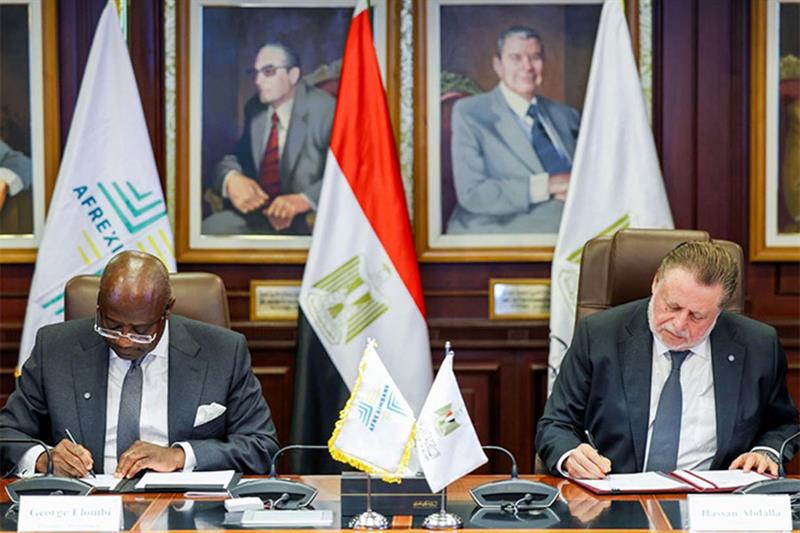
The MoU was signed on December 29 in Cairo by CBE Governor Hassan Abdalla and Afreximbank President and Board Chairman Dr George Elombi. The initiative aligns with Egypt’s push to deepen strategic partnerships across Africa and Afreximbank’s mandate to promote value addition and strategic mineral processing on the continent.
Under the agreement, the two institutions will jointly commission a feasibility study to assess the technical, commercial and regulatory requirements for developing an integrated Gold Bank ecosystem within a designated free zone in Egypt.
The proposed ecosystem would include an internationally accredited gold refinery, secure vaulting facilities, and related financial and trading services, with the participation of African countries.
The programme is designed to expand across the continent by engaging governments, central banks, mining companies and industry stakeholders to strengthen institutional collaboration, harmonise best practices and promote the sustainable trade of gold and related services within Africa.
Speaking at the signing ceremony, Governor Abdalla said the initiative could evolve into a continent-wide framework involving African governments, central banks and market participants.
He noted that Egypt’s potential role as a hub—subject to the outcome of the feasibility study and regulatory approvals, reflects confidence in the country’s readiness to host large-scale continental projects.
“With its strategic geographic location at the crossroads of Africa, the Middle East and Europe, Egypt is well positioned to serve as a natural hub for regional gold trade and financial innovation,” Abdalla said, reaffirming Egypt’s commitment to advancing African economic integration.
Dr Elombi described the agreement as a decisive step towards ensuring Africa’s mineral wealth benefits Africans. “Africa’s gold must serve African people,” he said. “By transforming how we extract, refine, manage, value, store and trade gold, this initiative will help retain value on the continent, build resilience, reduce exposure to external shocks, improve currency stability and create wealth within Africa.”
Egypt is Afreximbank’s largest shareholder and host country, reflecting a long-standing partnership between the two institutions.
Afreximbank, a pan-African multilateral financial institution, plays a central role in financing and promoting intra-African and extra-African trade and is a key supporter of the African Continental Free Trade Area (AfCFTA).
At the end of December 2024, Afreximbank’s total assets and contingencies exceeded US$40.1 billion, with shareholder funds of US$7.2 billion. The bank holds investment-grade ratings from major international credit rating agencies and operates through a group structure that includes its impact investment arm, FEDA, and insurance subsidiary, AfrexInsure.
If implemented, the proposed African Gold Bank could mark a significant shift in how Africa manages and monetises one of its most valuable natural resources, reinforcing the continent’s push for financial sovereignty and deeper economic integration.