


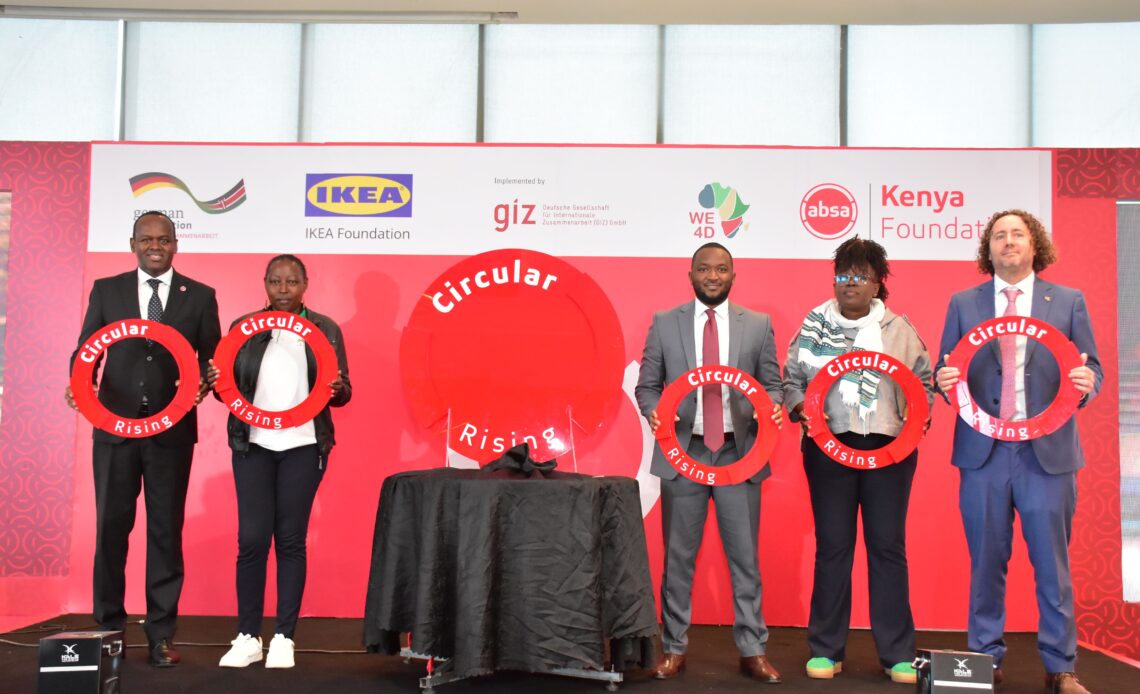
Absa Kenya Foundation, in partnership with the German Corporation for International Cooperation (GIZ) and the African Guarantee Fund (AGF), has unveiled the country’s first and largest circular economy initiative, dubbed CirculaRising, targeting the creation of over 6,000 new and improved jobs by 2028.
Ambitious Targets for Jobs, Sustainability and Inclusion
However, the programme aims to empower more than 2,000 women- and youth-led micro, small and medium enterprises (MSMEs) across Kenya’s circular economy value chains. It also seeks to recycle over 6,000 tonnes of waste and indirectly improve the livelihoods of more than 30,000 people.
At its core, CirculaRising is designed to promote circular solutions and gender-inclusive approaches that support sustainable economic growth, environmental conservation, and inclusive development.
A Shift from Linear to Circular Growth
Speaking at the launch in Nairobi, Absa Bank Kenya Managing Director and CEO Abdi Mohamed emphasised the urgency of transitioning from traditional economic models.
He noted that for decades, global growth has followed a linear “take, make, use and discard” model, which has led to increased waste, environmental strain, and inequality. He said the circular economy offers a new pathway where waste becomes a resource, efficiency drives competitiveness, and sustainability fuels enterprise growth.
Three-Phase Implementation Model
The programme, co-funded by the German government and IKEA Foundation and implemented by GIZ, will roll out in three key phases:
- CirculaRising Academy: Fully funded by Absa Kenya Foundation, this phase will support over 2,000 microenterprises through training, coaching, access to markets, and financing over 27 months.
- CirculaRising Accelerator: Targeting 150 growth-stage small enterprises across Nairobi, Central, Western, Nyanza, and Coastal regions, this component will focus on capacity building, market linkages, and financing access.
- CirculaRising Scale-Up: Aimed at 25 to 30 medium and large enterprises, this phase will support businesses generating significant waste volumes to integrate circular practices and expand export capabilities, including certification to global sustainability standards.
Boosting Women-Led Enterprises and Green Value Chains
GIZ’s WE4D Kenya Team Leader, Thomas Jaeschke, highlighted the programme’s dual focus on women’s empowerment and green transformation.
He noted that the initiative combines financial and advisory support to strengthen women’s participation in green value chains while driving economic, social, and environmental impact through improved incomes, job creation, and sustainable waste management.
Government Backs MSME-Led Transformation
The Kenyan government has thrown its weight behind the initiative, underscoring the critical role of MSMEs in economic growth.
In remarks delivered on her behalf, Principal Secretary for MSME Development Susan Mang’eni said the programme aligns with government efforts to enhance access to finance, strengthen enterprise support systems, and create a conducive regulatory environment for sustainable business growth.
Driving Climate Action Through Circular Economy
Officials from the Ministry of Environment and Climate Change also emphasised the programme’s potential to accelerate climate action.
Dr. Selly Kimosop, representing Principal Secretary Festus Ng’eno, noted that supporting MSMEs in adopting circular practices will play a significant role in reducing waste and advancing Kenya’s climate goals.
Bridging the Financing Gap for Women Entrepreneurs
Africa Guarantee Fund’s Group Director of Capacity Development, Patrick Lumumba, highlighted the financing challenges facing women-led enterprises.
Furthermore, despite women owning 40 per cent of MSMEs and contributing up to 20 per cent of Kenya’s GDP, many still lack access to formal financing. He said the partnership leverages the Affirmative Finance Action for Women in Africa (AFAWA) initiative to bridge this gap and unlock the potential of women entrepreneurs.
Financing and Long-Term Impact
By 2028, the programme aims to mobilise over €2 million in financing while delivering measurable environmental benefits through waste reduction, reuse, repair, and recycling.
In addition, the initiative aligns with Absa Kenya Foundation’s pillars of entrepreneurship, education and skills development, and natural resource management, reinforcing its commitment to driving sustainable economic transformation.
A Step Toward a Sustainable Future
CirculaRising marks a significant milestone in Kenya’s transition to a circular economy, positioning MSMEs, especially women- and youth-led enterprises, at the centre of sustainable growth and climate action.