


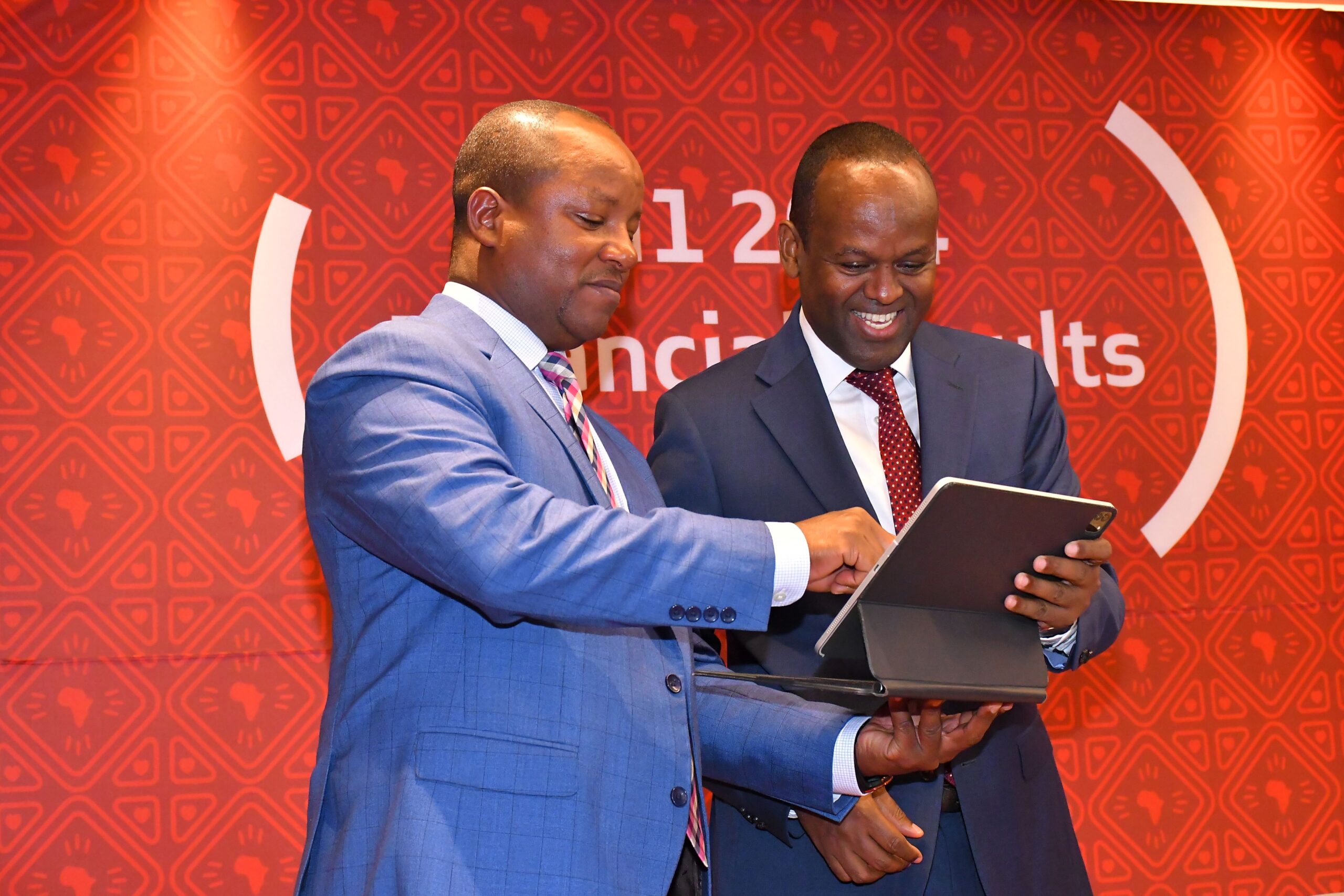
Absa Bank Kenya CFO Yusuf Omari and MD & CEO Abdi Mohamed during the unveiling of H1 2024 financial results in Nairobi
Absa Bank Kenya PLC has reported a profit after tax of Kshs. 10.7 billion for the first half of 2024, marking a 29 percent increase compared to the same period last year. This growth was driven by strong revenue performance across all business segments. The bank also declared an interim dividend of Kshs. 0.20 per share.
For the six-month period ending June 30, 2024, the bank’s total revenues increased by 16 percent to Kshs. 31.8 billion. This was supported by a rise in funded income to Kshs. 23 billion and an 8.4 percent growth in non-funded income, reflecting both the strength of traditional revenue streams and the successful expansion into new income sources. Customer deposits grew by 6 percent to Kshs. 353.3 billion, indicating continued confidence in Absa as a leading financial partner.
Abdi Mohamed, Managing Director and CEO of Absa Bank Kenya, highlighted that the improved financial results were a result of strategic prudence and customer resilience.
“This commendable outcome, realized amidst a challenging macro-economic environment, underscores the efficacy of the Bank’s growth strategy and its unwavering dedication to providing relevant financial solutions that address the diverse needs of individuals, enterprises, and communities because we want to continue being a critical enabler to their growth stories,” Mohamed said.
 Absa Bank Kenya CFO Yusuf Omari and MD & CEO Abdi Mohamed during a media and investor briefing in Nairobi. Absa Bank Kenya reported a 29pc growth in profit after tax to Kshs.10.7 billion for the half year ended 30 June 2024.
In response to economic challenges, Absa Bank undertook several initiatives to support its customers. The bank restructured approximately Kshs. 1.4 billion in loans for retail consumers affected by economic difficulties and enhanced non-financial support for MSMEs and women in business, benefiting over 14,000 entrepreneurs.
The bank also made strides in enhancing customer value and experience. It relaunched its La-Riba platform to offer more innovative Shariah-compliant solutions and strengthened its Wezesha Stock platform for SMEs.
Additionally, Absa invested Kshs. 3 billion in technology upgrades to improve its core banking and back-office systems.
Sustainability was a significant focus during this period. Absa Bank expanded its Environmental, Social, and Governance (ESG)-linked lending, advancing Kshs. 16 billion in sustainable finance, including climate finance. The bank also allocated Kshs. 12 billion to start-ups and youth through the Timiza platform. Community initiatives included impacting over 5,000 students through the Ready to Work programme and rolling out 67 computer labs in schools, benefiting more than 100,000 learners.
Mohamed emphasized the bank’s commitment to becoming a sustainable financial services company that meets modern consumer needs through innovation and partnerships.

“The bank aims to diversify revenue streams with scalable payment solutions, enhance customer experience, and advance financial inclusion through digital finance, digital savings, affordable housing, and SME offerings like Wezesha and Microinsurance” he stated
During this period, Absa Bank increased its brand-building efforts with the launch of a new brand repositioning campaign, “Your Story Matters,” and engaged in significant sponsorships, including the Magical Kenya Open Golf tournament and the Absa Kip Keino Classic athletic championship.
The bank’s statutory operating expenses rose by 12 percent due to investments in transformation and people. These investments have contributed to a significant improvement in the cost-to-income ratio, which decreased to 35.8 percent from 37 percent year-over-year. Impairment increased marginally to Kshs. 5.2 billion, reflecting prudence in risk management amidst balance sheet growth and a tough operating environment. Despite this, the bank’s portfolio quality remains better than the industry average, with an adequate coverage ratio surpassing industry levels to manage future credit losses effectively.
Absa Bank’s capital and liquidity ratios remain strong, with the total capital adequacy ratio closing at 18.6 percent and the liquidity reserve position at 35.2 percent, well above the regulatory limits of 14.5 percent and 20 percent, respectively.
Mohammed reaffirmed Absa’s commitment to driving meaningful transformation in communities and contributing to economic progress in Kenya.