

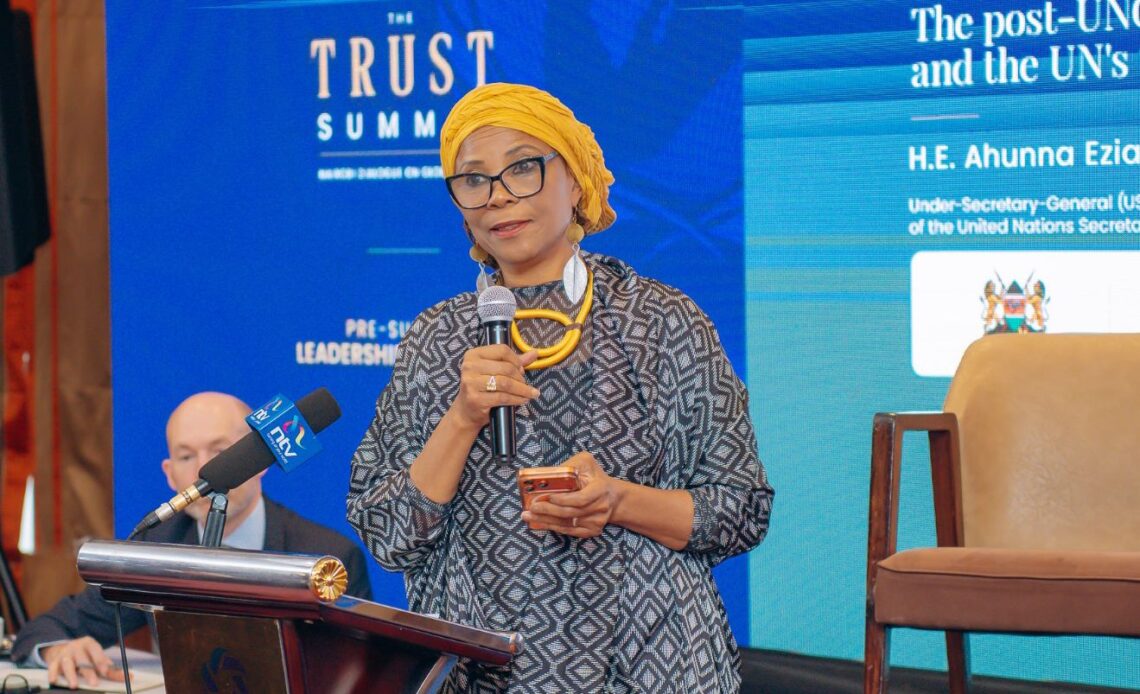
Africa is challenging global institutions to move beyond diplomatic promises and demonstrate measurable results, as the United Nations warns that rebuilding public confidence in multilateralism requires accountability, inclusive decision-making and a fundamental shift in how international partnerships operate.
Speaking at a leadership meeting in Nairobi on Thursday, ahead of the Trust Summit scheduled for October 21–23, Ahunna Eziakonwa, United Nations Under-Secretary-General and Special Adviser to the Secretary-General, said international institutions could not restore their credibility without recognising Africa as an equal partner in shaping global priorities.
Her remarks placed accountability at the centre of efforts to renew confidence in international cooperation, shifting attention from what institutions promise to what they deliver, who benefits and whether their commitments can be independently assessed.
“Africa is not asking for a seat at someone else’s table anymore. Africa is a co-architect of a system that is renewed, and not only repaired,” Eziakonwa said.
She argued that treating African countries merely as recipients of international assistance undermines the trust necessary for effective cooperation, particularly when decisions affecting their economies, development priorities and populations are made without sufficient African influence.
The challenge comes as questions persist over the credibility of global institutions, unequal representation in international decision-making and the gap between financial pledges and actual resources reaching developing countries.
For African governments, these concerns include access to development finance, climate funding and greater influence over the rules governing the global economy.
However, Eziakonwa emphasised that demands for international accountability must be matched by stronger domestic governance.
African leaders, she said, must demonstrate that they can deliver on their own commitments, particularly in agriculture, education and public services, where government performance directly affects citizens’ confidence in public institutions.
“Trust is not rebuilt by grand declaration. It’s rebuilt by commitment, one commitment after another, each with a named owner, a timeline, and a date on which we report back,” she said.
The approach is central to the Nairobi Call to Action, which seeks to establish a practical framework for turning political declarations into specific obligations that can be monitored over time.
Rather than measuring progress through summit attendance or statements of intent, the initiative places emphasis on identifying responsible actors, setting deadlines and reporting publicly on implementation.
This could provide a more concrete basis for evaluating whether international institutions and national governments are meeting the expectations they create.
Kenya’s Principal Secretary for Foreign Affairs, Abraham Korir Sing’Oei, said restoring confidence would also require institutions to expand participation beyond traditional government representatives.
“If we are serious about rebuilding trust, states must open the door to greater engagement with society, and large institutions must make room for non-state actors,” Sing’Oei said.
His remarks highlighted the importance of involving civil society, businesses and other stakeholders in decisions that have historically been dominated by governments and established international organisations.
Young people are also seeking a stronger voice in determining the future of multilateral cooperation.
Deborah Ndanu Nzomo, secretary-general of Kenya Model United Nations, said institutions must demonstrate that young people are valued contributors rather than passive observers.
“The future of multilateralism depends not only on whether young people believe in its institutions, but also on whether those institutions demonstrate that they believe in young people,” Nzomo said.
The October summit is expected to advance proposals including a Nairobi Statement on Global Trust, a summit report, a Trust Barometer dashboard, a joint task force to monitor implementation and an assessment of Africa’s trust landscape.
These mechanisms could help establish whether commitments translate into meaningful changes, although their effectiveness will depend on transparent reporting, independent scrutiny and the willingness of institutions to acknowledge unmet targets.
As preparations continue, the central question is whether global institutions will accept greater accountability while giving African countries a stronger role in setting international priorities.
For Africa, rebuilding trust is therefore about more than repairing damaged relationships. It is about reshaping the partnership itself, ensuring that influence is shared, promises are verifiable and institutions earn confidence through results rather than rhetoric.