


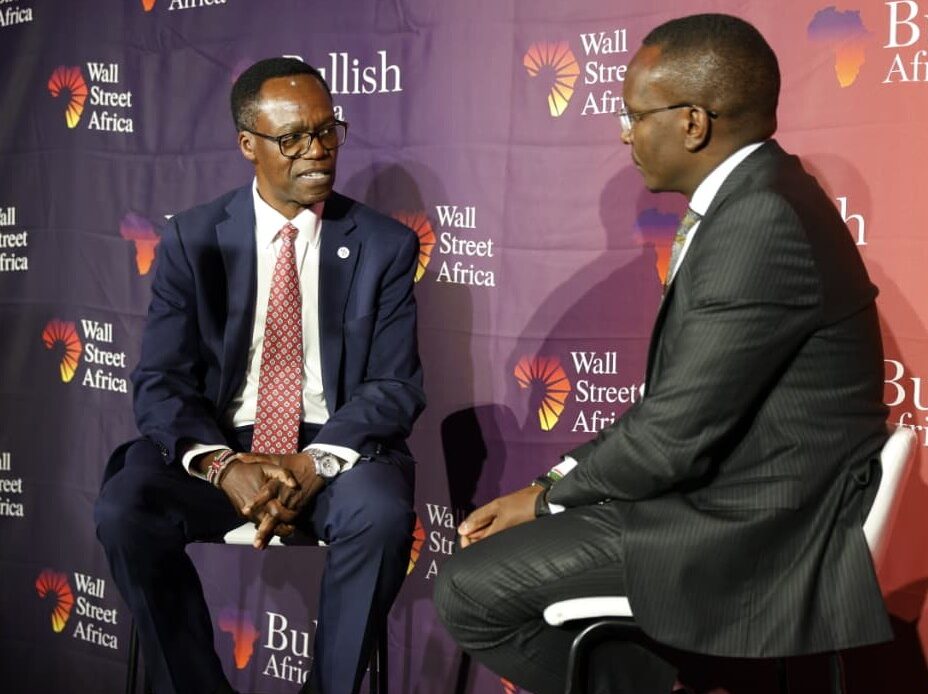
Africa is attracting increasing amounts of global capital, but the continent’s biggest financing challenge is now its ability to channel that money into businesses and projects that need it, NCBA Group Managing Director John Gachora has said.
Speaking during the opening panel of the Bullish Africa Summit in New York, Gachora said more than US$700 billion in annual demand across infrastructure, climate finance, trade finance and MSME funding remains unmet despite growing capital flows into Africa.
Capital Flows Into Africa Rising
Gachora pointed to several indicators showing the deepening pool of capital available to the continent.
Foreign direct investment reached US$70 billion in 2025, the third-highest level in 25 years and about a third above the 2010–2024 average. Private capital fundraising for Africa more than doubled to US$5.1 billion, while venture funding stood at US$3.9 billion across 506 deals.
Diaspora remittances are also projected to surpass US$100 billion, while mobile money transactions reached US$1.1 trillion across 81 billion transactions in 2024.
“The buyer of Africa risk has diversified,” Gachora said, noting that African-based investors account for 30% of active venture capital participants, alongside domestic pension funds and development finance institutions.
Banks Key to Unlocking Capital
Gachora said the growing involvement of African and Gulf institutions in regional financial markets demonstrates the emergence of a stronger intermediation layer.
He cited transactions involving NCBA, KCB, Equity, and Absa as examples of increasing regional consolidation. He also pointed to MTN’s US$6.2 billion acquisition of IHS Holding’s Nigerian tower operations and Afreximbank’s US$4 billion-led facility for the Dangote Refinery.
East Africa is also attracting growing investor attention, with the region recording US$14.6 billion in FDI in 2025, a 12% increase.
Gachora highlighted Nairobi’s emergence as a financial centre, citing its admission as the first East African centre to the World Alliance of International Financial Centres and the KES25.8 billion in new investment secured from 15 certified firms.
Trade and SME Financing Gaps
The NCBA chief said financial intermediation remains particularly important in trade, noting that only 23% of Africa’s cross-border trade was intermediated by financial institutions between 2020 and 2024.
“Global capital speaks dollars and decades. African demand speaks shillings and months. Banks sit between the two,” he said.
On MSMEs, Gachora said NCBA is targeting the estimated US$331 billion financing gap through lending and digital financing. The bank recorded KES18 billion in MSME lending, while KES819 billion in digital loans was disbursed in the first half of 2026.
“We are not competing for the ten-billion-dollar project. We are structuring the ten-million-dollar SME deals that make it economically viable,” he said.
Climate and Creative Economy
Gachora said NCBA is targeting KES3.5 billion in green financing in 2026, intending to reach KES30 billion in Group sustainable financing by 2030.
He also highlighted financing initiatives targeting Kenya’s creative economy, including the Elev8 LIVE music accelerator and a capital-match partnership with HEVA Fund.
The facility provides early-stage creators with up to KES100,000 in zero-security financing at a 9% interest rate.
Call for Long-Term Capital
Gachora urged international investors to look beyond providing capital and support the institutions and platforms that can translate investment commitments into economic activity.
“Invest in Africa by investing in the intermediation layer, the banks, managers and platforms that turn commitments into local outcomes,” he said.