

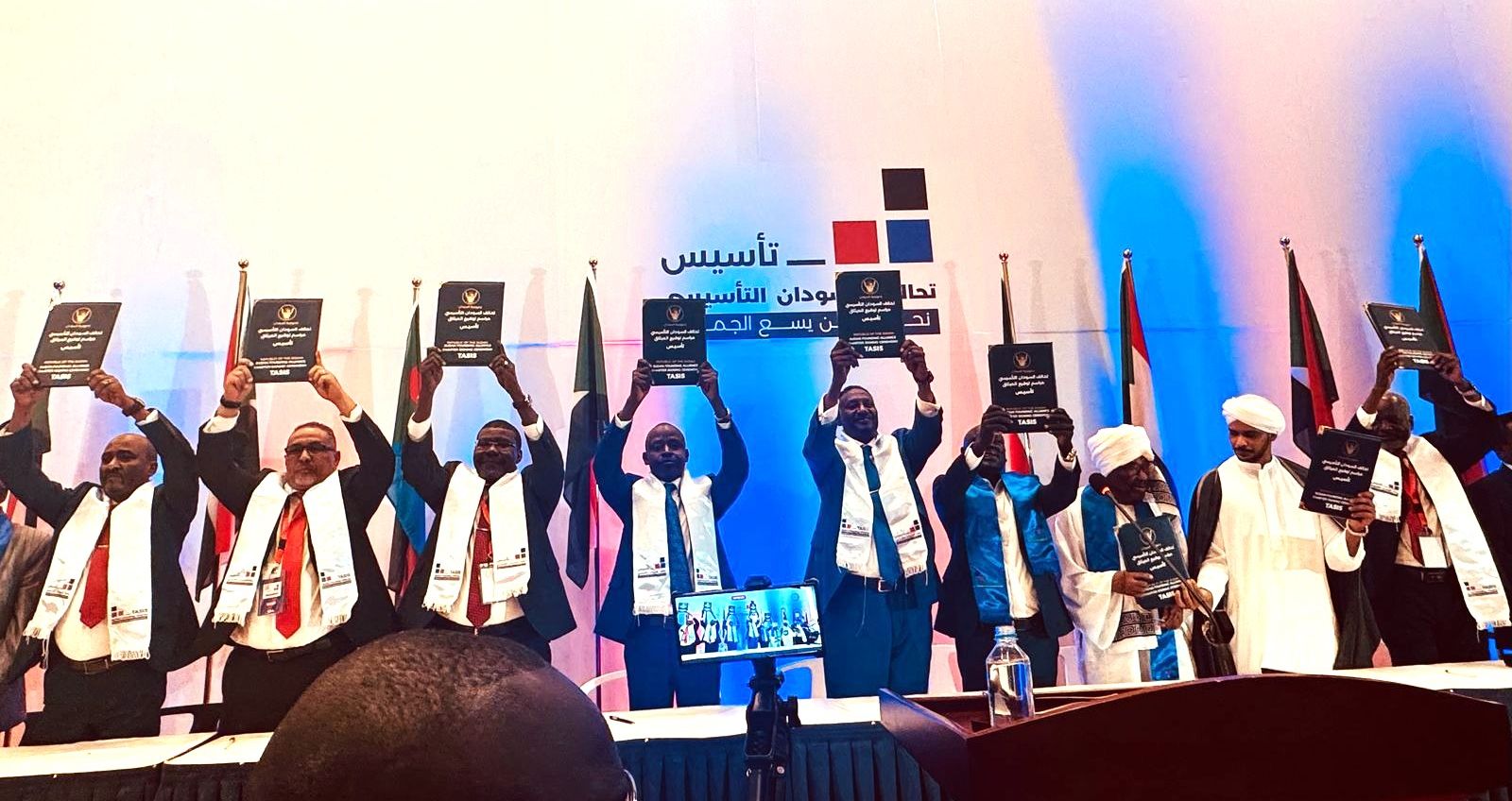
Sudan’s RSF and allies sign charter in Nairobi to pave way for rival government
Sudan’s Rapid Support Forces (RSF) and its allied political and armed groups have signed a charter in Nairobi Kenya, to establish a “Government of Peace and Unity” aimed at governing the territories under their control. The signing took place on Saturday, following extensive consultations and postponements, according to signatories al-Hadi Idris and Ibrahim al-Mirghani.
Among the signatories is Abdelaziz al-Hilu, a prominent rebel leader who commands vast territory and forces in South Kordofan. Al-Hilu has long advocated for secularism in Sudan, a contentious issue in the country’s ongoing political struggle. The charter’s signatories emphasized that the new political formation seeks to end the war and bring stability to the war-ravaged nation.
The newly announced government will be structured into three key bodies: a Sovereignty Council, a Council of Ministers, and a legislative body representing Sudan’s diverse population. The official declaration of this government is expected to take place within Sudan in the coming days.
The RSF and its allies insisted that the government is not intended to divide Sudan but to unify it, citing the failure of the army-aligned government operating from Port Sudan to end the ongoing conflict. The RSF and Sudanese Armed Forces (SAF) have been locked in a brutal war since 2023, leading to a severe humanitarian crisis that has driven millions into hunger and displacement.
Kenya has defended its role in hosting the RSF-led delegation, citing its long-standing tradition of conflict mediation in Africa. Prime Cabinet Secretary and Cabinet Secretary for Foreign and Diaspora Affairs, Musalia Mudavadi, emphasized that Nairobi’s role is neutral and aimed at fostering peace in Sudan.
“When Kenya offers this space, it is without any ulterior motives,” Mudavadi stated, referencing Kenya’s past involvement in peace agreements, including the Machakos Protocol of 2002 that helped end Sudan’s Second Civil War.
He further reassured that Kenya remains committed to working with regional organizations such as the African Union (AU) and the Intergovernmental Authority on Development (IGAD) to support Sudanese-led peace efforts. He also highlighted previous Sudanese peace negotiations held in Juba and Addis Ababa, which, despite not yielding conclusive agreements, set a precedent for such engagements.
However, Sudan’s army-aligned government has strongly opposed Kenya’s role, calling the meeting an “act of hostility.” The Sudanese government accused Kenya of undermining Sudanese sovereignty by allowing the RSF and its allies to hold talks in Nairobi, especially ahead of the announcement of a parallel government.
The RSF, on the other hand, remains optimistic. In a statement on Tuesday, the group expressed gratitude to Kenya for providing a neutral platform and confirmed that a draft constitution outlining the structure of Sudan’s transitional government had been agreed upon by all stakeholders.
General Mohamed Hamdan Dagalo, the leader of the RSF, remains a controversial figure. Earlier this year, the U.S. imposed sanctions on him, citing allegations of human rights abuses, including genocide. However, his supporters view this new charter as a pathway to rebuilding Sudan after years of military rule and conflict.
As Sudan faces mountinghe establishment of the Sudanese Peace Government in Nairobi marks a significant turning point. Whether it will lead to lasting stability or further deepen divisions remains to be seen as the international community watches closely