


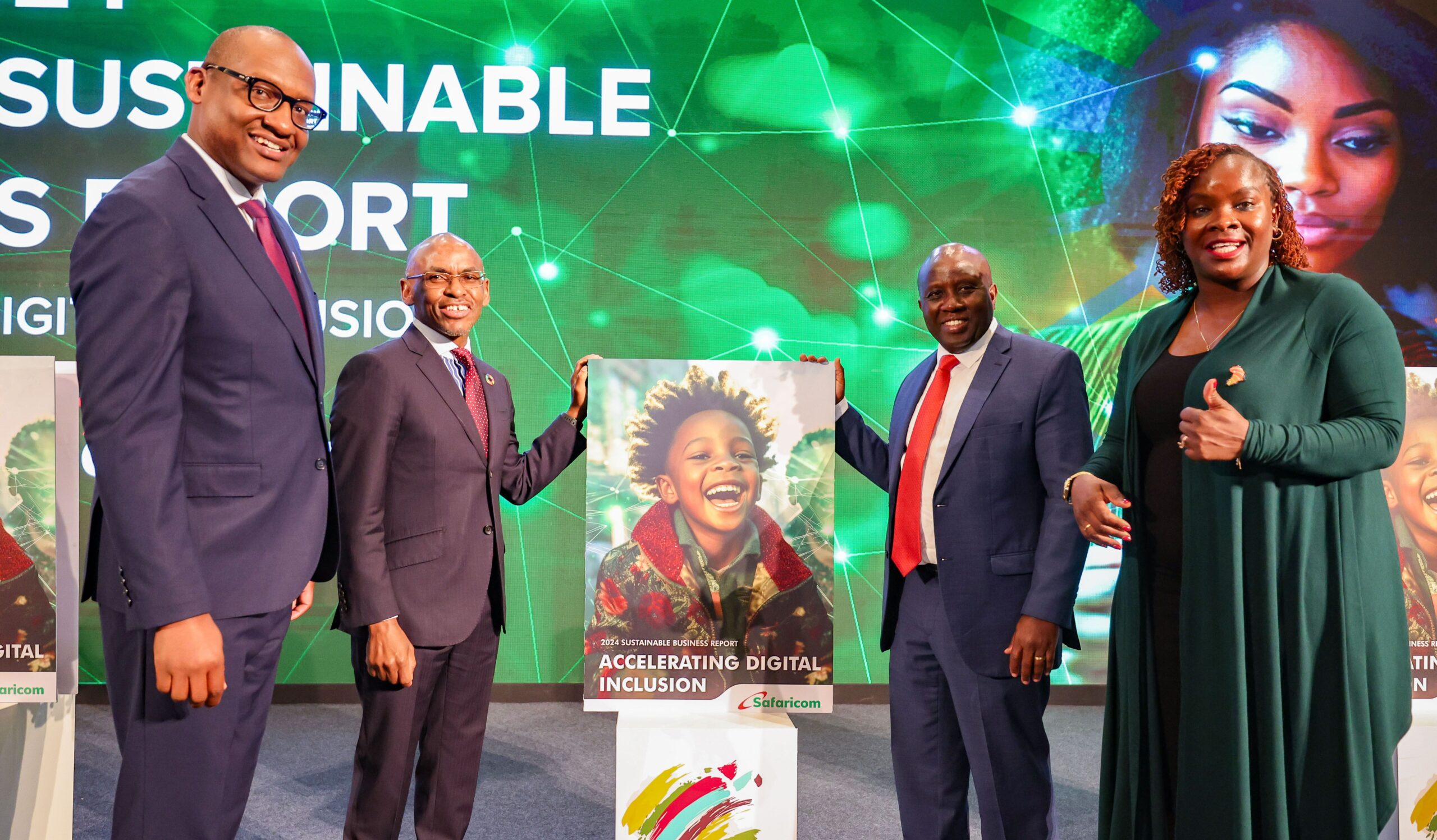
Acting Chief Corporate Affairs Officer at Safaricom, Fred Waithaka, Safaricom PLC CEO Peter Ndegwa, Eng. John Tanui Principal Secretary at Ministry of Information, Communications and the Digital Economy and Karen Basiye, Director, Sustainable Business & Social Impact Safaricom PLC during the launch of Safaricom’s 2024 Sustainable Business Report.
Safaricom, Kenya’s leading telecommunications company, has announced a remarkable contribution of KES 983 billion to the Kenyan economy, underscoring its critical role in digital and financial transformation. The figures, highlighted in Safaricom’s 13th Sustainable Business Report, celebrate the company’s ongoing impact on the country’s socioeconomic fabric, with over 1.28 million jobs sustained in the past financial year.
Themed “Accelerating Digital Inclusion,” the report reinforces Safaricom’s dedication to fostering connectivity, financial inclusion, and sustainable practices. With a vision to become Africa’s foremost purpose-led technology company by 2030, Safaricom is advancing its environmental, social, and governance (ESG) principles, driven by innovative technologies.
Safaricom’s operations generated KES 562.2 billion in economic value last year, while M-PESA, its revolutionary mobile money platform, contributed KES 348 billion in social value. The platform, which has reshaped how Kenyans transact and manage their finances, impacts millions of lives, from customers to agents and dealers. M-PESA’s role in increasing financial inclusion is profound, now enabling over 30 million Kenyans to access secure, cashless services.
The company’s community initiatives through the Safaricom and M-PESA Foundations have impacted over 8 million Kenyans, focusing on healthcare, education, and economic empowerment. The company has also made strides in gender diversity, with women now making up 42.4 percent of its leadership team.
Safaricom has made sustainability a cornerstone of its operations, with CEO Peter Ndegwa noting that the company’s transition to a tech company (TechCo) by 2030 will unlock new opportunities to serve evolving community needs. As part of this commitment, Safaricom secured a KES 15 billion Sustainability Linked Loan (SLL) with several banks, earmarked to support key ESG initiatives, including carbon neutrality and social equality goals.

The company’s commitment to green energy is evident, with more than 1,400 sites now using solar and hybrid clean power. In Ethiopia, where Safaricom has expanded operations, 84 of its sites are solar-powered, contributing to the country’s clean energy efforts.
Safaricom’s sustainable business practices align with nine of the United Nations’ 17 Sustainable Development Goals. These initiatives include extensive tree-planting efforts, achieving 50 percent gender parity, and implementing a circular economy with a 100 percent recycling/refurbishing rate of 290 tonnes of electronic waste last year. In Ethiopia, Safaricom has also provided employment opportunities for women with disabilities in partnership with local social enterprises.
“By embracing SDGs and putting purpose before profit, we have positioned ourselves as a catalyst for empowerment and opportunity,” said Adil Khawaja, Safaricom’s Chairman. “Our commitment is to drive positive change and lasting value across Kenya and Ethiopia.”
Safaricom’s technological reach covers more than 99 percent of Kenya’s population, with infrastructure advancements in 5G in 43 of 47 counties. This commitment to connectivity and digital inclusion has been a game-changer, allowing 22 million Kenyans access to affordable funds through platforms such as the Hustler Fund and Women Enterprise Fund.
As it looks to the future, Safaricom aims to achieve a 50:50 senior management gender parity by 2025 and become a net-zero carbon-emitting company by 2050. The company’s ambitious plans, now 24 years strong, continue to lead Kenya and East Africa towards a more inclusive and connected digital future.