

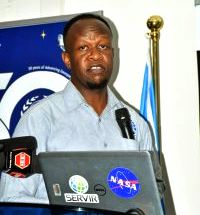
Kenneth Kasera, the User Engagement Manager at RCMRD, speaking during a media breakfast ahead of 50th anniversary on Friday 13th, 2025 in Nairobi
As it marks 50 years of transformative work in geospatial technology, the Regional Centre for Mapping of Resources for Development (RCMRD) is calling on the media to help amplify its role in shaping sustainable development across Eastern and Southern Africa.
Speaking during a media breakfast briefing held on Friday ahead of the Centre’s golden jubilee celebrations, Kenneth Kasera, the User Engagement Manager at RCMRD, emphasized the critical role of Earth observation data in modern governance.
He noted that the Centre leverages satellite imagery to provide governments with accurate information that supports planning in sectors such as land management, agriculture, water resources, and disaster preparedness.
“RCMRD utilizes Earth observation information to support decisions on planning, water, agriculture, and land management.Our data helps identify features like roads, forests, and buildings, enabling more effective use and conservation of resources,” Kasera said.
RCMRD serves 20 member states with a combined population of over 500 million people. Over the decades, the Centre has grown into a continental leader in geospatial research, satellite data application, and technical capacity building.
Kasera highlighted that one of the Centre’s key strengths lies in its ability to support early warning systems for disasters. Through sophisticated models that analyze rainfall and other parameters, RCMRD can predict the likelihood and location of floods, droughts, and other hazards.
“When climate variability occurs, our data helps assess the extent of damage, identify vulnerable communities, and estimate response costs,” he said. “This enables governments to act faster evacuate people, allocate resources, and protect livelihoods before disasters strike.”
The media breakfast briefing was part of RCMRD’s broader effort to engage journalists and strengthen partnerships with the press. Kasera acknowledged that the Centre’s work is often technical and underreported, making media collaboration crucial for public awareness.
“We rarely get the opportunity to engage directly with the media. Today’s session allows us to explain what we do, who we serve, and how our work benefits Kenyans and other member states,” he noted.
RCMRD’s 50th anniversary celebrations will include a series of activities and forums aimed at highlighting its legacy, current projects, and strategic direction for the future. The Centre also hopes to use the occasion to reaffirm its commitment to supporting data-driven policies for sustainable development across the Africa.
“As we celebrate five decades of geospatial excellence, we also look to the future towards even more innovative tools and stronger collaboration with governments, institutions, and media stakeholders,” Kasera added.