


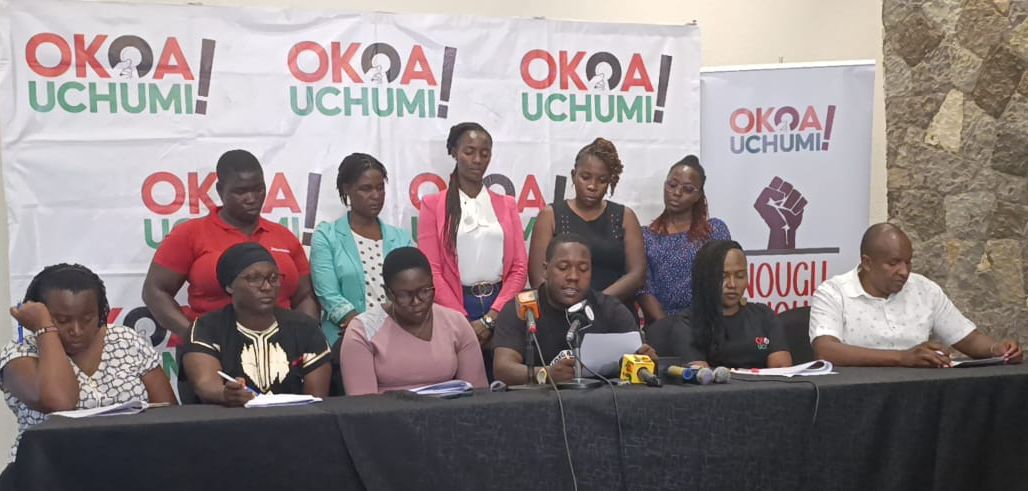
The Okoa Uchumi campaign, a coalition of civil society organizations and concerned citizens, has urged the government to listen to the people and adhere to constitutional principles in managing Kenya’s public debt crisis. Speaking at a press briefing, the campaign warned against unchecked government spending and called for a forensic audit of public debt through legally mandated institutions.
The campaign, which has received strong backing from Gen Z activists and the wider public, condemned President William Ruto’s recent assent to the Appropriation Bill, arguing that it directly contradicts the will of the people. According to Daniel Ndirangu from the Institute of Public Finance (IPF), the government is committing the nation to unsustainable expenditure.
“Gen Zs and Kenyans are demanding that we live within our means! President Ruto’s assent to the Appropriation Bill is a betrayal and insult to the public. His actions are tantamount to signing off expenditures that Kenyans had firmly rejected,” Ndirangu stated.
He further warned that Kenya is heading toward a spending deficit of more than Ksh. 1 trillion in the 2024/25 financial year, which would likely be converted into additional public debt, placing a heavy burden on future generations.
The campaign accused the government of attempting to amend the Appropriation Act through a supplementary budget, a move they claim is unconstitutional. Okoa Uchumi argued that such an amendment would go against Article 223(1) of the Constitution, which outlines strict conditions under which unappropriated funds can be spent.
TISA Executive Director Diana Gichengo emphasized the need for adherence to the rule of law, stating, “The continued insistence on using a supplementary budget to amend the Appropriation Act must cease. This is a grave violation of budgetary expenditure laws, and we demand redress.”
Furthermore, Okoa Uchumi criticized the government’s handling of county funds, pointing out that the national government continues to approve its own expenditures while delaying allocations to counties responsible for essential public services.
The campaign also raised concerns over President Ruto’s establishment of a Presidential Task Force on Forensic Audit of Public Debt, citing constitutional violations. They argued that auditing public debt falls exclusively under the mandate of the Auditor General, as stipulated in Article 229 of the Constitution.
Michael Oduor from the Kenya Youth Parliamentary Association (KAYPAT) said, “Mr. President, you have no power to appoint a task force to audit public debt; that authority belongs to Parliament and the Office of the Auditor General.”
Okoa Uchumi called on Parliament to exercise its oversight powers under Article 211 of the Constitution and formally request a forensic and performance audit of all public debt acquired since the 2010 Constitution was promulgated. They demanded that the Auditor General be granted the necessary resources to conduct a thorough review and provide findings to Parliament and the Kenyan people.
Beyond the issue of debt, the campaign also highlighted the government’s failure to combat corruption, illicit trade, and money laundering, which continue to drain national resources. According to the Ethics and Anti-Corruption Commission (EACC), Kenya loses Ksh. 608 billion annually to corruption—equivalent to 7.8 percent of the country’s GDP.
Okoa Uchumi expressed frustration over the withdrawal of corruption cases and the reluctance to prosecute those implicated. “We demand that the ODPP, EACC, Judiciary, and ARA fast-track the prosecution of corruption cases. Prosecutors who mishandle public interest cases must also be sanctioned and debarred,” stated Oduor.
The coalition outlined a series of urgent demands aimed at addressing Kenya’s fiscal crisis:
Parliament must enact a new appropriation law that aligns with the people’s wishes and follows constitutional guidelines, preferably through zero-based budgeting.
A forensic and performance audit of all public debt acquired since 2010 must be conducted by the Auditor General. Parliament should provide clear terms of reference and necessary resources.
Budget allocations must be reduced further by Ksh. 119.5 billion, in addition to the Ksh. 177 billion already proposed by the President, to ensure responsible spending.
Unconstitutional expenditures such as the National Government Constituencies Development Fund (NGCDF), National Government Affirmative Action Fund (NGAAF), and payment of non-essential advisors must be scrapped.
The presidential task force on debt audit must be disbanded, and the audit must be undertaken by the legally mandated institutions.
Counties must receive adequate revenue allocations in line with the principles of devolution.
Corruption cases must be expedited, and legal reforms should be implemented to enhance accountability in public finance management.
Okoa Uchumi emphasized that the government must not ignore public outcry over reckless spending and corruption. The campaign insisted that Kenya’s economic future depends on strict adherence to fiscal discipline and the Constitution.
“The government must not sacrifice prudent and responsible expenditure on the altar of political convenience. We demand transparency, accountability, and respect for the rule of law,” Okoa Uchumi declared.
With public debt levels soaring and economic hardships increasing, the coalition has vowed to continue its advocacy, ensuring that Kenyan leaders uphold financial integrity and prioritize the welfare of citizens over political interests