


As pre-season showers usher in Kenya’s long rains, farmers across the country prepare for another planting cycle. Among them are thousands of women entrepreneurs who play a critical role in sustaining the nation’s food systems.
From farms to aggregation centres and processing facilities, women remain central to agricultural production, rural livelihoods, and food security. However, many still face structural barriers that limit their participation in higher-value segments of the agri-food value chain.
For many women-led businesses, the biggest challenge is not ambition or innovation, but access to affordable finance, structured markets, and the technical support required to grow sustainable enterprises.
Addressing the Financing Gap
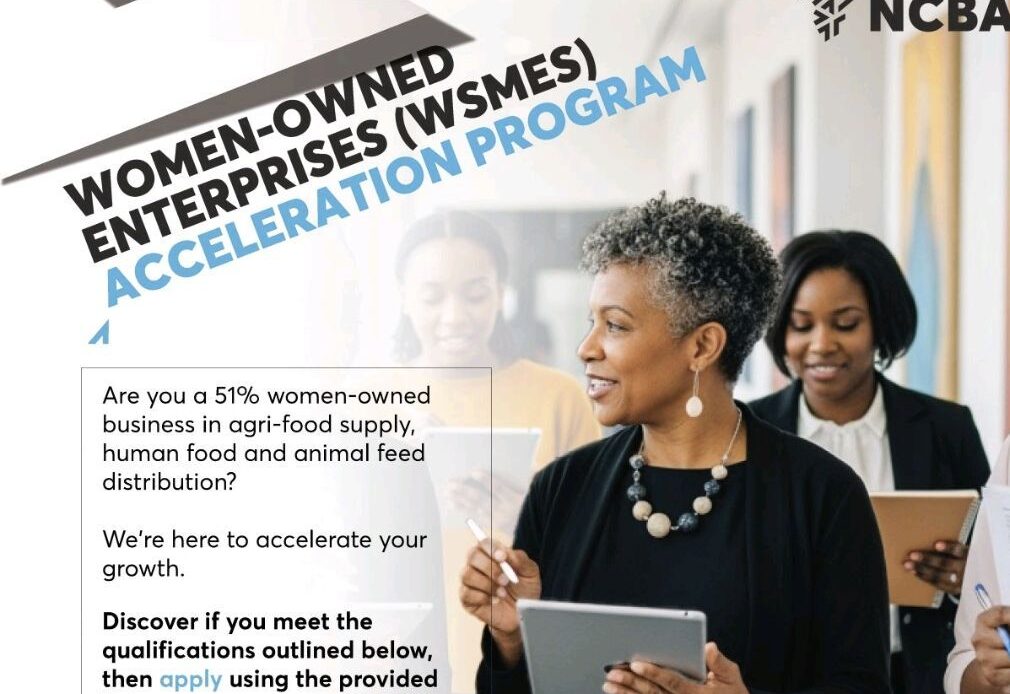
Recognizing this gap, NCBA Group has partnered with African Guarantee Fund under the African Development Bank Group-led Affirmative Finance Action for Women in Africa (AFAWA) initiative to support women-owned small and medium enterprises (WSMEs) operating in the agri-food sector.
The NCBA–AFAWA WSMEs Acceleration
Program aims to move beyond conventional lending by building an ecosystem that combines financing, capacity building, and market access for women entrepreneurs.
The renewed partnership builds on earlier collaboration between NCBA and the African Guarantee Fund in 2025, which unlocked more than KES 17 billion in lending through a risk-sharing facility. The program supported over 700 SMEs and helped create or sustain more than 7,000 jobs, including 2,200 opportunities for women.
Doubling Lending Capacity for Women
Entrepreneurs
Under the expanded programme, lending capacity for women and youth entrepreneurs has doubled from KES 1.5 billion to KES 3 billion. The initiative targets more than 80 women entrepreneurs across two cohorts, while aiming to unlock USD 5 million in financing and create at least 300 new jobs.
Since its launch in October last year, NCBA has already facilitated over KES 747 million in loans to women-led enterprises, signaling growing momentum for inclusive financing in Kenya’s agricultural sector.
Moving Beyond Traditional Lending
Unlike traditional lending models that often exclude informal businesses, the programme uses blended credit and partial guarantees to reduce risk while expanding access to financing.
Women entrepreneurs participating in the initiative also benefit from mentorship and tailored advisory services covering financial management, agribusiness value chains, climate risk management, and market opportunities.
The programme further provides space for strategic engagement on issues such as special economic zone opportunities, long-term business planning, and resilience-building within evolving market conditions.
Building Future-Ready Women Entrepreneurs
According to NCBA, the programme is designed not just to provide capital, but to nurture resilient and competitive businesses capable of scaling sustainably.
By pairing finance with technical support and mentorship, the initiative seeks to address both financial and structural barriers that have historically constrained women entrepreneurs.
The bank has also committed to channel at least 30 per cent of its procurement spending to women and youth, widening economic participation and strengthening inclusive supply chains.
Agriculture’s Role in Kenya’s Economic Growth
Agriculture remains one of Kenya’s most strategic sectors, contributing significantly to GDP, employment, and export earnings. Strengthening the agri-food ecosystem is therefore critical for improving food security, stabilizing inflation, and boosting rural incomes.
However, systemic challenges such as limited land ownership, collateral constraints, and high levels of informality continue to lock many viable women-led enterprises out of traditional lending systems.
Investing in Women for Long-Term Impact
Through the NCBA–AFAWA partnership, financial institutions are increasingly recognizing women-owned enterprises not as high-risk borrowers but as high-potential drivers of economic growth.
Experts say that when women gain access to finance, markets, and training, the benefits extend far beyond individual businesses to households, communities, and entire value chains.
NCBA explains that this is not merely a capital channeling programme but it is a way of nurturing women’s business that are resilient and competitive to scaling them sustainably.
The programme, by harmonising finance, technical support, and mentorship, aims at making women entrepreneurs without the financial backing the main focus of the changes.
Another way the bank is investing in the most vulnerable groups is by devoting at least 30 per cent of its purchasing money to women and youth. This is in addition to efforts very much connected to economic participation and inclusive supply chains.
However, due to structural inequalities, women- led enterprises face difficulties when it comes to acquiring land, finding collateral, and also the fact that they operate mostly in the informal sector makes it harder for them to get financial institution lending.
Women Empowerment Leads to Larger Socio, Economic Benefits
Since the NCBA-AFAWA collaboration, many financial institutions no longer perceive female, owned enterprises as high risks but as agents of economic growth.
According to studies, enabling women’s participation in business through access to finance, markets, and skills development results in a ripple effect that goes beyond the individual businesses to households, communities, and value chains.