


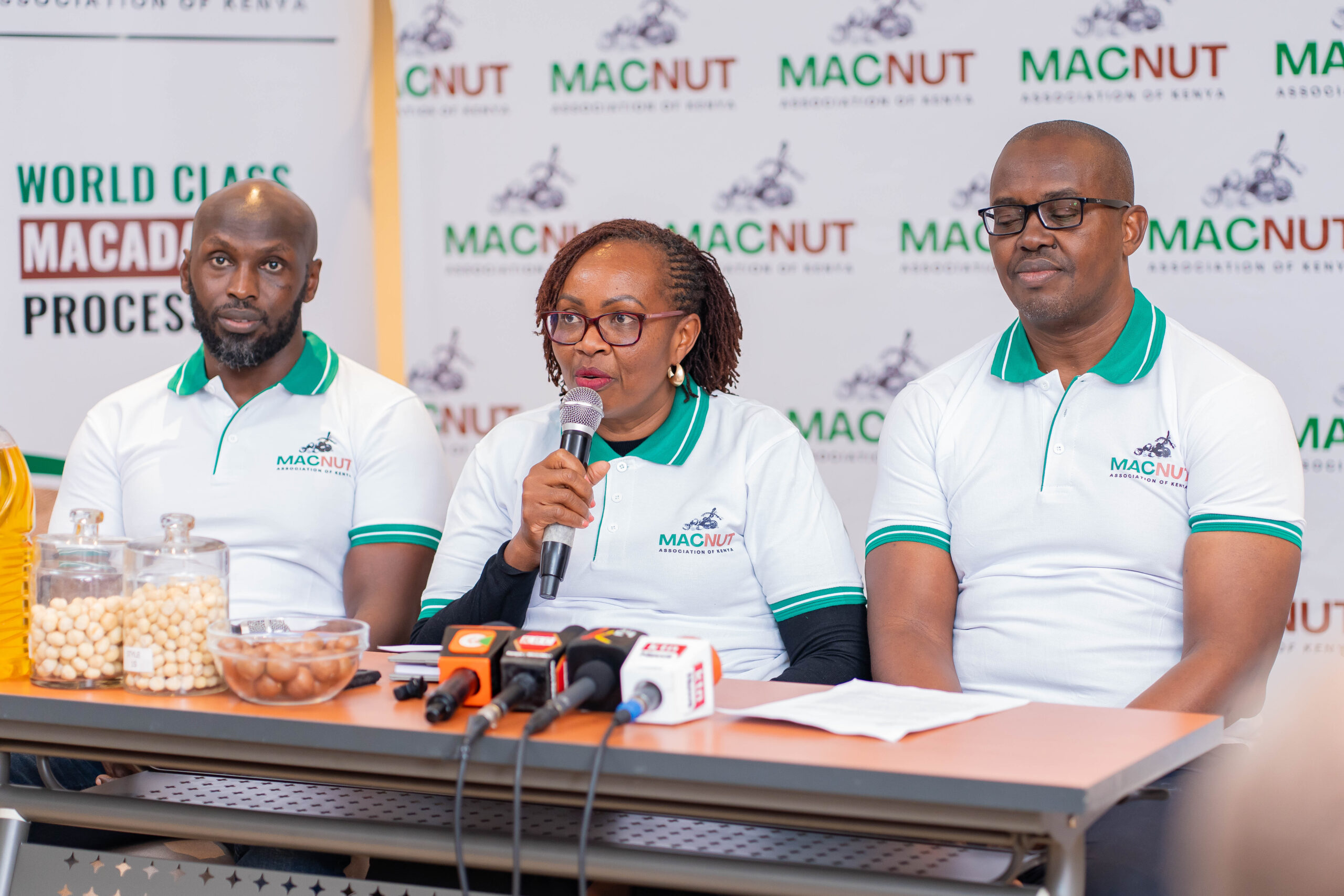
The MACNUT Association, a key representative of Kenya’s macadamia nut processing sector, has issued a pressing call to the Government of Kenya and the Ministry of Agriculture to address severe challenges faced by local processors due to the direct export of raw, unprocessed macadamia nuts.
The practice, which was intended as a temporary measure in 2023, has led to substantial financial losses for processors, farmers, and significant job layoffs.
The government’s recent approval of the direct export of raw macadamia nuts has predominantly benefitted Chinese exporters, who have increasingly purchased nuts through brokers. These traders focus on grafted nuts, which make up 50 percent of Kenya’s crop, neglecting the indigenous varieties that local processors also purchase for value addition. This shift has notably diminished farmers’ incomes, as the nut-in-shell market favors grafted nuts while Kenyan processors support both types for processing.
The impact on Kenya’s economy has been significant. For instance, the total export revenue from macadamia kernels reached KES 3.3 billion by July 2024, but this figure could have been higher if more nuts were available for processing. Before the new policy, processed kernels contributed KES 6.9 billion to Kenya’s revenue.
The current policy has led to revenue losses exceeding $50 million—$20 million from raw nut exports and $30 million from post-harvest losses. The decline in local processing and exports has also reduced government tax income.
Local processors have reported financial setbacks exceeding 50 percent in the past year, leading to closures and debt. The industry has already seen over 5,000 job losses in the first half of 2024, with projections indicating a potential loss of 30,000 jobs by mid-2025. This situation endangers over 50,000 livelihoods reliant on the macadamia processing sector.
Farmers are also suffering, selling their produce at about 30 Perce lower prices. The scarcity of quality nuts for kernel markets has led to increased production costs as lower-quality nuts are mixed with higher-quality ones and sent to local processors. Additionally, Chinese buyers are using X-ray machines to reject inferior nuts, further affecting farmers’ incomes.
The MACNUT Association has highlighted the negative environmental impacts of the policy. Local processors use macadamia nut shells as a sustainable energy source, while new exporters are relying on wood for drying processes, which is environmentally unsustainable.
The direct export policy has also strained Kenya’s relationships with key buyers in the US and Europe, leading to a loss of market share and long-established trade connections. Kenya’s share of the global kernel market has fallen from 13 percent, jeopardizing the country’s position in international markets.
In response to these issues, the MACNUT Association is advocating for re-evaluation and reinstatement of the ban on raw macadamia nut exports to protect the industry and maintain export quality.
Farmer education initiatives to better understand market dynamics and secure fair compensation.
The Association call on Government incentives to boost local processing investments and enhance global competitiveness. The establishment of quality standards for both raw and processed nuts to preserve Kenya’s reputation for excellence.
Additionally the promotion of sustainable agricultural practices to ensure long-term viability for farmers and environmental sustainability was another burning issue, MRegular consultations with stakeholders to address ongoing challenges.
Mrs. Jane Maigua, Chairperson of the MACNUT Association, emphasized the urgency of the situation: “Our local macadamia nut processing industry is on the brink of collapse due to the direct export of raw unprocessed nuts to China. We are losing our competitive edge in the global market, and the livelihoods of thousands of Kenyans are at stake. We urge the government to implement policies that support local processors and ensure the industry’s sustainability.”