


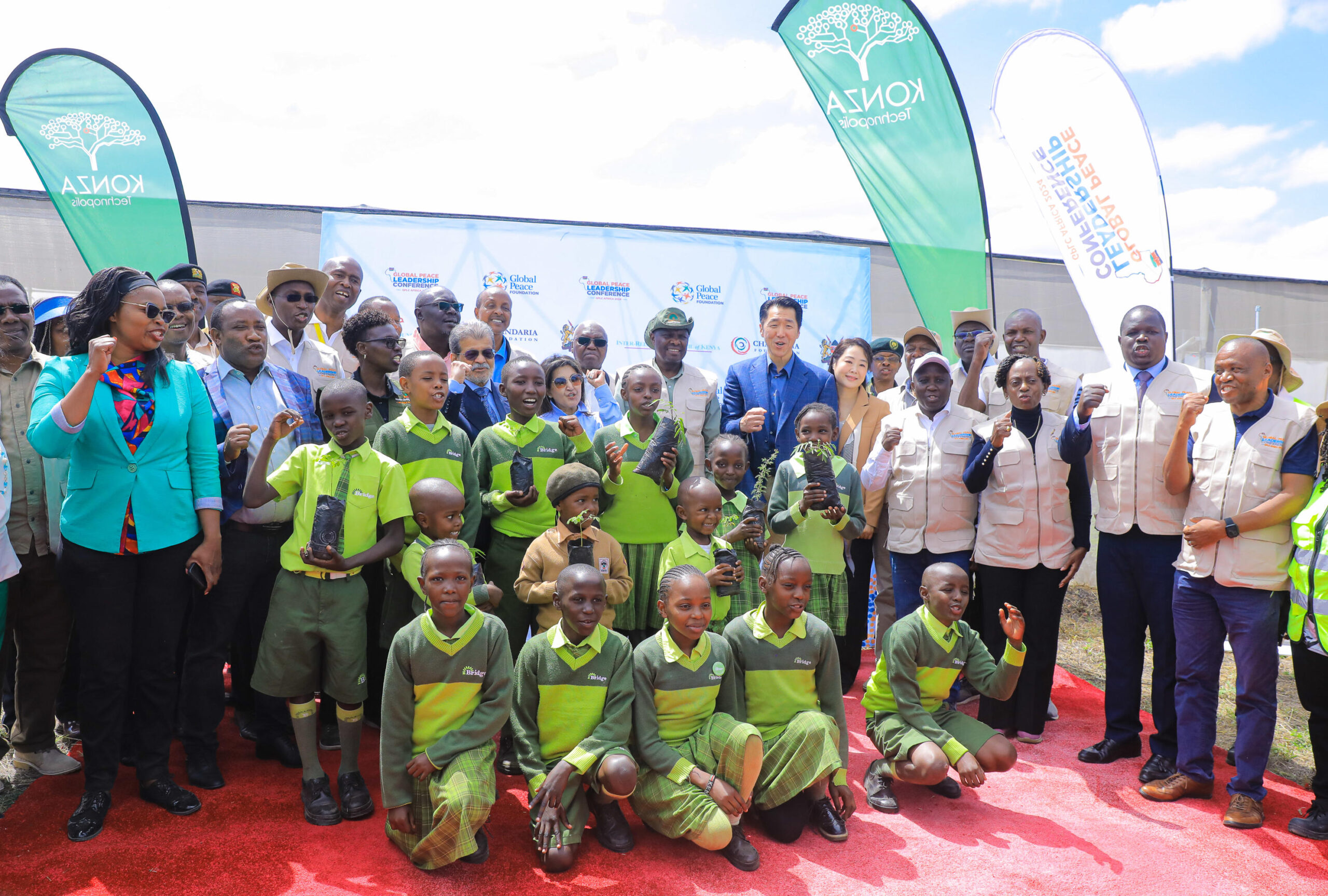
In a significant environmental effort, over 1,000 participants, including primary and high school students, planted 30,000 seedlings at Konza Technopolis in Machakos County this June as part of the Greening Konza Initiative.
The initiative, highlighted during the Global Peace Leadership Conference (GPLC) held in Kenya from June 25-28, underscores a commitment to sustainable development and environmental stewardship. It forms a key component of the broader effort to establish a sustainable ecological future for Konza Technopolis, a technology city currently under construction.
Daniel Juma, Executive Director of the Global Peace Foundation, emphasized the importance of collective action, stating, “Kenyans and Africans, in general, are encouraged to invest in the green transition as part of the continent’s renewal and renaissance story. The ecological future of Africa depends on the active participation and commitment of its people to sustainable practices and environmental conservation.”
 Dr. Hyun Jin Preston Moon, Founder and Chairman, Global Peace Foundation is all smiles after planting a tree seedling at the Chandaria Foundation Tree Nursery located at the Konza Technopolis. He is flanked from the left by John Tanui, Konza Technopolis Development Authority CEO, Priti Chandaria of Chandaria Foundation, Felix Koskei Head of Public Service, M.W Mutie, Kenya Forestry Service and Prof. Raphael Munavu, Chair Konza Technopolis.
Konza City, dubbed Africa’s Silicon Savannah, has allocated 1,200 acres for parks and green spaces, reflecting its commitment to balancing technological growth with environmental sustainability. These green areas are intended to serve as the city’s ecological backbone, enhancing the region’s environmental health.
Gitonga Mugambi, Principal Secretary of the State Department of Forestry, described the initiative as a crucial step towards improving Machakos County’s low tree cover of 2.5 percent. “Each tree that we grow at Konza Technopolis symbolizes hope, growth, and the promise of a better tomorrow. Our objective is to help grow the national tree cover to 30 percent by 2032. For Machakos County, this means we need to grow an average of 290 million trees over the next ten years, or 29 million annually,” he said.
 Felix Koskei, Chief of Staff and Head of Public Service plants a tree at the Konza Technopolis in support of the Greening Konza Initiative during the recent Global Peace Leadership Conference.
Since January 2024, the county has managed to grow 2 million trees, yet it still needs substantial contributions to meet the annual target. The Greening Konza Initiative has attracted various partners to support this ambitious goal. The Chandaria Foundation and Mama Doing Good have pledged to plant 45 million trees at Konza, supporting the Government of Kenya’s target of planting 15 billion trees by 2030.
Dr. Manish Shah of the Earth-keepers Foundation has donated 50,000 bamboo seedlings, known for their rapid growth and adaptability to arid conditions. The Earth-keepers Foundation aims to plant 2 million trees at Konza as part of its broader 1 billion tree campaign across Kenya by 2030. Rotary International has committed to planting 500 million trees by 2030 on 17 acres allocated at Konza, working with the Global Peace Foundation and Chandaria Foundation. iChooseLife has also pledged to plant 1 million trees.
 Gitonga Mugambi, Principal Secretary, State Department of Forestry, demonstrates the process of planting a tree seedling at the Chandaria Foundation Tree Nursery located at the Konza Technopolis. He is flanked from left by Amb. Dr. Josephine Ojiambo of The University of Nairobi, Felix Koskei Head of Public Service, Dr. Hyun Jin Preston Moon, Founder and Chairman. Global Peace Foundation and his wife Dr. Junsook Moon, Chairwoman, Global Peace Women.
A new pilot project between Konza City and the University of Nairobi will establish ethno-botanical gardens to utilize African indigenous knowledge and modern technology for extracting essential oils, potentially enhancing economic development and healthcare.
Despite the progress, challenges remain, as only about 60 percent of tree seedlings currently survive due to issues such as inadequate care and wildlife interference. Dr. Josephine Ojiambo stressed the need for improved strategies to increase seedling survival rates, including better irrigation, protective measures, and community education.
The Greening Konza Initiative illustrates the power of collaborative effort and underscores the importance of environmental conservation in ensuring a sustainable future for Kenya and Africa.