


The Federation of Kenya Employers (FKE) has called for urgent policy reforms to unlock job creation, address the growing dominance of informal employment, and improve Kenya’s investment climate.
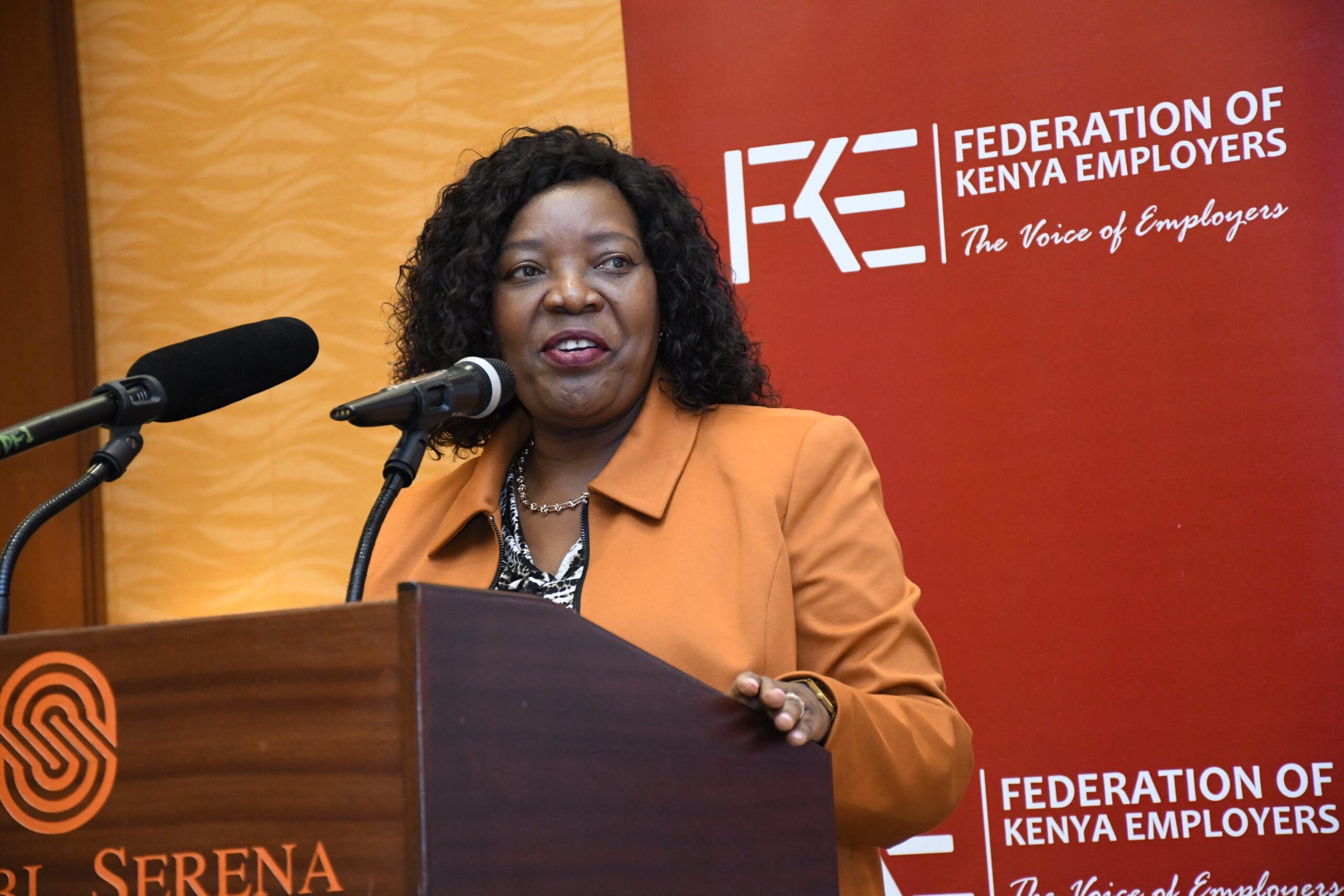
Speaking during FKE’s 66th Annual General Meeting (AGM) held under the theme “Thriving Businesses in a Shifting Environment,” Executive Director Jacqueline Mugo and President Gilda Odera outlined the federation’s positions on wage implementation, economic policy, employment trends, and labour law compliance.
Mugo confirmed that FKE members have implemented the 2024 Minimum Wage Order, which set a 6 percent statutory increase. She noted that the Federation had issued advisories to ensure compliance and was working closely with the Ministry of Labour and Social Protection to address enforcement challenges, especially in the informal sector.
“We are not aware of any non-compliance among our members,” Mugo said. “However, we recognize this is ongoing work, especially as 84 percent of Kenya’s workforce is in the informal sector.”
According to the 2025 Economic Survey, Kenya had 20.8 million employed persons in 2024. Of these, 17.4 million were in informal employment, with only 3.4 million in the formal sector. Worryingly, only 75,000 new formal jobs were created in 2024—down from 123,000 in 2023 and 109,300 in 2022—despite an annual influx of 800,000 to 1.2 million job seekers.
Mugo warned that Kenya risks producing a generation of jobless graduates unless employment growth aligns with educational output. She emphasized the need for policy support to empower enterprises and stimulate job creation, especially in the private sector.
“Employers continue to call for reforms that promote enterprise-led job creation. The mismatch between labour market demand and job creation is a national crisis,” she said.
Feedback on Finance Bill 2025
FKE welcomed several progressive proposals in the Finance Bill 2025, including:
Raising the daily subsistence allowance (DSA) from KSh 2,000 to KSh 10,000,
Exempting gains from traded securities and dividends from companies registered under the Nairobi International Financial Centre (NIFC),
Introducing advance pricing agreements to enhance tax certainty.
However, FKE opposed several provisions, citing risks to business sustainability:
Granting the Kenya Revenue Authority access to personal data and trade secrets,
Imposing a five-year cap on tax loss deductibility,
Removing the 15 percent corporate tax incentive for local motor vehicle assemblers,
Extending tax refund timelines from 90 to potentially 180 days.
“These measures could severely affect business cash flow and undermine investor confidence,” Mugo warned.
FKE President Gilda Odera noted that Kenya’s investment climate is deteriorating. Citing the 2024 World Citizenship Report, she said Rwanda, Uganda, and Tanzania have overtaken Kenya as more attractive destinations for high-net-worth individuals.
“This is unprecedented. Kenya has always led the region,” she said, attributing the shift to policy unpredictability, rising costs of doing business, and a loss of trust in institutions.
She also highlighted the burden on employers from statutory levies like the 1.5 percent Housing Levy and 2.5 percent SHIF deductions, which have contributed to redundancies and operational difficulties
Odera reiterated FKE’s support for tripartism—the collaborative governance model between government, employers, and workers—as key to maintaining industrial harmony. “It is the bedrock of productivity and social stability,” she said.
On global labour matters, Mugo confirmed that FKE will lead Kenya’s delegation to the upcoming International Labour Conference (ILC) in Geneva. Discussions at the ILC will focus on platform work and biological hazards, with Mugo cautioning against blanket assumptions that platform workers always have employer-employee relationships.
FKE also voiced support for the ratification of ILO Conventions C189 and C190, which promote decent work for domestic workers and eliminate workplace violence and harassment, respectively. However, Odera stressed that the process must be consultative and align with national legal frameworks.
“We support these conventions, but the ratification must reflect Kenya’s context and follow due process,” she said.
The 66th AGM brought together employers from across the country to reflect on labour market trends, conduct statutory business, and elect new board members. Both Mugo and Odera reaffirmed FKE’s commitment to working with the government and other stakeholders to create a more resilient, inclusive, and business-friendly Kenya.
“FKE remains ready and willing to work collaboratively to promote decent work and inclusive growth,” Odera concluded.