


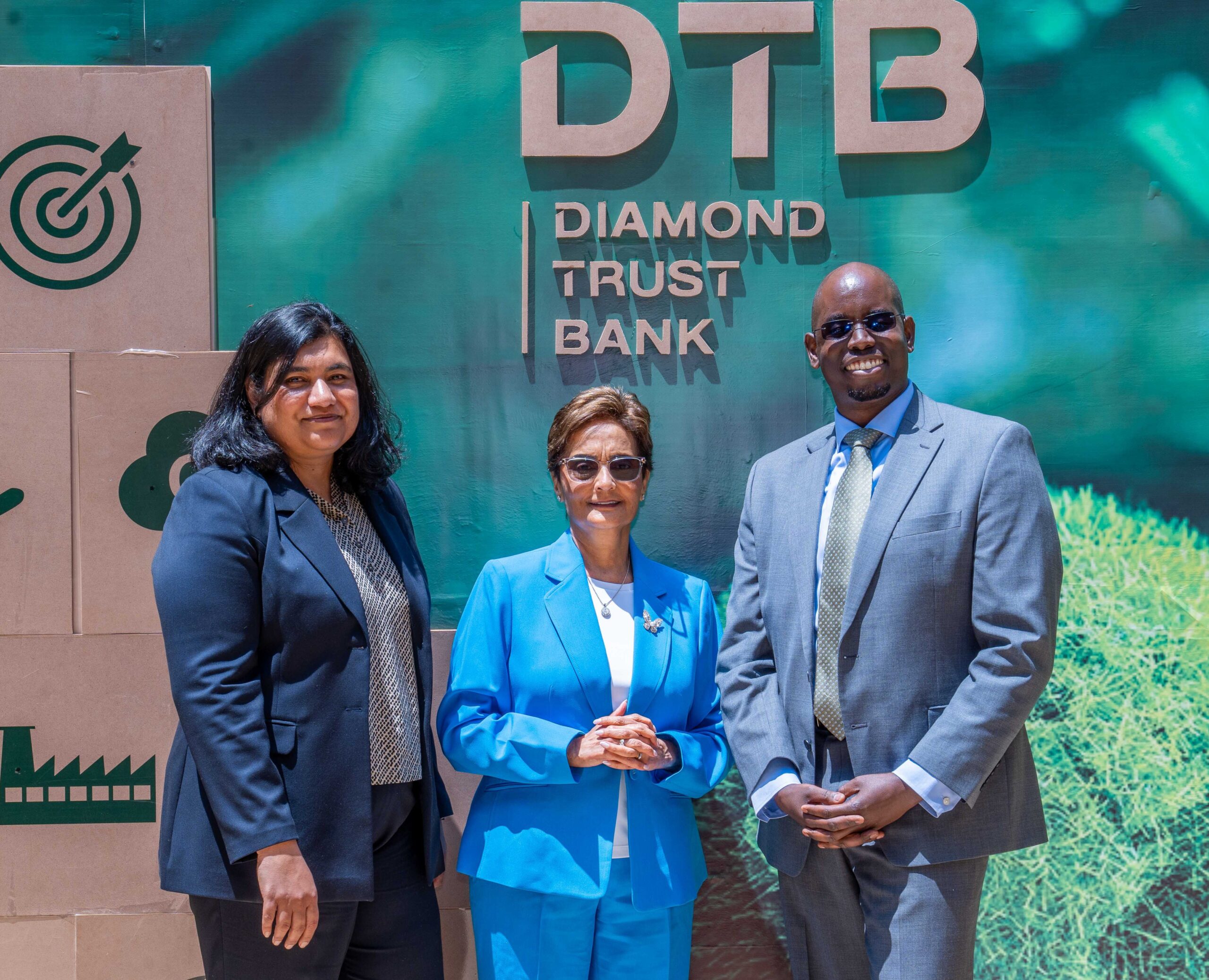
Reshma Shah, Lead Carbon Market FSD Africa (left), Nasim Devji Group CEO DTB (Centre) and Paul Muthaura CEO Africa Carbon Markets Initiative (Right) during the DTB fourth Economic and Sustainability Forum held at Serena Hotel in Nairobi.
Kenya stands on the brink of substantial economic opportunity through its carbon markets, but regulatory delays are hampering progress, speakers at Diamond Trust Bank’s Sustainability and Economic Forum highlighted.
Since becoming the first African nation to enact a Climate Change Act in 2016, Kenya amended the law in 2023 to incorporate carbon markets and issued its first set of regulations in May 2024. However, experts argue that further legislative action is necessary to unlock the potential for billions of dollars in carbon credits.
At the 4th DTB Economic and Sustainability Forum, industry leaders emphasized the urgency of expediting regulatory frameworks to allow financial institutions to establish standards for potential borrowers in the emerging carbon market sector.
Paul Muthaura, CEO of the Africa Carbon Markets Initiative, pointed out that Kenya’s leadership in technology and digital systems could position it as a continental leader in carbon trading. “We now have a fairly solid legal framework. The law is only the first step, and with robust public participation, we can truly live up to our potential,” he stated.
Dr. Jackson Koimburi, head of the Circular Economy and Climate Change at the Kenya Private Sector Alliance, addressed the barriers Small and Medium Enterprises (SMEs) face in accessing the carbon market. He identified several challenges, including lack of awareness and capacity, high transaction costs, regulatory hurdles, and market volatility affecting carbon pricing. These factors have deterred businesses from participating in what he described as a “low-hanging fruit” compared to traditional investment avenues.

From left: Alkarim Jiwa, Finance & Strategy Director at DTB, Reshma Shah, Lead Carbon Market FSD Africa, Nasim Devji Group CEO DTB, Clarice Wambua, Environmental Lawyer & Consultant Cliffe Dekker Hofmeyer and Paul Muthaura CEO Africa Carbon Markets Initiative during the DTB fourth Economic and Sustainability Forum held at Serena Hotel in Nairobi.
“Unscrupulous buyers and high upfront costs are significant deterrents for investors looking to enter the carbon markets,” Dr. Koimburi added.
Clarice Wambua, an Environmental Lawyer and Consultant, underscored the government’s role in facilitating the carbon market’s growth. Following the 2023 amendment, the National Environment Management Authority (NEMA) is designated as the National Designated Authority for carbon trading. However, the effective implementation of the Act depends on the establishment of four additional regulations, including technical infrastructure committees, a national carbon registry, and comprehensive carbon trading regulations.
Wambua noted that while Kenya’s carbon markets have been operational since 2005, the absence of robust regulations has led to complaints regarding revenue sharing with local communities involved in carbon projects.
Reshma Shah, Lead for Carbon Markets at FSD Africa, reported that in 2023, forestry projects accounted for 50 percent of carbon credits issued in Sub-Saharan Africa, while land use represented 40 percent Yet, the region grapples with a complex regulatory environment, verification issues, and initial investment costs that complicate market entry.
The call for streamlined regulations grows louder, with stakeholders emphasizing the need for urgent action to position Kenya as a leader in the global carbon market. The potential for economic growth through sustainable practices remains significant, contingent on effective and swift legislative measures.