

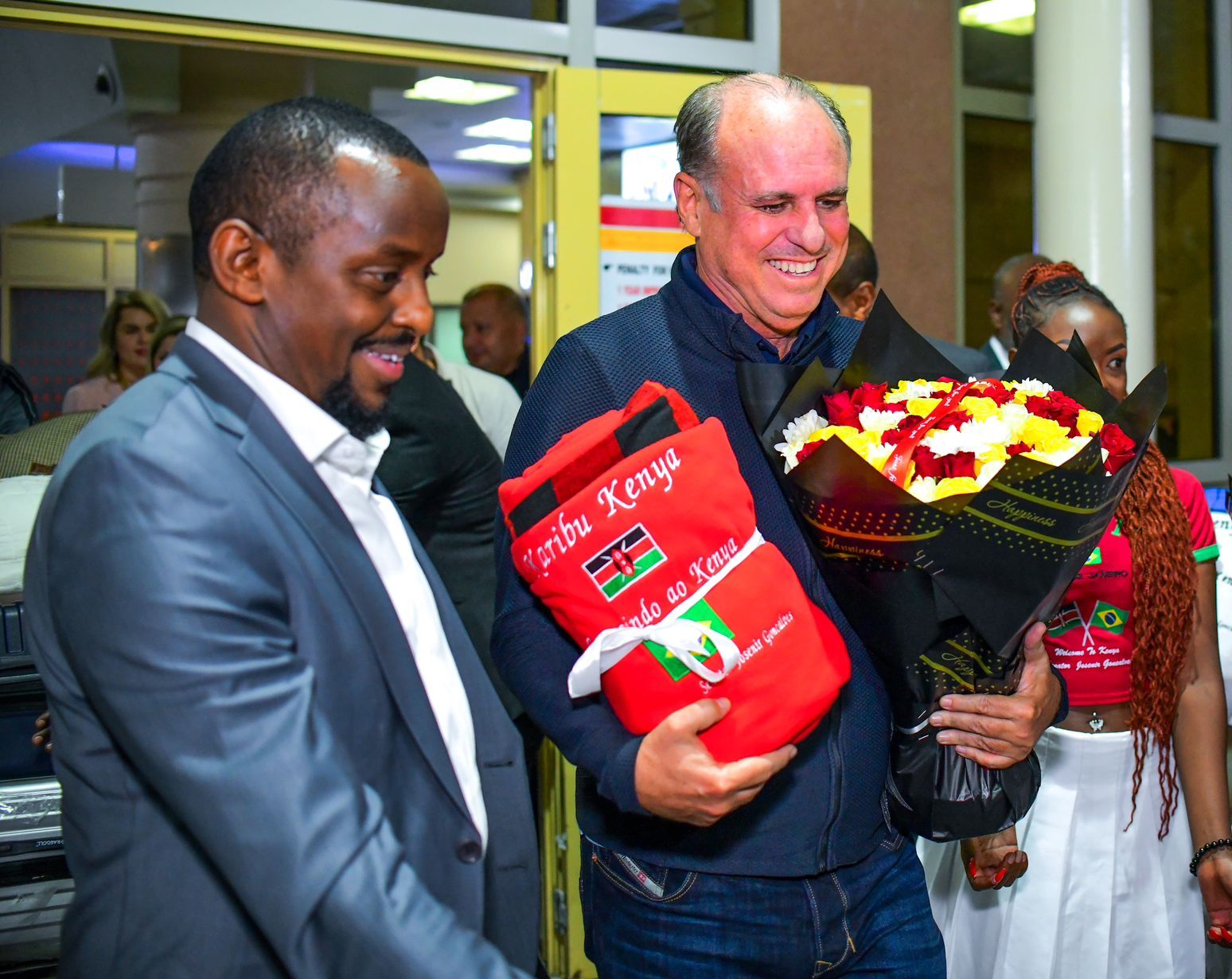
Nairobi businessman James Wanjohi Njoroge has hosted Brazilian Senator H.E. José Gonçalves Oliveira in Nairobi for high-level investment talks poised to reshape East Africa’s economic landscape.
The discussions, centered on a $40 billion investment package in health technology and agriculture, signal one of the most ambitious foreign direct investment (FDI) pursuits in Kenya’s recent history.
Senator Oliveira, who represents Pará—the largest state in Brazil by landmass, exceeding the combined size of Kenya, Uganda, and Tanzania—arrived at Jomo Kenyatta International Airport (JKIA) to a ceremonial reception.
He was received by Hon. Danson Mungatana, Chairman of the African Congress Delegation in South Africa and Senator representing Tana River County, underscoring the diplomatic weight of the visit.
The initiative marks a strategic push by Brazil to expand its footprint across East Africa through high-impact sectors. Wanjohi, a well-known figure in regional trade circles and a dual officeholder at the Kenya National Chamber of Commerce and Industry (KNCCI) and the East African Chamber of Commerce, has been instrumental in strengthening economic bridges between Brazil and the African continent.
“This is more than just diplomacy—it is a blueprint for economic transformation,” said Wanjohi. “Senator Oliveira’s presence in Kenya is a testament to Brazil’s commitment to long-term, meaningful investment. We are looking at partnerships that will generate employment, enhance technology transfer, and boost food security across East Africa.”

The visit comes at a critical moment for Kenya, which is seeking robust investment in health systems and agriculture as part of its Vision 2030 development agenda. Should the deal come to fruition, it would represent one of the largest injections of FDI into these sectors, potentially catalyzing thousands of jobs and elevating the country’s innovation ecosystem.
Senator Oliveira’s agenda in Kenya includes meetings with senior government officials, private sector stakeholders, and development partners. A key highlight of his itinerary will be a courtesy visit to KNCCI President Dr. Eric Ruto, where the talks will delve into health-tech innovation, agribusiness modernization, and the formation of public-private partnerships.
“Africa, and particularly Kenya, represents the future,” said Senator Oliveira. “Our countries share a vision—Kenya with its youth-driven innovation and Brazil with its leadership in tropical agriculture and biohealth technology. Together, we can build something transformative.”
The Senator’s tour will also extend to Uganda next week, reinforcing Brazil’s growing interest in regional economic integration and cross-border development. This broader engagement reflects a shift in Brazil’s foreign policy toward fostering new alliances across the Global South.
Kenya and Brazil offer highly complementary economic profiles. Brazil is a recognized global powerhouse in tropical agritech and public health innovation, while Kenya stands out for its dynamic private sector, thriving digital economy, and fertile agricultural zones.
The proposed investment seeks to capitalize on these synergies, bringing advanced agricultural techniques and health innovations to East Africa while opening new markets for Brazilian technologies and expertise.
The expected outcomes of the deal are expansive: improved healthcare infrastructure through digital and mobile health platforms, enhanced agricultural productivity via mechanization and biotechnology, and the creation of sustainable jobs in both rural and urban areas.

Wanjohi, who maintains close working relationships with both President William Ruto and President Yoweri Museveni of Uganda, has reiterated the strategic significance of the visit. “This engagement could redefine Latin America’s economic relationship with East Africa. We are laying the groundwork for a new era of South-South collaboration—one that is driven by trade, innovation, and mutual prosperity.”
As global observers turn their attention to Nairobi, the $40 billion proposal is being seen as a litmus test for emerging-market cooperation, where developing nations seek homegrown solutions and partnerships beyond traditional North-South paradigms.
If successful, the partnership could become a model for transformative diplomacy, signaling that the future of development lies in horizontal partnerships anchored in shared interests and regional solidarity.