

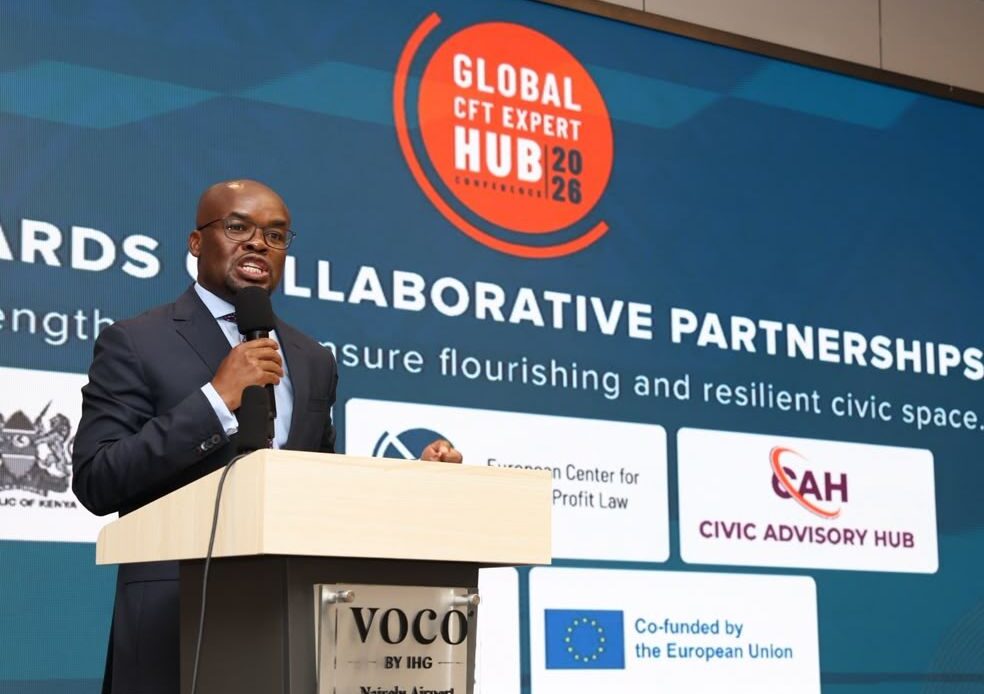
More than 150 international experts have gathered in Nairobi to address a growing challenge in global security: preventing terrorist financing through non-profit organisations without imposing regulations that could restrict humanitarian work and civic freedoms.
The 2026 Global Expert Hub Conference on Anti-Money Laundering and Countering the Financing of Terrorism (AML/CFT) opened on Tuesday, November 17, bringing together security practitioners, government officials, policymakers, financial institutions and civil society representatives.
The three-day conference, running until November 19, is being held under the theme, ‘Towards Collaborative Partnerships that Strengthen and Ensure Flourishing and Resilient Civic Space.’
Its central focus is strengthening international cooperation, sharing emerging insights and developing strategies to disrupt financial networks that sustain terrorism while ensuring legitimate non-profit organisations can continue serving communities.
Supported by the European Union, the conference is co-hosted by the European Center for Not-for-Profit Law (ECNL), Civic Advisory Hub (CAH), Kenya NPO Working Group (KNWG) and Public Benefit Organizations Regulatory Authority (PBORA).

Experts Warn Against Restricting Civic Space in Fight Against Terror Financing
The gathering marks the first Global Expert Hub conference to bring governments, regulators and financial institutions together with civil society organisations from the beginning, providing an opportunity for stakeholders to develop more coordinated approaches to financial oversight.
Speaking during the official opening, Kenya’s Principal Secretary for Internal Security and National Administration, Dr Raymond Omollo, said effective regulation was necessary to protect public benefit organisations rather than frustrate their operations.
“Kenya is committed to meeting international standards in the fight against money laundering and terrorism financing. Effective oversight is not meant to frustrate public benefit organisations. It protects them and the communities they serve,” Omollo said.
He noted that combating terrorist financing required coordinated action, adding that no single institution or country could successfully address the threat independently.
Omollo said Kenya was committed to strengthening inter-agency cooperation, improving supervisory capacity, helping non-profit organisations understand their obligations and engaging constructively with financial institutions and international partners.
Public Benefit Organizations Regulatory Authority Director General Dr Laxmana Kiptoo said the conference came at an important stage in the transformation of Kenya’s non-profit regulatory framework.
He pointed to the operationalisation of the Public Benefit Organizations Act, 2013, on May 14, 2024, as a significant milestone in strengthening governance, accountability and transparency within the sector.
Kiptoo said PBORA was committed to implementing the law in a way that promotes compliance while allowing organisations to undertake legitimate public benefit activities.
Meanwhile, Kodjo Attisso, Coordinator of the Illicit Finance Fusion Center at the United Nations Office on Drugs and Crime (UNODC), emphasised that trust, transparency and dialogue were essential to successful AML/CFT implementation.
He said the agency supported member countries in strengthening financial inclusion and integrity, including within the non-profit sector.
Attisso explained that UNODC helped countries conduct risk assessments and introduce proportionate measures that address financial crime threats without disrupting humanitarian and other legitimate activities.
The agency is also promoting regional collaboration, partnerships and knowledge-sharing to strengthen international responses to money laundering and terrorist financing.
For civil society organisations, the discussions are particularly important because poorly designed financial regulations can create unnecessary barriers for legitimate organisations seeking access to financial services and resources.
Vanja Skoric of ECNL said the Global Expert Hub, established in 2018, had grown to connect civil society leaders and experts from more than 45 countries.
Previous gatherings have been held in The Hague, Vienna, Paris, Haarlem and Johannesburg, with Nairobi extending the initiative’s international cooperation efforts.
“Cross-sector collaboration is difficult but, once achieved, very impactful,” Skoric said.
Yona Wanjala of Civic Advisory Hub said civil society was not opposed to measures targeting money laundering and terrorist financing, acknowledging the importance of transparency, accountability and responsible management of organisational resources.
However, he maintained that security and civic freedoms should not be treated as competing objectives, describing them as mutually reinforcing foundations of stable, accountable and resilient societies.
The conference is expected to strengthen partnerships and advance risk-based approaches that protect financial systems without undermining the work of legitimate non-profit organisations.