


Kenya Pipeline Company Plc (KPC) has reported an 8% increase in profit before tax to KSh17.54 billion for the 2026 financial year, supported by higher petroleum transportation volumes, revenue growth and improved operational efficiency.
The listed petroleum products transportation and storage company recorded a 9% increase in group revenue to KSh43 billion, up from KSh39.5 billion in the previous financial year, as local and transit volumes grew by 7%.
Profit after tax rose 13% to KSh11.58 billion from KSh10.24 billion, reflecting stronger business performance despite volatility in global petroleum prices and supply disruptions linked to the Middle East crisis.
The results, announced on Wednesday, October 14, mark the company’s first full-year financial performance since its privatisation earlier in 2026.
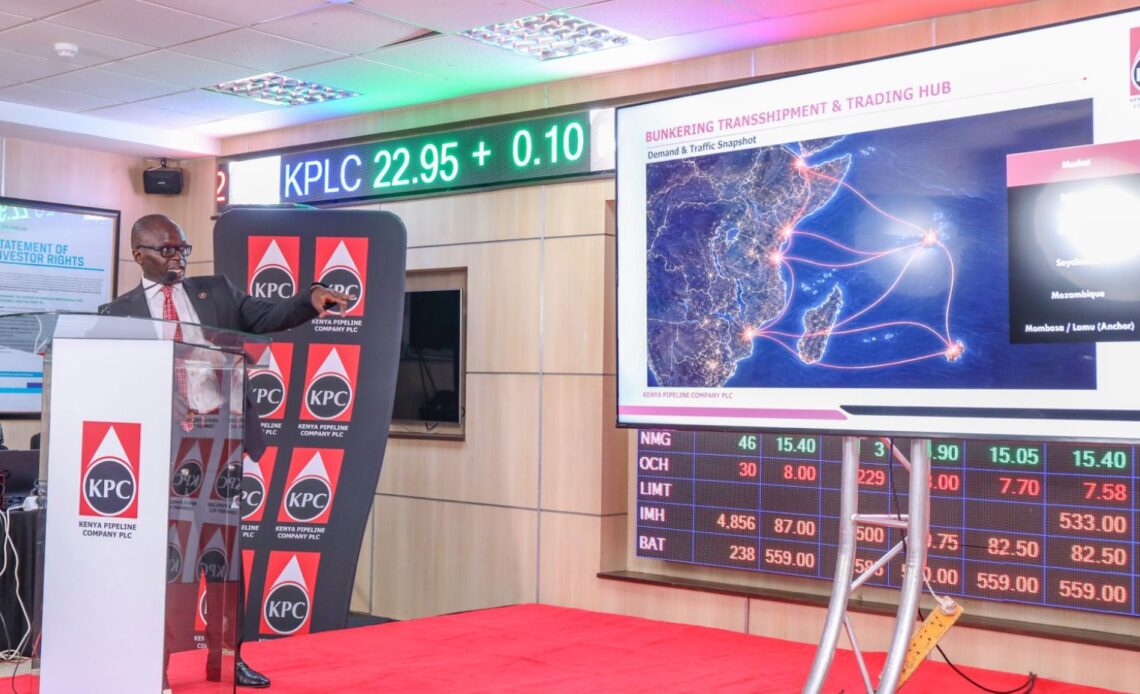
Speaking during the financial results announcement, Acting Managing Director Pius Mwendwa attributed the growth to sustained revenue expansion, better operational efficiency, improved product availability and stronger cash generation from the company’s core business.
“Despite a difficult operating environment characterised by global petroleum prices and supply volatility due to the Middle East crisis, KPC Plc has managed to grow its top line and bottom line while improving operating cost efficiencies,” Mwendwa said.
The company’s cash generation improved significantly during the period, with cash from operating activities increasing 34% to KSh17.39 billion. Cash and cash equivalents at the end of the financial year rose 84.4% to KSh20.54 billion.
KPC’s balance sheet also strengthened, with total assets increasing 6% to KSh149 billion. Shareholders’ equity grew 11% to KSh119 billion, while borrowings declined 83% to KSh442.86 million following debt reduction during the year.
The company operates approximately 1,342 kilometres of pipeline, supported by strategically located storage, pumping and loading facilities that serve Kenya and regional petroleum markets.
Beyond its traditional transportation and storage business, KPC is pursuing diversification initiatives aimed at increasing revenue and strengthening its position as a regional energy infrastructure provider.
Chairperson Faith Bett-Boinett said the board supports plans to establish an integrated petroleum trading hub at the Kenya Petroleum Refineries Limited (KPRL) facilities in Kipevu, Mombasa.
KPRL, a wholly owned subsidiary of KPC, is expected to provide a platform for expanding into additional energy and logistics services.
The proposed Kipevu trading hub will offer transhipment, bulk breaking, bunkering and re-export services to regional markets. The development is expected to help KPC tap into growing demand for petroleum products and emerging opportunities in the regional energy sector.
Bett-Boinett said the company was exploring opportunities beyond pipeline operations, including storage, re-export, liquefied petroleum gas (LPG), liquefied natural gas (LNG), biofuels, power generation and support for third-party petroleum trading operations.
She added that the company’s assets could strengthen national energy security, support regional demand and generate additional revenue streams.
The expansion strategy also includes plans to extend the existing pipeline from Eldoret to Kampala, Uganda, and subsequently to Kigali, Rwanda.
The recent launch of Uganda’s 320 million-litre Kampala Storage Terminal is expected to support KPC’s regional expansion ambitions.
Mwendwa said the company intends to increase annual revenue from the current KSh43 billion to KSh68 billion by the 2030 financial year. However, he acknowledged that petroleum transportation and fossil fuel storage would remain central to its operations.
Meanwhile, the board has recommended a first and final dividend of KSh5.9 billion, equivalent to KSh0.32 per ordinary share, for the 2026 financial year.
The share register will close on November 30, 2026, marking another milestone for the company following its entry into the Nairobi Securities Exchange earlier this year.