


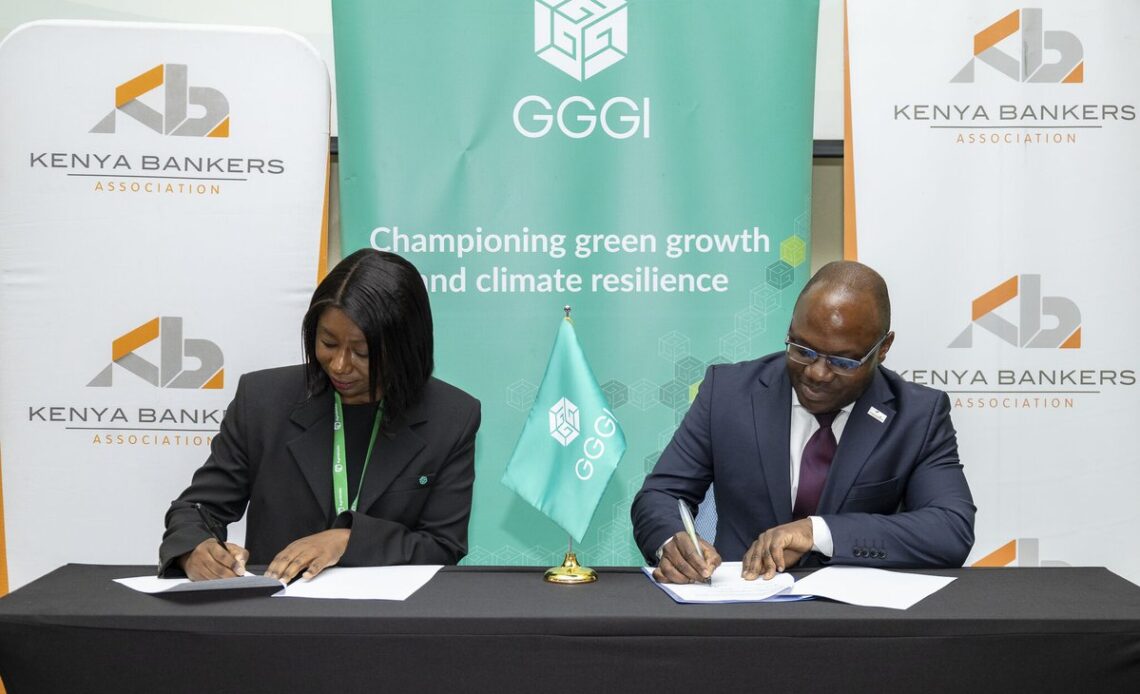
The Kenya Bankers Association (KBA) has signed a five-year Memorandum of Understanding (MoU) with the Global Green Growth Institute (GGGI) Kenya to strengthen sustainable finance, green investment and inclusive green growth in the country.
The partnership establishes a framework for cooperation aimed at strengthening sustainable finance policies and market practices while mobilising public and private capital towards Kenya’s transition to a low-carbon economy.
The two organisations will also collaborate on capacity building in environmental, social and governance (ESG), climate and nature finance, as well as developing bankable investment opportunities and innovative financing solutions.
The signing was followed by the opening of a Green, Social and Sustainability Bonds training programme for commercial banks in Kenya.
KBA Chief Executive Officer Raimond Molenje said the banking sector has a significant opportunity to leverage green, social and sustainability bonds to strengthen Kenya’s position as an attractive and competitive financial market in Africa.
Molenje highlighted progress made by the banking industry, including the development of Sustainable Finance Guiding Principles and an e-learning platform that has trained more than 60,000 bank employees.
He also noted the industry’s advocacy efforts that contributed to securing tax exemptions for green bonds in Kenya.
According to the Green Economy Strategy and Implementation Plan (GESIP), Kenya requires approximately KSh2.4 trillion (US$23.5 billion) to transition to a low-carbon economy.
Through the KBA Centre for Sustainable Finance and Enterprise Development (CSFED), potential issuers will receive practical support to prepare sustainable finance projects and bring them to the market.
Ms. Nagnouma Koné, Manager, Africa Strategy and Partnership and Head of GGGI Kenya, said the focus should now shift from policy discussions towards actual financial transactions.
She emphasised that finance remains fundamental to transforming developing economies, noting the need to improve how available funds are structured and deployed to support national development.
The partnership is expected to help build a pipeline of sustainable finance projects and increase the flow of capital into green and socially beneficial investments.
The initiative comes as Kenya seeks to expand its sustainable finance market and mobilise more private-sector capital to address climate change, environmental challenges and inclusive economic development.