


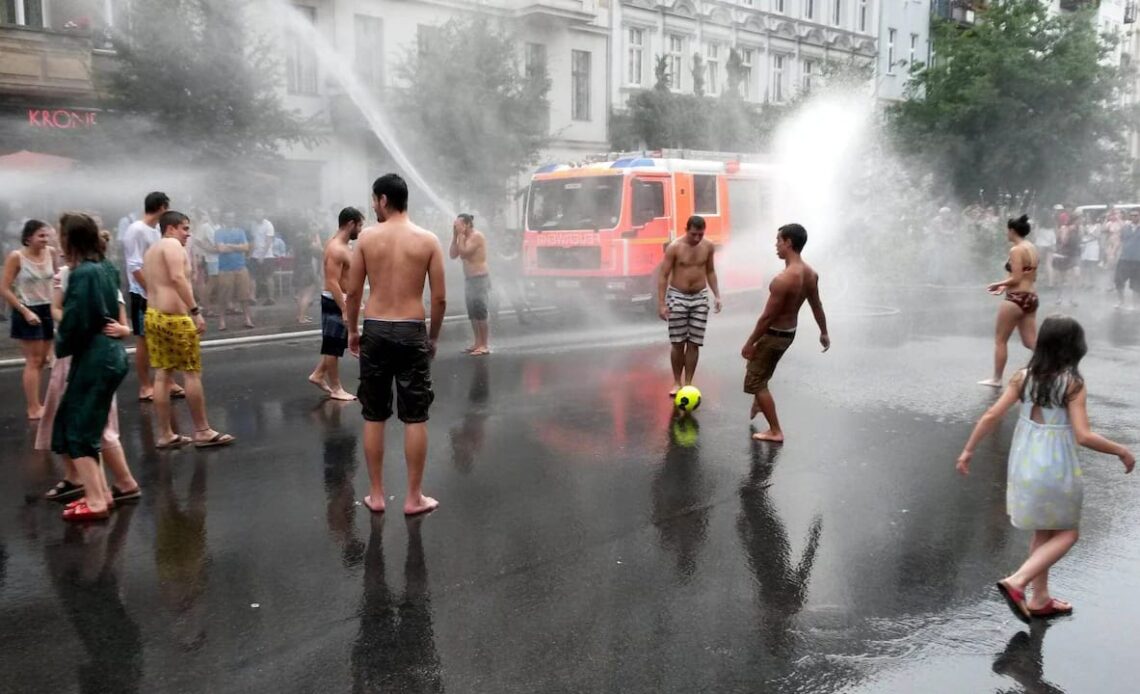
Europe’s searing heat in June and July 2026 has offered a stark glimpse into a warming world, as record-breaking temperatures, wildfires, drought, and heat-related deaths exposed the growing risks of climate change.
From France, Spain, and Germany to the Netherlands, Hungary, Italy, Belgium, Greece and the United Kingdom, extreme heat swept across western and central Europe, turning summer into a dangerous test of how societies cope with increasingly intense weather events. The episode has also renewed calls for faster action to reduce greenhouse gas emissions while strengthening communities’ ability to adapt.
June was the hottest June on record for western Europe, with an average temperature of 20.74°C—3.06°C above the 1991–2020 average, according to the Copernicus Climate Change Service. Global sea surface temperatures also reached record levels for the month.
A persistent high-pressure system, described as a “heat dome” or Omega block, trapped hot air over large parts of the continent. Heat from the Sahara further intensified temperatures, while dry soils reduced the land’s ability to cool the atmosphere.
In France, June 23 became the country’s hottest June day since records began in 1947. Temperatures reached 44.3°C in Pissos, 42.1°C in Bordeaux, and 40.9°C in Paris.
Germany recorded a national high of 41.8°C in Drewitz, with dozens of weather stations recording temperatures above 40°C. Thirteen of the country’s 16 states reportedly broke their all-time temperature records. By early July, heat-related deaths in Germany were estimated at more than 5,000.
Hungary also recorded its highest temperature ever, at 42.0°C in Szécsény on June 30, exceeding the previous national record of 41.9°C set in 2007.
Beyond the statistics, the heatwave exposed the human and economic costs of a changing climate. Thousands of people died prematurely across Europe, while wildfires consumed tens of thousands of hectares. Drought conditions threatened agriculture, infrastructure came under pressure, and businesses faced disruptions.
The World Weather Attribution analysis concluded that such extreme heat would have been virtually impossible without human-caused climate change. Europe has also warmed at roughly twice the global average, making extreme heat an increasingly recurring threat.
Speaking on the broader challenge of global warming, Parvana Valiyeva, a Member of Parliament of Azerbaijan’s Milli Majlis and a climate change expert, said cutting greenhouse gas emissions must be at the centre of global climate action.
“If we want to tackle climate change and halt the negative impacts of global warming, firstly, we need to cut our global greenhouse gas emissions,” Valiyeva said.
She highlighted methane and carbon emissions as key areas requiring urgent action, noting that Azerbaijan has committed to reducing methane emissions by 30% by 2030 under the Global Methane Pledge.
Valiyeva also pointed to carbon taxation and carbon markets as potential tools for encouraging businesses to reduce emissions while generating revenue for governments. She stressed that reducing fossil fuel use remains essential to tackling the climate crisis.
Climate change, she added, is no longer simply an environmental concern. It affects health, food systems, businesses, infrastructure, and everyday life.
The Intergovernmental Panel on Climate Change (IPCC) has warned of increasingly severe consequences if global warming exceeds 1.5°C.
Europe’s summer, therefore, carries a message far beyond its borders: climate change is already reshaping lives and economies.
Alongside rapid fossil-fuel reduction, governments must invest in early-warning systems, urban greening, cooling centres, resilient agriculture, better building insulation, and stronger healthcare preparedness.
“The Earth is not something humanity inherits from its grandparents; it is borrowed from its children. Protecting it is therefore not only an environmental responsibility, but a duty to future generations” Valiyeva