


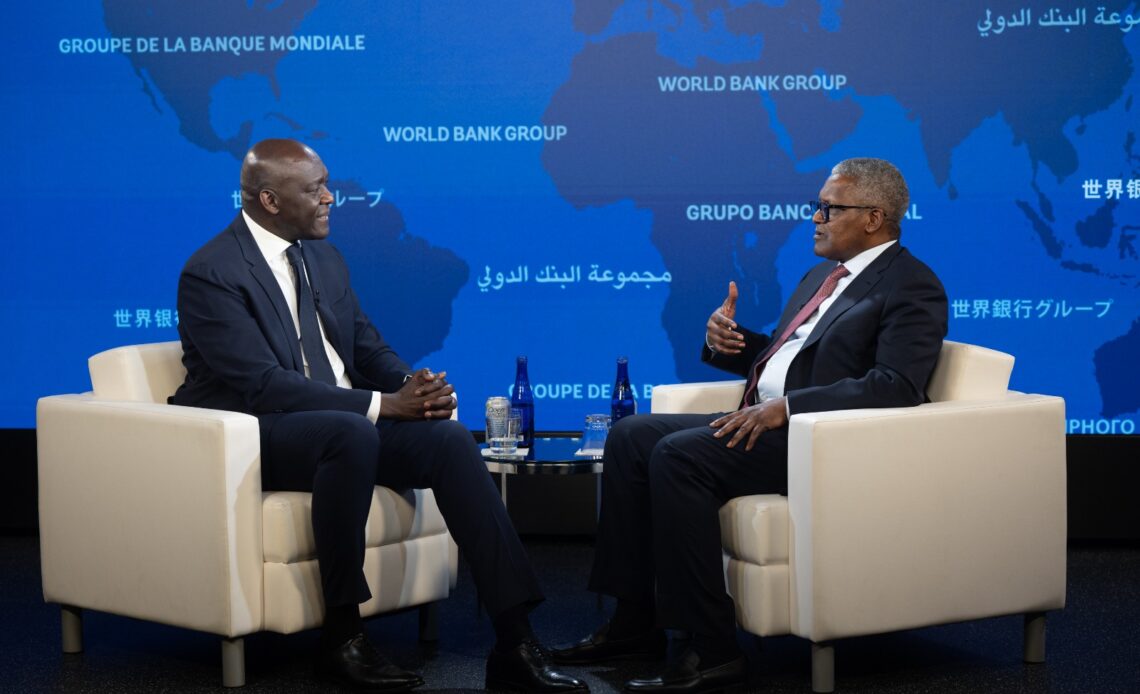
A candid conversation between Aliko Dangote and Makhtar Diop has laid bare both the immense promise and persistent structural barriers shaping Africa’s economic future, with a strong call for African-led investment, deeper integration, and practical delivery of long-discussed reforms.
Hosted under the International Finance Corporation (IFC) Trendlines platform, the discussion explored how the continent can transition from potential to tangible economic transformation.
From Potential to Reality: A Vision for Africa
Speaking at IFC, Dangote emphasized that Africa’s long-cited “potential” must now translate into real economic growth. This conviction led to the formation of the African Renaissance Group, a coalition of like-minded leaders focused on dismantling systemic barriers to development.
At the heart of his argument is a simple but powerful premise: Africa must invest in itself.
“We will open Africa by demonstrating that we believe in Africa, by investing our money in Africa,” Dangote said.
He argued that credibility in attracting global investors comes only when Africans themselves commit capital at scale.
Structural Barriers Holding Back Growth
Despite progress, Dangote highlighted major constraints that continue to stifle intra-African trade and investment:
Visa restrictions: He revealed that he requires up to 38 visas to travel across the continent, calling it a major deterrent to investment.
Trade bottlenecks: Moving goods across borders can take weeks, undermining regional commerce.
High logistics costs: Shipping within Africa can cost more than importing from Europe.
Expensive air travel: Intra-African flights remain unaffordable for many, limiting mobility.
“These are critical areas,” he noted, stressing that without free movement of people, goods, and services, Africa cannot achieve prosperity.
Building at Scale: The Dangote Industrial Model
Dangote pointed to his flagship refinery project as proof that large-scale industrialization is possible in Africa. The refinery, now operating at 650,000 barrels per day, stands as one of the continent’s most ambitious infrastructure investments.
He admitted entering the oil sector with no prior experience, driven instead by necessity:
Africa’s dependence on imported petroleum products
The need for value addition to local resources
The urgency of industrial self-sufficiency
The project, backed in part by IFC financing, demonstrates what he describes as “delivery over diagnostics.”
Strategic Investments in Critical Sectors
Dangote outlined a sweeping investment strategy targeting sectors critical to Africa’s development:
Energy: Expansion into refining, LNG, and power generation (targeting 20,000MW)
Fertilizer: Plans to become the world’s largest urea producer with 12 million tons
Mining: Development of potash and phosphate in Congo-Brazzaville
Infrastructure: Construction of a deep-sea port with 80-meter draft capacity
Agriculture: Large-scale investments to boost food security and job creation
He stressed that Africa must move beyond exporting raw materials, such as cocoa—and instead prioritize local processing and value addition.
Unlocking African Capital Through Local Investment
A key theme in the discussion was mobilizing African capital for African projects. Dangote revealed plans to list parts of his business empire, allowing Africans to invest directly in high-quality assets.
He projected that future dividends could inject between $20 billion and $25 billion into African investors, describing it as a “life-changing” opportunity.
This approach, supported by collaboration with regulators and institutions, aims to reverse capital flight and deepen local ownership of major industries.
Agriculture, Water, and Job Creation
Dangote identified agriculture as the most powerful engine for inclusive growth, rejecting the notion that it is a “poor man’s business.”
He projected that agricultural expansion alone could generate up to 200,000 jobs.
Central to this vision is water infrastructure. He highlighted the potential of rehabilitating over 400 small dams in Nigeria:
•Desilting and repairing dormant dams
•Enabling year-round irrigation
•Supporting rural livelihoods
•Reducing conflict driven by resource scarcity
“Once the dams are working, people will farm… this will take out poverty and create prosperity,” he said.
IFC’s Role: Financing, Advisory, and Risk-Taking
Diop underscored the importance of institutions like IFC in enabling Africa’s industrialization.
Beyond financing, Dangote praised IFC for its advisory role, particularly in governance, environmental, and social standards.
He recalled IFC’s early support, a $478 million loan in 2005, which was repaid in just 18 months, marking the beginning of a long-term partnership.
Diop reaffirmed IFC’s commitment to supporting transformative African businesses:
“Industrialization of Africa requires people to take risks… and institutions like ours must support that.”
Dangote’s Journey: From Trader to Industrial Giant
Reflecting on his entrepreneurial journey, Dangote recounted starting with the sale of just four truckloads of cement per day. From those beginnings, he built a diversified industrial empire spanning multiple sectors.
His story mirrors the broader African enterprise journey, from trading to manufacturing to large-scale industrialization, highlighting the importance of nurturing local business champions across all levels.
A Call for Collective Action
Both Dangote and Diop stressed that Africa’s transformation will require coordinated action among:
•Governments
•Private sector leaders
•Development finance institutions
•Local investors
The conversation closed with a shared commitment to deepen collaboration and accelerate Africa’s economic progress.
The Bottom Line
The message from the discussion is clear: Africa’s future will not be unlocked by rhetoric alone, but by bold investments, structural reforms, and a willingness to take risks.
Dangote’s model, investing heavily in critical sectors while advocating for integration, offers a blueprint for how African capital and leadership can drive the continent’s next phase of growth.
As Diop noted, the goal is not just economic expansion, but a continent where people have jobs, dignity, and pride in shared progress.