

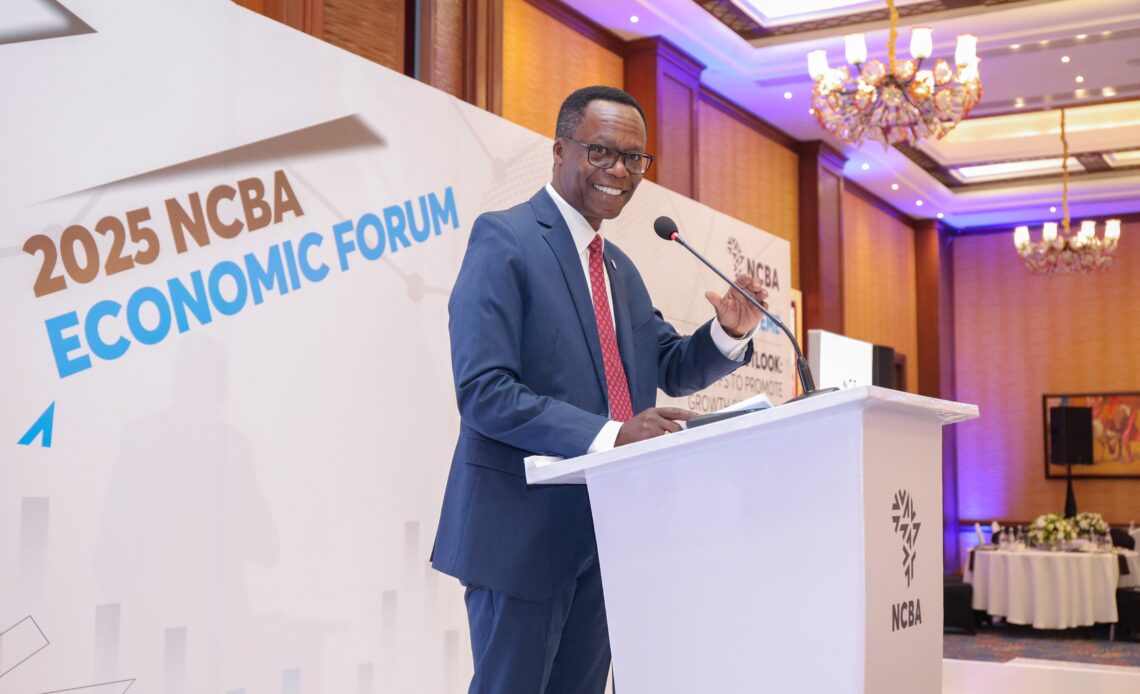
John Gachora, NCBA Group Managing Director. Photo by Oxygene
NCBA Group has projected that Kenya’s economy will expand by 5.0 percent in 2025, buoyed by improved private sector credit growth, stable inflation, and increased fiscal spending.
The optimistic outlook was unveiled during the 10th NCBA Economic Forum held at the Nairobi Serena Hotel, where policymakers, economists, and industry leaders convened to discuss strategies for strengthening Kenya’s economic resilience amid shifting global dynamics.
Speaking at the forum, NCBA Group Managing Director John Gachora expressed confidence in Kenya’s near-term prospects but cautioned that fiscal prudence and efficient policy coordination remain vital for sustainable growth.
“The outlook for 2025 remains positive despite global uncertainty. Kenya must continue to pursue pragmatic policy coordination and efficiency in public spending to ensure sustainable growth,” said Gachora. “Through our thought leadership platforms, we will continue to bring you innovative research and the best brains in our country to chart a path toward growth and resilience.”
Gachora noted that the global economy is expected to grow by 3.2 percent in 2025, slightly below 2024’s 3.3 percent, reflecting persistent trade disruptions and tighter financial conditions.
He warned that slower growth in major economies such as the United States and key Asian markets could dampen Kenya’s exports and remittance inflows in 2026.
Kenya’s growth, he said, continues to rely heavily on public expenditure, agriculture, and a resilient services sector, but faces fiscal pressures from mounting debt obligations. In the first quarter of the 2025–2026 fiscal year, the government spent KSh 509 billion on debt servicing out of KSh 554 billion collected in taxes, leaving limited space for development spending.
The forum also highlighted that while inflation has remained on a downward trajectory throughout 2025, it remains vulnerable to fluctuations in food prices.
Participants called for maintaining liquidity in the foreign exchange market, strengthening public debt management, and deepening regional trade to sustain inclusive growth under the Bottom-Up Economic Transformation Agenda (BETA).
Gachora pointed out that Kenya’s economy continues to draw strength from vibrant telecommunications, transport, and domestic trade sectors. The manufacturing sector, however, is expected to record mixed results. with the food sub-sector demonstrating greater resilience.
On exports, he projected promising trends, citing that global coffee prices are likely to remain high at around USD 7.00 per kilo, while horticultural exports will remain stable following the extension of the EU’s deforestation regulation for small and medium enterprises.
Looking ahead, NCBA expects Kenya’s economy to expand by 5.1 percent in 2026, driven by renewed fiscal momentum, export diversification, and improving investor confidence.
Gachora also proposed the development of a high-frequency consumer activity indicator to better track household consumption trends, which account for over 70 percent of GDP.
Reaffirming the bank’s commitment to advancing informed economic dialogue, he said platforms like the NCBA Economic Forum will continue to play a pivotal role in shaping Kenya’s economic future through research, innovation, and evidence-based policy engagement.