

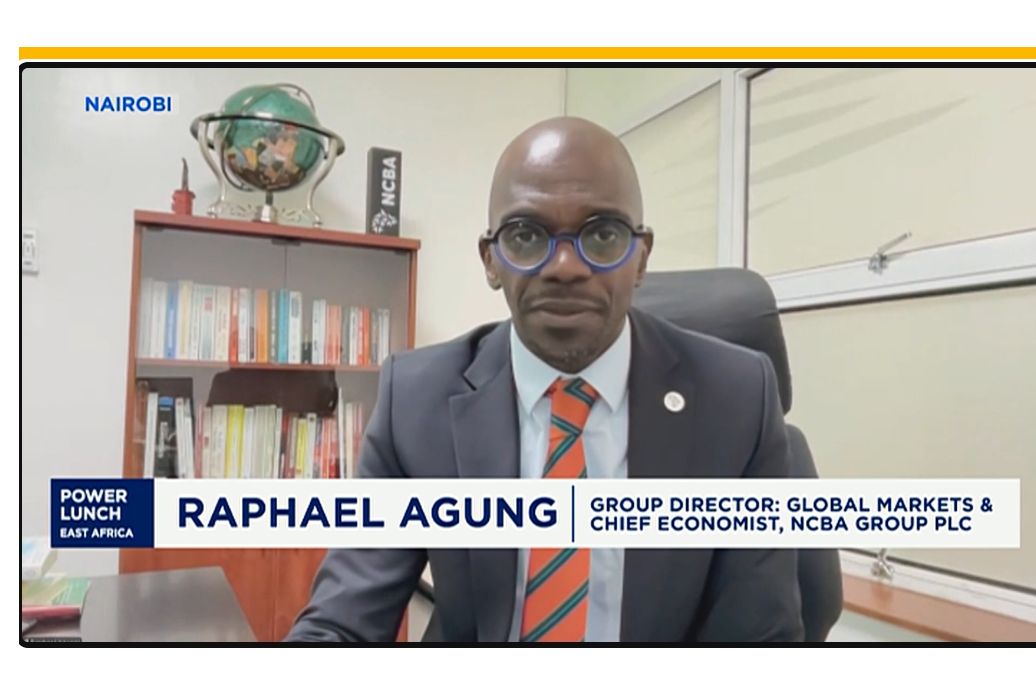
Raphael Agung, Group Director of Global Markets and Chief Economist at NCBA Group PLC, Speaking at CNBC Africa on Wednesday 20th
As Kenya navigates a complex economic landscape, Raphael Agung, Group Director of Global Markets and Chief Economist at NCBA Group PLC, offered a detailed analysis during the recent CNBC Africa Power Lunch on Wednesday.
With inflation at 3.82 per cent, a GDP growth rate of 4.9 per cent, and a Central Bank Rate (CBR) recently cut to 9.5 per cent, Agung’ addressed the nation’s efforts to tackle debt, credit constraints, and the impending expiry of the African Growth and Opportunity Act (AGOA) in 2025.
Interest rate strategy
The Central Bank of Kenya’s decision to lower the CBR by 75 basis points last week has sparked debate about whether this signals overcompensation for risk or a justified cautious stance.
Agung’ defended the move, stating, “The Monetary Policy Committee (MPC) was correct in jumpstarting growth, given the sub-5 per cent GDP growth and anchored inflation expectations through December 2025.”
He emphasised that this monetary easing aligns with the need to stimulate private sector lending, though global rate volatility and debt refinancing pressures remain significant challenges.
Banking Sector Risks, Tackling Rising Non-Performing Loans
Kenya’s banking sector faces a pressing issue with non-performing loans (NPLs) stuck at 17.6 per cent, the highest since April 2015, despite a revival in private credit.
Agung highlighted the Central Bank of Kenya’s (CBK) proactive stance, noting, “A new credit pricing framework tied to a benchmark rate is in development, aiming to enhance transparency and lower lending rates.”
This approach, he added, avoids broad loan restructuring seen during the COVID-19 period, favouring a market-driven correction instead.
With global central banks cutting rates, Kenya faces a strategic decision on refinancing its Eurobond maturities, particularly those due in 2027. Agung pointed to the success of last year’s liability management operations, which mitigated risks around the 2024 Eurobond.
“If external financing conditions ease, as expected with a potential 75 basis points drop in the Fed funds rate, Kenya should seize the opportunity to refinance,” he advised, underscoring the government’s readiness to act tactically.
Investment potential
Despite challenges, Agung remains optimistic about Kenya’s investment climate. “With stable inflation, low interest rates, and a stable exchange rate, Kenya is the centre of gravity in East Africa,” he said, citing its 4.9 per cent growth as a magnet for regional investors. He believes the country’s policy framework balances fiscal and monetary risks effectively.
Fiscal monetary tug of war, managing long-term stability
The tension between fiscal dominance and monetary policy continues to loom, with debt markets pushing for harder choices.
Agung’ acknowledged revenue challenges but noted the government’s focus on consolidating primary balances and widening the tax base.
“There’s political will to manage this tension, reflecting stability so far,” he added painting a cautiously hopeful picture for Kenya’s economic future.