


By Parvana Valiyeva,Member of Azerbaijan Parliament, Member of Foreign and Inter-parliamentary Relations Committee
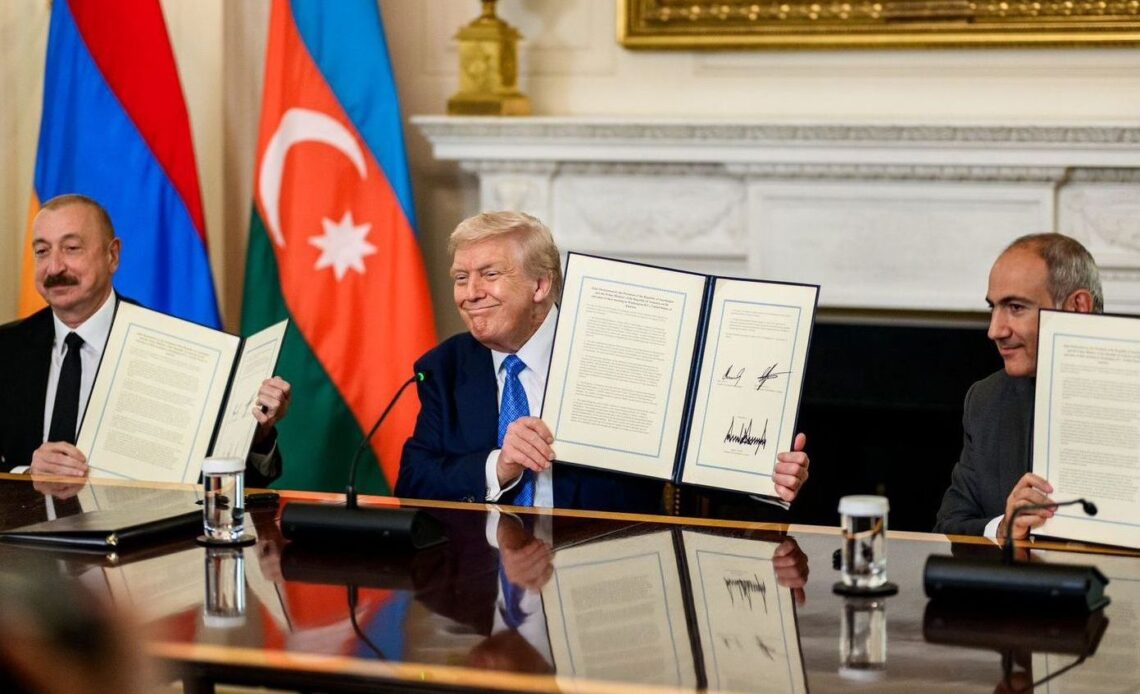
At the White House on Friday, the Republic of Azerbaijan and the Republic of Armenia took a historic step toward ending over three decades of conflict with the signing of a Joint Declaration witnessed by U.S. President Donald Trump.
This pivotal document signals that the long-awaited Azerbaijan–Armenia Peace Agreement is nearing completion, promising to bring peace, stability, and prosperity to the South Caucasus region.
The Joint Declaration: A New Dawn for Azerbaijan and Armenia
While initialling the peace treaty text is distinct from the formal signing, it marks a significant breakthrough after years of stalemate. The Joint Declaration not only lays the foundation for sustainable peace but also introduces a new regional corridor—dubbed the “Trump Route for International Peace and Prosperity (TRIPP)”—aimed at boosting regional connectivity and development.
Unlike previous peace efforts that narrowly targeted cessation of hostilities, this agreement tackles the underlying political, economic, and infrastructural challenges that have long fueled tensions between the two nations. This broader, integrated approach enjoys robust support from President Trump, who has emphasised the fusion of peace initiatives with regional development.
Political and Constitutional Prerequisites Confirmed
The Joint Declaration also confirms that Azerbaijan and Armenia will jointly petition the OSCE Secretary General to dissolve the Minsk Group, the 1990s-era body that failed to deliver lasting peace or resolve occupation issues. Importantly, the declaration acknowledges the necessity of amending the Armenian constitution—a key prerequisite to the final peace treaty’s signing and ratification—thus addressing one of the critical hurdles in the peace process.
Strengthening Azerbaijan–U.S. Strategic Relations
Parallel to the peace process, Azerbaijan and the United States have fortified their bilateral ties, which have evolved positively since their establishment on February 28, 1992.
Under the visionary leadership of National Leader Heydar Aliyev, these relations grew on mutual interests, with energy cooperation as a cornerstone.
The 2024 re-election of President Donald Trump injected new momentum into the partnership. Exchanges between President Trump and President Ilham Aliyev reflected mutual respect and optimism. President Aliyev notably praised Trump for avoiding new wars during his first term and lauded his dedication to family and traditional values.
Pivotal Diplomatic Visit and Strategic Partnership
President Aliyev’s official visit to Washington, extended by President Trump’s invitation, marked a diplomatic milestone. The visit signalled a new phase in Azerbaijan–U.S. relations and accelerated efforts for peace in the South Caucasus. During the visit, a Memorandum of Understanding established a Strategic Working Group tasked with advancing the “Charter on Strategic Partnership” between the two nations.
This expanded partnership targets cooperation across multiple fronts, including regional connectivity in energy, trade, and transit; economic investment focusing on emerging sectors like artificial intelligence and digital infrastructure; as well as defence, arms sales, and counterterrorism. The agreement also opens avenues for enhanced U.S. technological and financial engagement in Azerbaijan.
Significantly, the Trump administration formalised the suspension of Section 907 of the Freedom Support Act, a 1992 congressional amendment that had restricted direct U.S. aid to Azerbaijan until its repeal under Trump’s presidency.
A Vision for Regional Stability and Prosperity
President Ilham Aliyev’s visit and the resultant agreements have elevated Azerbaijan–U.S. relations to a strategic partnership level, advancing peace, security, and stability in the volatile South Caucasus region. Under his leadership, Azerbaijan is poised to strengthen its international stature while pursuing sustainable national development.
The signing of the Joint Declaration and the unfolding peace treaty mark a historic moment with the potential to transform the South Caucasus from a region marked by conflict to one of connectivity and prosperity, heralding a new era underpinned by strategic diplomacy and visionary leadership.