


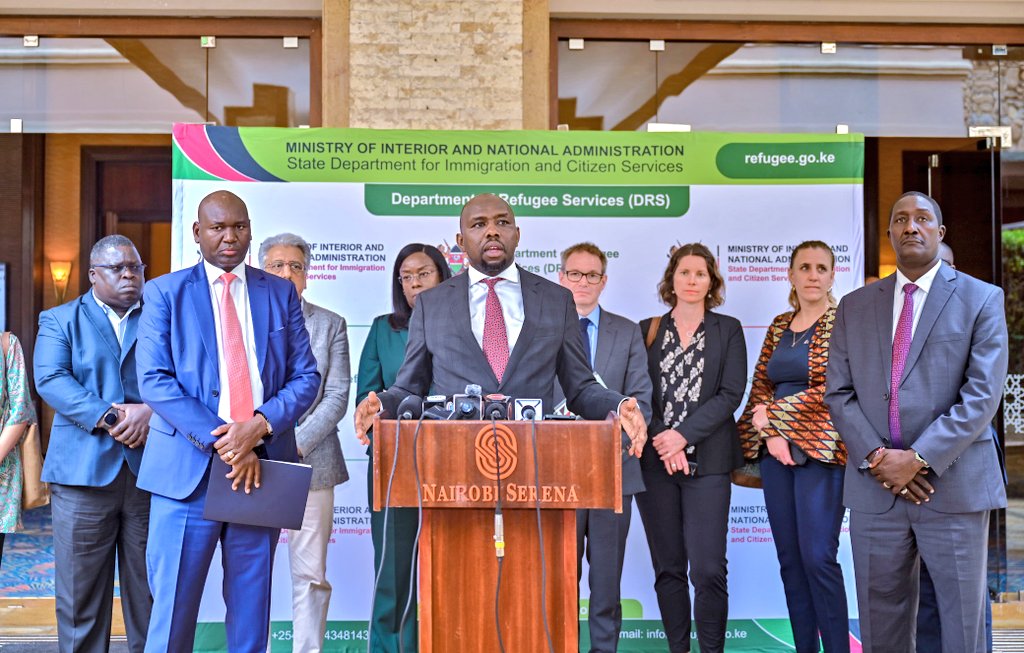
Kenya has reaffirmed its dedication to ensuring the welfare of refugees, even as security concerns mount due to dwindling resources in refugee camps across the country. Interior Cabinet Secretary Kipchumba Murkomen, speaking after a high-level consultative meeting with ambassadors, high commissioners, and international donors in Nairobi, assured that humanitarian support in Daadab, Kakuma, and Kalobeyei camps would continue uninterrupted.
The meeting was convened in the wake of recent protests in Kakuma, where refugees voiced frustrations over food ration cuts linked to shifting donor funding policies. Murkomen assured stakeholders that the situation had been stabilized and emphasized the government’s commitment to long-term solutions under the Shirika Plan, a policy initiative aimed at integrating refugees into Kenya’s socioeconomic framework.
Described as a game-changer in refugee management, the Shirika Plan seeks to transition refugees from aid dependency to economic self-sufficiency. The policy aims to integrate refugees into local economies by granting them work permits, improving access to education and healthcare, and fostering business opportunities within host communities.
Murkomen stressed that beyond benefiting refugees, the plan would spur economic growth in Kenya by enabling skilled refugees to contribute to national development. “The Shirika Plan is not just about refugees—it’s about ensuring that host communities also thrive through shared prosperity,” he said.
International partners at the meeting lauded the initiative, urging Kenya to ensure public participation and legal reforms to facilitate a smooth rollout.
Kenya’s refugee population has now surpassed 800,000, making it one of Africa’s largest refugee-hosting nations. The strain on resources has been exacerbated by funding constraints, leading to essential service reductions in camps. However, Murkomen acknowledged the role of humanitarian organizations in mitigating these challenges, singling out the United States government for lifting a ban on humanitarian funding—a move expected to alleviate financial pressure on refugee support programs.
The high-level meeting brought together key international stakeholders, including US Embassy Charge d’Affaires and Refugee Donor Group Chair Amb. Marc D. Dillard, UN Resident Coordinator Dr. Stephen Jackson, and UNHCR Country Representative Caroline Van Buren. Kenyan officials, led by Principal Secretary for Immigration and Citizen Services Prof. Julius Bitok, reinforced the government’s commitment to fostering partnerships for sustainable refugee management.
As Kenya continues to host a growing refugee population, authorities are navigating the complex balance between security, resource constraints, and humanitarian obligations. With increasing instability in neighboring countries driving new arrivals, the successful implementation of the Shirika Plan, alongside sustained international support, will be crucial in ensuring that Kenya remains a regional leader in refugee protection.
For now, the government remains steadfast in its promise: to uphold the dignity and rights of refugees while ensuring national security and economic stability.