


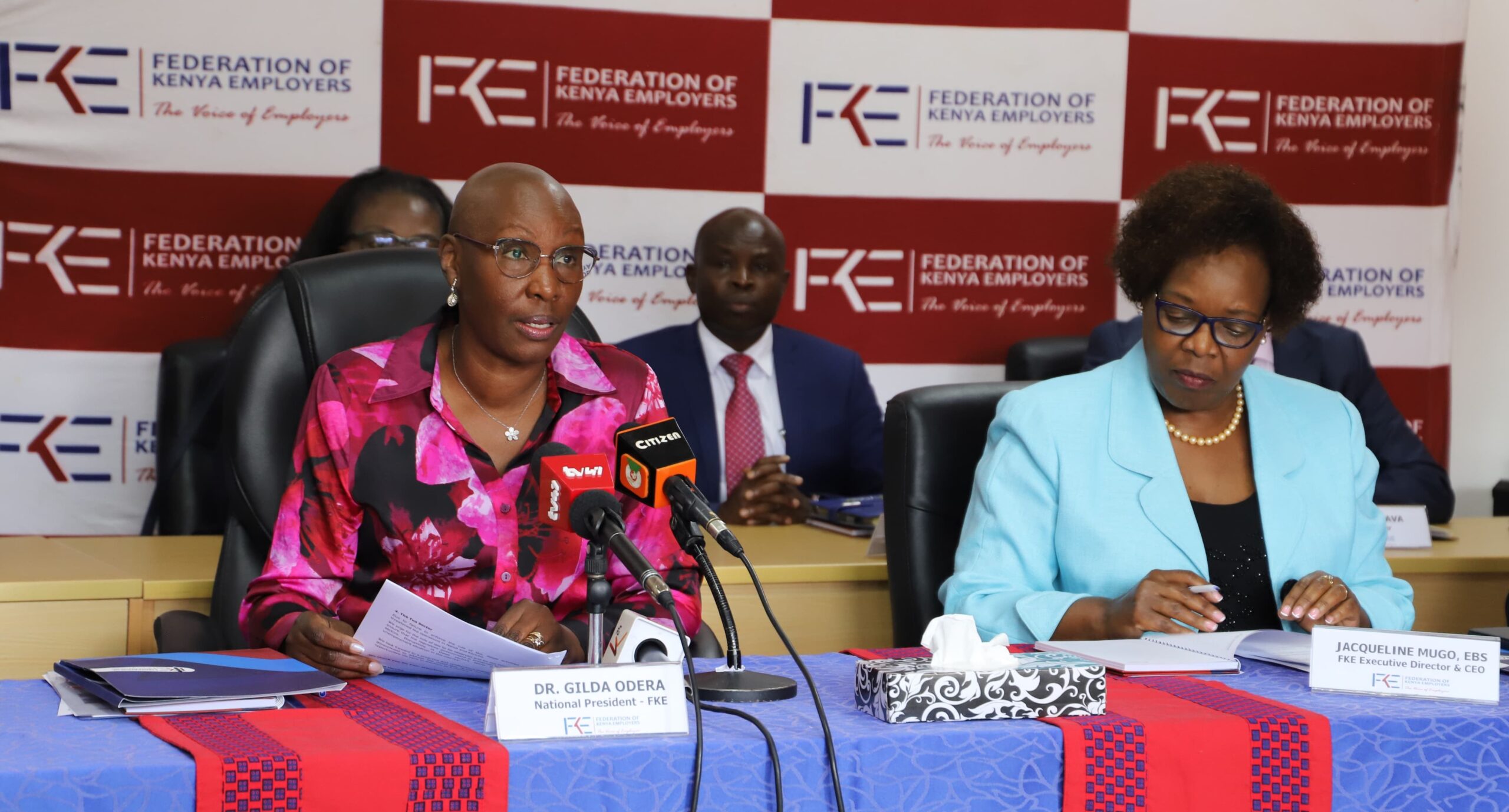
(Right) FKE National President Dr. Gilda Odera (left) FKE Executive Director Jacqueline Mugo during a press briefing in Nairobi on Friday 24
As Kenya gears up for another year of economic challenges and opportunities, the Federation of Kenya Employers (FKE) has laid out its comprehensive agenda for 2025. Speaking during the release of their reflections on the 2024 business environment, FKE National President Dr. Gilda Odera and Executive Director Jacqueline Mugo highlighted critical areas for reform and investment to revitalize the economy and secure livelihoods.
Reflecting on 2024, Dr. Odera acknowledged the government’s efforts in reforming key sectors such as health, housing, tourism, agriculture, and manufacturing. While strides were made, especially in tourism, where the post-COVID-19 recovery activation plan has driven full recovery, challenges remain.
“Transit travelers and short-stay visitors should be granted visa-free entry to open Kenya further to the world,” said Dr. Odera, urging the government to sustain these gains.
However, employers faced significant hurdles, including rising costs, low demand, liquidity constraints, and a challenging tax regime. These pressures led to business closures, redundancies, and reduced productivity, straining job creation efforts.
FKE called for prudent debt management, streamlined government operations, and efficient public service delivery. Honoring contracts, clearing pending bills, and strengthening accountability are seen as crucial to boosting confidence and spurring economic growth.
To foster business growth, FKE urged the government to introduce a stable, predictable tax regime, avoid new tax burdens, and lower production and service taxes. “A progressive tax regime will not only ease the burden on businesses but also promote economic inclusivity,” said Jacqueline Mugo.
With the private sector shrinking, FKE emphasized the need to formalize informal businesses. Supporting SMEs through credit access, market opportunities, and skill development can drive innovation and rural economic growth.
The Federation highlighted the importance of industrial harmony, urging the government to gazette pending wages councils and implement negotiated agreements. “Social dialogue is key to fostering trust and ensuring sustainable industrial peace,” said Dr. Odera.
The agricultural sector, a backbone of Kenya’s economy, faces significant threats, according to FKE.
Air freight charges have risen by 40 percent, putting Kenyan fresh produce exporters at a disadvantage against competitors like Ethiopia and Colombia. FKE urged the government to leverage Kenya Airways to lower costs and expand freight capacity during peak seasons.
New EU regulations have increased inspection levels for Kenyan flowers, causing delays and higher costs. FKE called for renegotiated trade terms and diversification of export markets to reduce dependency on the EU.
With over KES 12 billion in pending VAT refunds, farmers and exporters are struggling. FKE urged the government to offset taxes to ease financial strain and promote sustainability.
Illegal activities in tea-growing regions like Nandi and Kericho are disrupting operations. FKE demanded strict enforcement of the rule of law to safeguard this critical sector.
As the country navigates its economic future, FKE emphasized the importance of a collaborative approach between employers and the government. “Proactive and constructive engagement will be key to unlocking Kenya’s potential,” said Dr. Odera.
From fiscal discipline to tax reforms, labor relations, and agricultural sustainability, the FKE’s 2025 roadmap provides a clear and actionable blueprint for addressing Kenya’s economic challenges. Will the government heed these calls and work towards a more vibrant business environment? Only time will tell.