


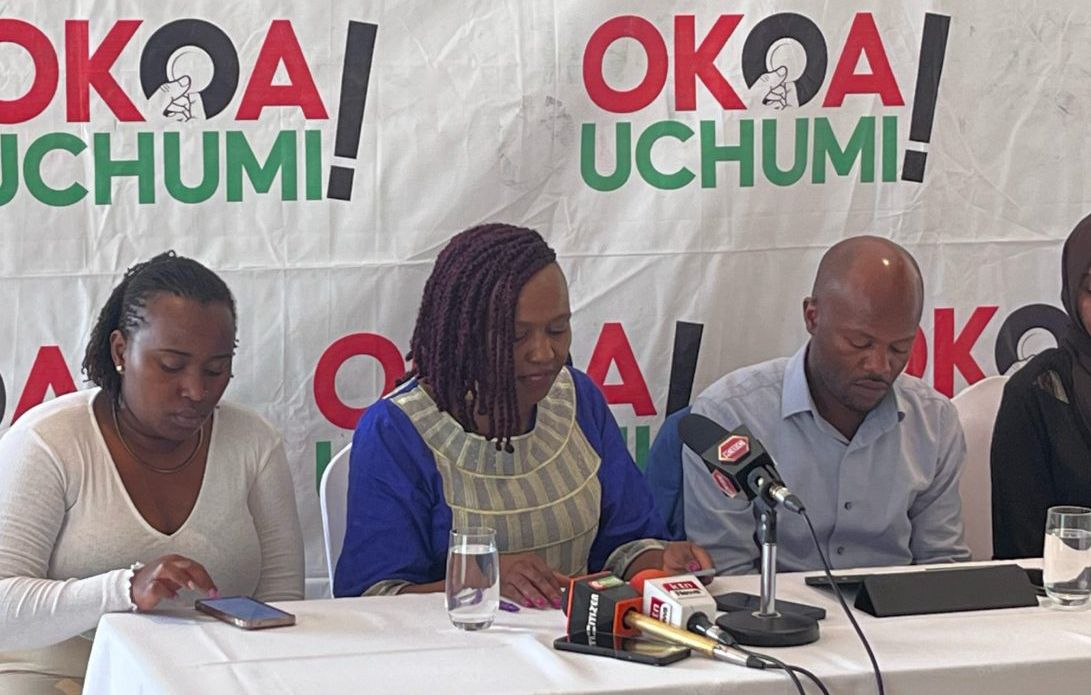
Okoa Uchumi Coalition a consortium of civil society organizations has issued a critical response to President William Ruto’s recent State of the Nation address.
While acknowledging certain economic achievements highlighted in the address, such as a strengthening Kenyan shilling and a reduction in inflation, the coalition underscored persistent socio-economic challenges and questionable governance practices that continue to burden Kenyans.
The coalition concedes that the government had made strides in stabilizing the economy, noting a 20 percent appreciation of the Kenyan shilling from Ksh 162/USD in February 2024 to Ksh 129/USD and a significant drop in inflation from 9.6 percent in September 2022 to 2.7 percent in October 2024.
However, they argues that these macroeconomic improvements have not translated into tangible benefits for ordinary citizens.
“Prices of basic commodities, such as school materials, remain prohibitively high, and the cost of living is still unsustainable,” the statement read. The coalition further criticized recent tax measures, such as the Housing Levy and Social Health Insurance Fund, which they claim have reduced household disposable incomes while exacerbating economic inequality.
The coalition raised alarm over Kenya’s engagement with controversial entities like the Adani Group, whose leader is facing fraud allegations abroad. The government’s approval of Public-Private Partnership (PPP) contracts involving Adani was labeled as reckless and lacking due diligence. They demanded transparency, an audit of the deals, and accountability for Kenyan officials implicated in the agreements.
Citing the need for transparency, the coalition urged the government to disclose details of these deals and ensure that all PPP agreements adhere to legal and ethical standards. The Adani scandal, they argued, is emblematic of a broader issue of unchecked corruption, which remains a persistent drain on public resources.
Kenya’s rising public debt was another major concern. The coalition highlighted that over 70 percent of the country’s tax revenues and nearly 50 percent of its budget are allocated to debt servicing. They criticized the government’s borrowing spree, accusing it of compromising constitutional principles of public finance management. They also questioned the authenticity of Kenya’s GDP estimates and called for an audit of public expenditure.
“The high levels of public debt are unsustainable and reflect a government prioritizing excessive borrowing over the welfare of its citizens,” the coalition declared.
The coalition accused the government of failing to combat corruption effectively. They criticized President Ruto’s administration for withdrawing corruption cases, appointing implicated officials, and failing to recover stolen public funds. High-profile projects, such as the Standard Gauge Railway and the Haiti peace mission, were flagged as examples of poor financial prioritization.
“Kenyan taxpayers have spent Sh2.1 billion on the Haiti mission, funds that could have been used to improve the education sector,” they noted, pointing to misplaced priorities in public spending.
To address these challenges, the coalition outlined several demands:
Accountability and transparency
Senior officials involved in irregular contracts should step aside, and all agreements linked to the Adani Group should be reviewed and disclosed.
Cost of living
The government must implement policies to reduce fuel costs and reinstate a more beneficial national health coverage scheme.
Anti-Corruption efforts
Investigative and prosecutorial bodies must act independently to address economic crimes and recover stolen public funds.
Parliamentary oversight
The coalition urged Parliament to impeach Cabinet Secretaries linked to questionable contracts, curtail excessive borrowing, and scrutinize Kenya’s GDP estimates.
Okoa Uchumi Coalition urges the government to prioritize the interests of the Kenyan people over political expediency. They emphasized that inclusive growth, transparency, and accountability are critical for restoring public trust and achieving sustainable development.
Signed by leading civil society organizations, including TISA, Transparency International Kenya and the Kenya Human Rights Commission among others, the statement underscores a growing demand for reform.
The Coalition reaffirmed its commitment to safeguarding the rights and dignity of all Kenyans while holding the government accountable for its promises and actions.
This latest critique amplifies the voices of many Kenyans who continue to feel the weight of economic hardship despite optimistic government narratives. The coalition’s call for action now puts the ball squarely in the government’scourt to address these pressing issues.