


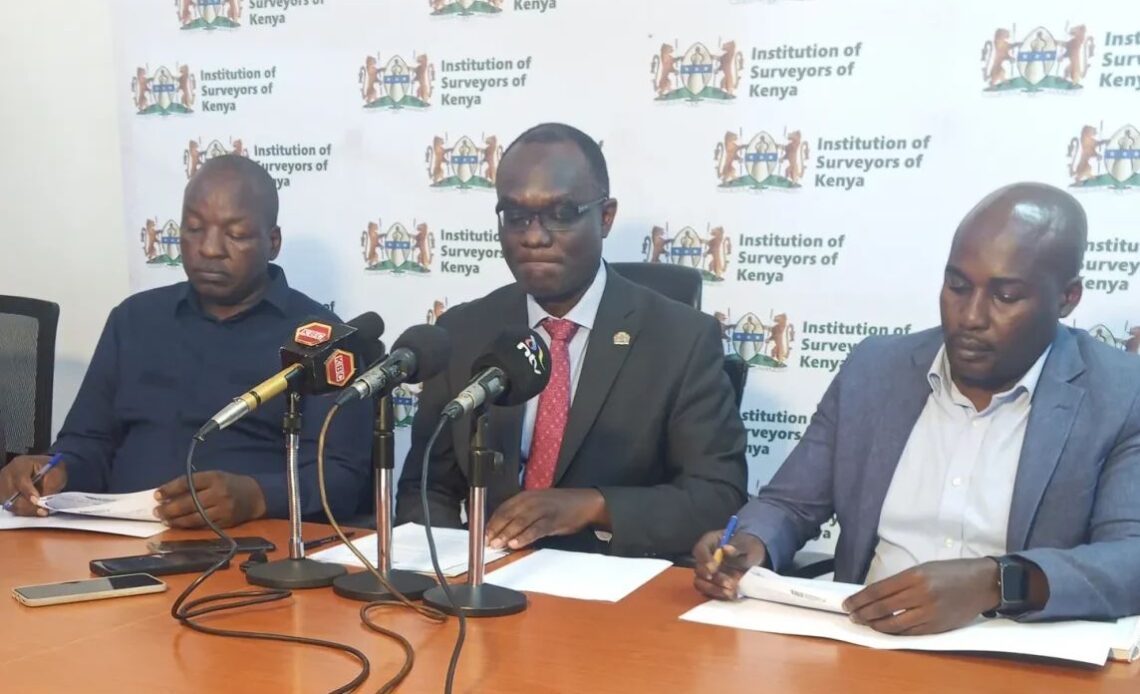
Institution of Surveyors of Kenya (ISK) has backed government efforts to reclaim and protect riparian reserves, but warned that ongoing enforcement risks violating property rights and constitutional safeguards if not properly managed.
In a detailed position statement, ISK supported initiatives under the Nairobi Rivers Regeneration Project aimed at restoring ecosystems, mitigating flooding, and safeguarding water bodies.
However, the institution cautioned that inconsistencies in legal definitions, measurement standards, and enforcement practices have created confusion and public concern, especially amid recent demolitions.
Legal Ambiguity and Property Rights
ISK challenged the assumption that riparian reserves automatically constitute public land, noting that under the Constitution of Kenya 2010, such land can still be privately owned, subject to regulated use. The body emphasized that riparian reserves should be treated similarly to other reserves, such as road reserves, where access and use are controlled but ownership may remain private.
The surveyors further highlighted that boundaries along rivers are often defined using centre lines, and that rivers can change course over time—factors that complicate blanket enforcement measures.
Compensation and Due Process
A key concern raised by ISK relates to properties lawfully acquired and developed under previous legal frameworks. The institution warned against retroactive application of new riparian definitions that could deprive landowners of property without compensation.
It stressed that where valid titles and approvals exist, any repossession amounts to compulsory acquisition and must comply with the law, including valuation, gazettement, and prompt compensation before demolition.
ISK, however, drew a clear distinction for illegally acquired or fraudulently developed properties, stating that such cases do not qualify for constitutional protection and can be subject to enforcement action.
Call for Harmonisation and Technical Clarity
The institution attributed current disputes to fragmented legal frameworks, citing inconsistencies in setback distances, reference points, and sectoral regulations. It called for urgent harmonisation of laws governing riparian reserves, including the Survey Act, Environmental Management laws, and land use planning statutes.
Flooding and Planning Failures
Beyond enforcement, ISK pointed to broader causes of flooding, including poor urban planning, blocked drainage systems, and overdevelopment. It recommended geospatial mapping, improved drainage infrastructure, and stricter adherence to zoning regulations as practical solutions.
Balancing Environment and Rights
ISK reaffirmed its commitment to working with government agencies and stakeholders to ensure that riparian management is scientifically sound, legally compliant, and socially just. It emphasized that environmental protection must be balanced with respect for property rights and the rule of law.
Additionally, ISK urged the government to ensure that only qualified surveyors undertake boundary mapping and to publish clear, comprehensive boundary plans for all riparian areas.