


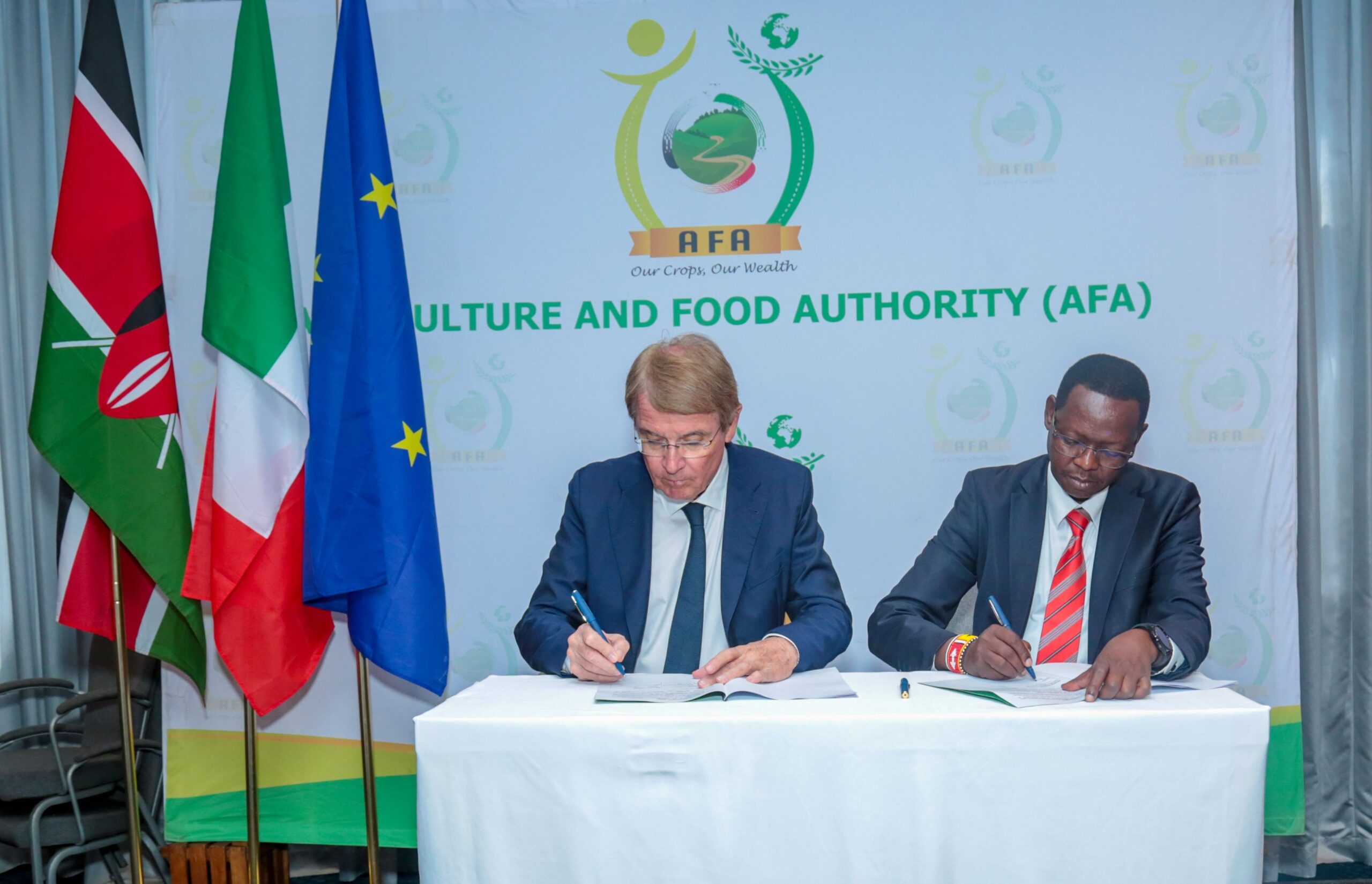
From right Renzo Piraccini, President of Macfrut signs MOU with AFA Director General Dr. Bruno Linyuru to enhance quality of horticulture exports in Kenya. Photo by AFA
Kenyan horticulture exporters are set to expand their footprint in the European Union (EU) market, with a keen focus on Italy as they capitalize on improved trade agreements and compliance with stringent EU standards. The Agriculture and Food Authority (AFA) Director General, Dr. Bruno Linyuru, has confirmed that Kenya is working to enhance the quality of its horticultural exports while leveraging the Economic Partnership Agreement (EPA) with the EU to increase market access.
Currently Kenya consumes only 2 percent of its horticultural exports within Europe, with avocados—particularly the Hass variety being a highly sought-after product. However, to solidify its position, the country is striving to diversify its horticultural offerings, improve market access, and maximize benefits from the favourable tariff conditions under the EU trade deal.
A major challenge for Kenyan exporters has been the disruptions caused by the ongoing Red Sea conflict, which has affected sea transport. However, Dr. Linyuru assured stakeholders that air freight remains a viable alternative, ensuring uninterrupted export of fresh produce to European markets. Additionally, he emphasized Kenya’s adherence to international quality standards, including the Horticulture Code of Practice and Good Agricultural Practices (GAP), which guarantee high-quality produce with full traceability.
“Breaking into the EU market requires the highest quality of standards. We have the Code of Practice, and our compliance with these standards has significantly improved the quality of our exports. Traceability mechanisms ensure that any issues can be tracked back to the farm level,” Dr. Linyuru stated.
Ital an EU member with a strong demand for horticultural produce, currently imports only 2 percent of its produce from Kenya. However, a Memorandum of Understanding (MoU) signed between AFA and Macfrut, a leading Italian agricultural trade exhibition aims to increase this share. As part of the agreement, Kenyan farmers and exporters will participate in the upcoming Macfrut Exhibition in Rimini from May 6th to 8th, where they will showcase their produce to global buyers.
Renzo Piraccini, President of Macfrut, emphasized the importance of the exhibition, stating, “This is not just an Italian exhibition; it is an international platform where buyers from Saudi Arabia, Eastern Europe, and other regions gather. It is a great opportunity for Kenyan exporters to expand their market reach.”
Besides avocados, Kenya exports a variety of horticultural products, including flowers, vegetables, and fruits. Flowers account for 80 percent of Kenya’s horticultural exports, with fruits contributing 30 buyers and vegetables 20 percent. The country is also keen on exploring value addition, particularly in avocado oil production, which can be re-exported to other EU destinations such as Belgium and Germany.
A key concern for Kenyan exporters has been the high rate of interceptions of horticultural produce in the EU due to compliance issues. In 2023, 50 interceptions were recorded, mainly due to the presence of false codling moth in flower and vegetable shipments. In response, the EU has introduced new regulations, effective April 26th, requiring Kenyan horticultural farmers to register with the Horticulture Crops Directorate. This measure aims to enhance traceability and compliance with phytosanitary standards.
To address these concerns, Kenya is working closely with various regulatory bodies, including the AFA, the Pest Control Products Board (PCPB), and the Kenya Agricultural and Livestock Research Organization (KALRO). The goal is to educate farmers on best agricultural practices, including proper pest control measures and the use of minimal residue levels (MRLs) in vegetables.
The government has also established the National Agriculture Standing Committee to engage with EU regulators. This committee is advocating for a reduction in border inspections and associated costs, given Kenya’s efforts to comply with EU requirements.
In addition to the EU, Kenya is exploring new horticultural markets in China, India, and Malaysia. The country has seen a surge in pineapple exports, with China emerging as a top buyer in 2024. These alternative markets provide Kenyan exporters with greater opportunities to diversify and reduce dependency on traditional European markets.
The Italian Trade Agency in collaboration with Macfrut is playing a pivotal role in supporting Kenyan farmers through technology transfer and training. Giuseppe Manenti, the agency’s director, highlighted the importance of innovation in modern agriculture. “Technology is key to maintaining international standards. From packaging to refrigeration and pest control, adopting modern agricultural technologies will improve Kenya’s global competitiveness,” he said.
The agency has also launched training programs, such as Labinova, aimed at equipping farmers with skills in marketing, standardization, and best farming practices. A training session scheduled for March 10th at the Trademark Hotel in Nairobi has already received an overwhelming response, with applications exceeding available slots.
Kenya exported horticultural produce worth KES 1.4 billion to Italy in 2023 and aims to increase this to KES 4 billion over the next five years. With strategic partnerships, improved compliance measures, and access to new markets, Kenyan farmers and exporters are poised to capitalize on the growing global demand for high-quality horticultural products.
As the country gears up for the Macfrut Exhibition in May, stakeholders remain optimistic that these efforts will cement Kenya’s position as a leading horticultural exporter to Europe and beyond.
That should provide a comprehensive overview of Kenya’s horticultural expansion efforts in Europe. Let me know if you need any refinements or additional details!