


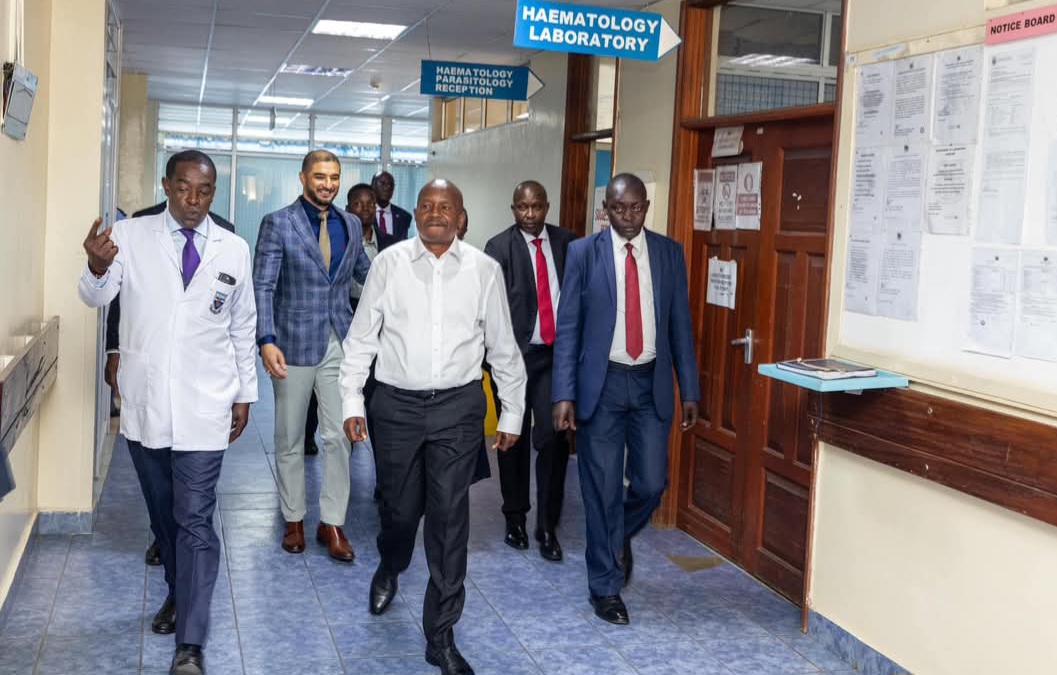
Deputy President Prof. Kithure Kindiki visited Kenyatta National Hospital (KNH) on Wednesday, where he assessed the progress of the Social Health Authority (SHA) program, an initiative designed to improve access to specialized healthcare services across Kenya. He was accompanied by Health Cabinet Secretary Dr. Deborah Barasa, PS Mary Muriuki for Public Health and Professional Standards, Principal Secretary for Medical Services Harry Kimtai, Director General of the Ministry of Health Dr. Patrick Amoth, and other senior government officials.
In his address, Prof. Kindiki commended KNH for its pivotal role in Kenya’s healthcare system, acknowledging the hospital’s longstanding history of providing essential health services and care to citizens. Despite the challenges the hospital faces after more than a century of operation, Kindiki praised its leadership and staff for ensuring that it remains the country’s foremost healthcare institution.
“Kenya’s premier health facility, Kenyatta National Hospital, continues to offer vital healthcare services to people across the country. While the hospital faces many challenges, its leadership has worked relentlessly to maintain its standing as the leading public healthcare provider,” Kindiki said.
The Deputy President also highlighted the ongoing healthcare transformation agenda under the current administration, emphasizing the government’s commitment to achieving Universal Health Coverage (UHC). As part of this broader strategy, the government has restructured the delivery of healthcare services and introduced the Social Health Authority (SHA), which oversees the new “Type of Care” initiative under UHC.
While the rollout of the SHA program and Type of Care has been making steady progress, Kindiki acknowledged that there are still challenges to address, particularly in terms of administration and technology. However, he pointed out that feedback from patients, particularly those receiving critical care, has been overwhelmingly positive.
“From the stories we’ve heard from patients, especially those undergoing treatment for life-threatening conditions, the speed and efficiency of services have been impressive,” Kindiki remarked. “The government is working diligently to address the remaining administrative and technological hiccups to ensure that Type of Care reaches its full potential.”
The Deputy President took the opportunity to tour various departments at KNH, including the trauma center and critical care units. Of particular interest to him was the South Africa Kidney Institute, which is nearing completion and will soon offer world-class renal care, including kidney transplants and dialysis services. This state-of-the-art facility is expected to reduce the logistical burden on Kenyan patients who currently have to seek kidney treatment abroad.
“We are determined to ensure that every Kenyan has access to medical services, and the South Africa Kidney Institute will play a critical role in improving renal care in the region,” Kindiki said. “This international-standard facility is expected to be operational in a few months, and it will significantly ease the burden for those in need of kidney treatments.”
Despite these strides, Kindiki noted that the SHA program still faces challenges, especially the historical debts accumulated under the National Hospital Insurance Fund (NHIF). He assured that the government is working to clear these debts gradually while ensuring that services are not disrupted.
A key topic raised during the press briefing was the financing of primary healthcare, particularly in light of new data showing an increase in out-of-pocket expenses for patients. Deputy President Kindiki acknowledged the importance of primary healthcare in the success of SHA and UHC but recognized that the government’s current budget allocation for primary care is insufficient.
“We are aware that funding for primary healthcare is not enough, and we are actively exploring ways to address this, including through a supplemental budget,” Kindiki explained. “Despite the challenges with revenue generation, the government is committed to adequately funding primary healthcare because it is central to the success of our healthcare transformation.”
Kindiki also stressed the importance of supporting the University of Nairobi’s School of Health Sciences, which has played a critical role in the training of healthcare professionals. For the healthcare transformation to succeed, he noted, it is essential that human resources development goes hand in hand with the physical infrastructure improvements being made.
The Deputy President further emphasized the government’s collaborative approach with county governments to address healthcare challenges at lower-level facilities. By working together, the government aims to improve diagnostics and service delivery, ensuring that healthcare advancements reach all corners of the country. Kindiki reaffirmed the government’s commitment to improving healthcare delivery in Kenya. He assured citizens that efforts to expand healthcare access and address systemic challenges would continue, with the goal of providing high-quality, affordable healthcare for all Kenyans.
“We are committed to ensuring that the Type of Care program succeeds. We will leave no stone unturned to make sure that every Kenyan has access to the healthcare services they need,” Kindiki stated. “This is a vital part of the Kenya Kwanza government’s agenda, and we are making it a reality.”
As the government works to resolve financial and logistical challenges in healthcare, it remains focused on achieving the long-term goal of Universal Health Coverage for all citizens, ensuring that no Kenyan is left behind in the pursuit of better health outcomes.