


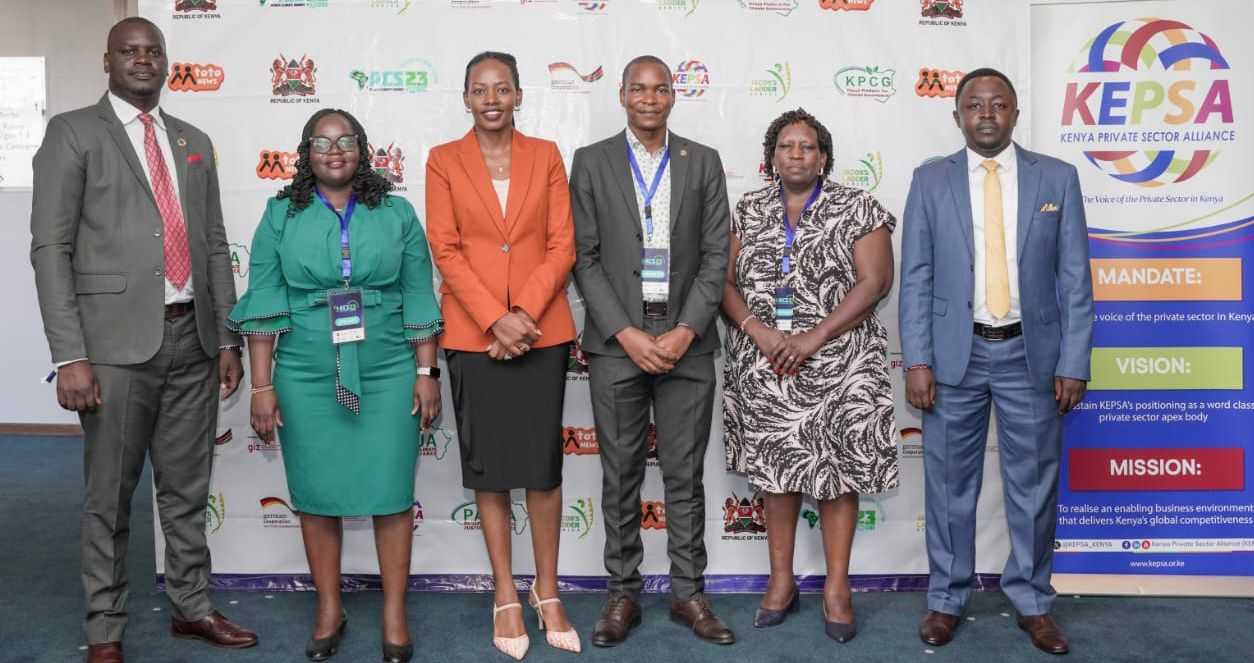
L-R: Kennedy Ouma, Advisor-Africa Climate Summit, German Corporation for International Cooperation, Kenya (GIZ KE); Faith Ngige HSC, National Coordinator for Kenya Platform on Climate Governance (KPCG); Sellah Bogonko, Co-Founder and CEO Jacob’s Ladder Africa (JLA); Dr. Jeremiah Rogito, Specialist Food and Land Use ( FOLU), Soil Health and Climate, AGRA; Anne Kamonjo, Head of Greening and Climate Change Division, State Department for Technical and Vocational Education Training; Dr. Jackson Koimbori, Head of KEPSA Consult, Circular Economy and Climate Change
In preparation for the upcoming Africa Climate Summit at One (ACS@One) in February 2025, leading organizations and advocates gathered in Nairobi for a series of impactful pre-conference events.
These gatherings, spearheaded by Jacob’s Ladder Africa (JLA) with key partners, centered on tackling Africa’s most pressing climate challenges: climate adaptation and resilience, alongside the inclusion of youth and children in climate policy and action.
This first of several thematic pre-convening events, organized in collaboration with the German Corporation for International Cooperation (GIZ KE), Kenya Private Sector Alliance (KEPSA), Pan African Climate Justice Alliance (PACJA), and other Civil Society Organizations (CSOs) under the auspices of Kenya’s Ministry of Environment, Climate Change, and Forestry, reinforced Africa’s growing commitment to climate accountability.
Participants evaluated progress since the 2023 Africa Climate Summit and set a forward-looking agenda that emphasizes sustainable, inclusive, and locally driven climate solutions.
Sellah Bogonko, Co-Founder and CEO of JLA, addressed the urgency and potential of the ACS@One Summit in her keynote speech, emphasizing the importance of leveraging the unique challenges and opportunities of Africa’s climate landscape to drive global impact. “The outcomes of ACS, if fully implemented, will significantly alter Africa’s climate trajectory,” said Bogonko. “Through continued partnerships with the private sector, civil society, and government, we are actively measuring progress, setting the stage for meaningful change that will shape the future of Africa’s youth.”
The November 4 session brought together leaders from multiple sectors to address Africa’s climate adaptation needs. From resilient agricultural practices to urban infrastructure capable of withstanding extreme weather events, the discussions highlighted scalable solutions tailored to Africa’s unique environmental and socio-economic vulnerabilities.
Dr. Jackson Koimbori, Head of KEPSA Consult’s Circular Economy and Climate Change Division, emphasized that resilient agricultural and infrastructural investments are essential to protecting both urban and rural communities from the increasing impact of climate instability.
“As Africa undergoes rapid urbanization, climate resilience must be a priority. We’re working on solutions that are both practical and sustainable to ensure communities across the continent can withstand future climate shocks,” Koimbori stated.
On November 5, the spotlight shifted to youth and children’s essential roles in climate policy. Leaders in this area, including Joseph Nguthiru, CEO of Hyapak & M-Situ, and Jennifer Kaberi, CEO of Mtoto News, brought together young climate advocates from across Kenya. These youth representatives passionately voiced the need for intergenerational equity and direct involvement in decision-making to build lasting resilience across Africa.
Jada Neema, representing children in the discussions, highlighted the importance of giving young people a platform in policymaking. “Youth inclusion is critical for creating long-term environmental resilience in Africa,” Neema emphasized. The discussions echoed the Nairobi Declaration’s commitment to intergenerational equity, calling for greater climate education and resource accessibility for youth and children.
Sharon Mutende, Policy Coordinator for the Children and Youth Major Group to UNEP, further stressed this point: “It’s vital for youth and children to have a voice in climate policy to build a future that is both just and resilient.”
These pre-summit events underscored the determination of African leaders, youth, and civil society to bring measurable change and accountability to climate action. As ACS@One in February 2025 approaches, stakeholders are building on the momentum from the 2023 Africa Climate Summit, setting high expectations for a comprehensive review and renewed commitments.
ACS@One is anticipated to be a historic gathering that will amplify Africa’s climate narrative on the global stage. With a shared vision for a resilient and sustainable future, Africa is taking the lead, determined to shape climate solutions that address the continent’s unique challenges and serve as a model for effective climate action worldwide.