


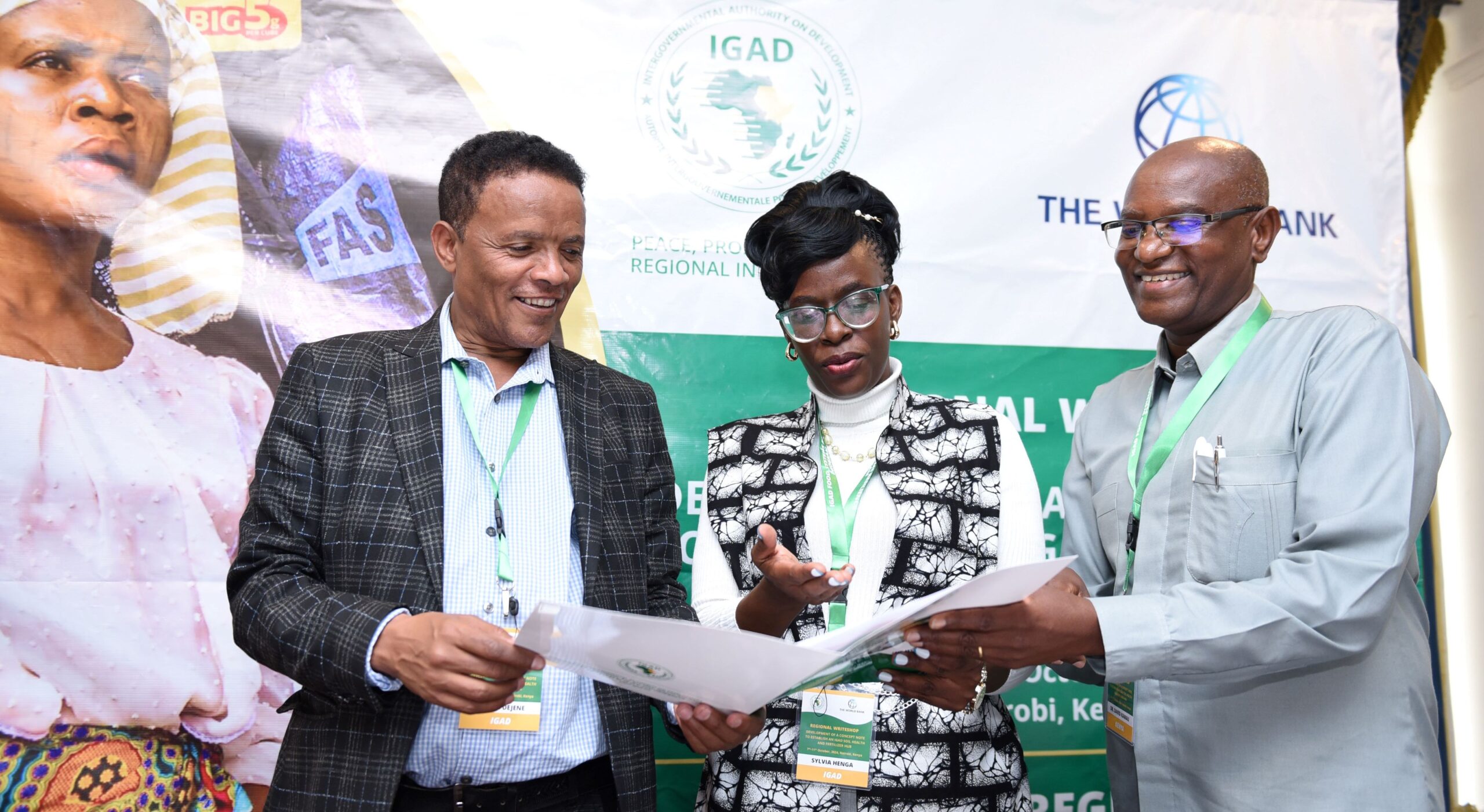
IGAD Program Manager for Sustainable Environment Protection & Coordinator of Blue Economy Dr. Eshete, Policy & Food Security Officer Dr. Sylvia Henga with KALRO Environment & Natural Resource Systems Director Dr. David Kamau during the IGAD regional write shop to discuss the outcome and follow up actions for implementing the 2024 Africa Fertilizer and Soil Health Summit Declaration
Nairobi, Kenya – October 7, 2024: The Intergovernmental Authority on Development (IGAD) convened a regional write-shop today, uniting member states and technical partners to create a roadmap and action plan in response to the Africa Fertilizer and Soil Health Summit (AFSHS) held in May 2024. This initiative aims to enhance food security and agricultural productivity across Eastern and Southern Africa.
The meeting builds on the Nairobi Declaration, which emerged from the AFSHS, endorsing the Fertilizer and Soil Health Action Plan and the Soil Initiative for Africa Framework. Participants highlighted critical challenges, including Africa’s low fertilizer consumption and insufficient application rates that hinder agricultural production. Many IGAD member states fell short of the commitment to apply 50 kilograms of fertilizer per hectare during the last CAADP-MALABO reporting period, underscoring the urgent need for improved fertilizer efficiency and the integration of organic solutions.
Dr. Eshete Dejen, Program Manager for Sustainable Environment Protection, emphasized the importance of healthy soils for food security and resilient agriculture in Africa. He noted that over 20 percent of the continent’s land suffers from soil degradation, impacting livelihoods and food production. “To protect Africa’s food systems, we must reverse soil degradation by reducing reliance on inorganic fertilizers and addressing cost barriers,” he stated, advocating for collaborative efforts between public and private sectors.
The write-shop also featured remarks from Dr. David Kamau, Director at the Kenya Agricultural and Livestock Research Organization (KALRO). He reiterated the commitment of member states to implement the Continental Action Plan, aimed at restoring soil health through targeted strategies. Dr. Kamau called for a collective approach to improve the production and distribution of certified fertilizers, enhance agronomic recommendations for smallholder farmers, and operationalize the Africa Fertilizer Financing Mechanism.
During the write-shop, IGAD member states presented their current statuses regarding soil fertility management, discussing institutional arrangements and challenges faced. The agenda included sharing knowledge on successful soil hub creation from other African regions, with the goal of developing proposals for forming effective soil hubs.
Participants included representatives from various international organizations, such as the Accelerating Impacts of GIAR Climate Research for Africa (AICCRA), the Consortium of International Agricultural Research Centers (CGIAR), the Africa Fertilizer Financing Mechanism (AFFM), and others.
As the write-shop progresses, it aims to foster collaboration and commitment among IGAD member states to implement sustainable agricultural practices, ultimately driving economic growth and ensuring food security for the region.